
Hi, I’m Steve. I’ve been in the water treatment business since 1994, and I can tell you bromate is one of the contaminants almost nobody has heard of — not because it doesn’t matter, but because it doesn’t come from where people expect. It doesn’t leak out of old pipes. It doesn’t run off a farm or a factory. Bromate is created inside the water treatment plant itself, during disinfection. Here’s what it is, where it comes from, and what the numbers actually mean.
What Bromate Is, and How It Forms
Bromate is a disinfection byproduct — a compound that isn’t in the source water, but gets made while the water is being cleaned.
Start with bromide. Bromide is a harmless, naturally occurring mineral found in small amounts in rivers, lakes, and groundwater, dissolved out of soil and rock. On its own, at natural levels, it’s not a health concern.
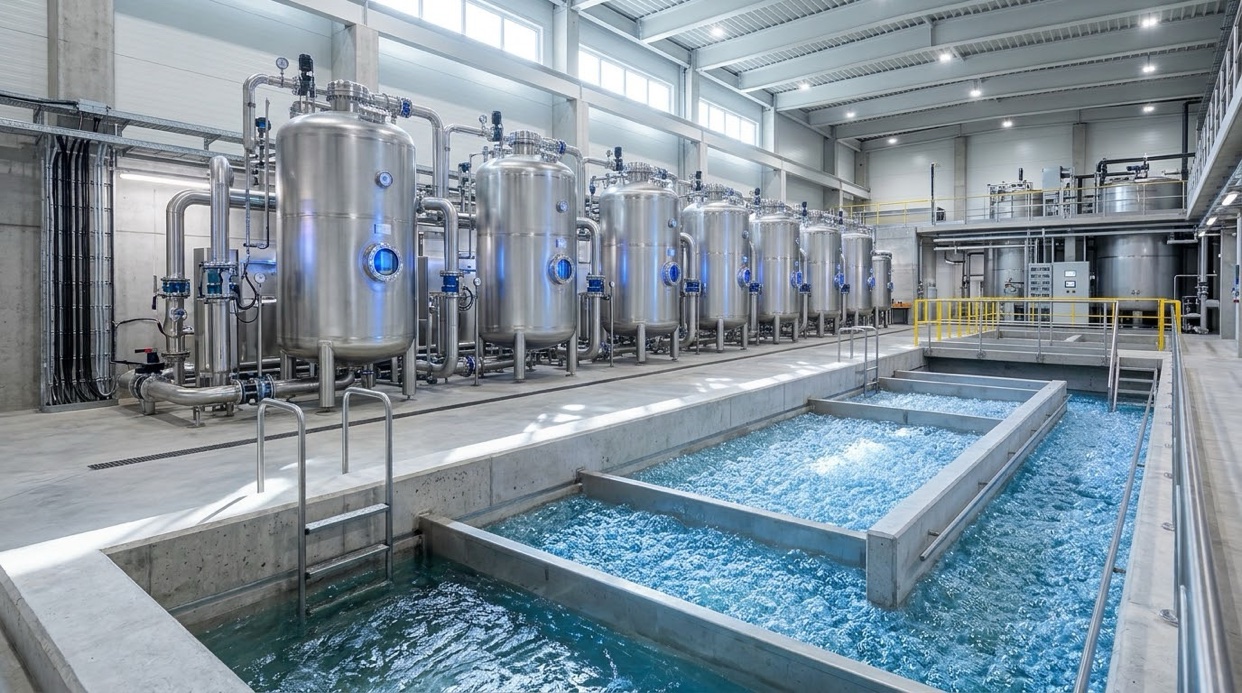
The problem starts when a city treats its water with ozone. Ozone is one of the strongest disinfectants a plant can use — excellent at killing bacteria, viruses, and tough parasites like Cryptosporidium. But when ozone bubbles through water that contains bromide, the ozone oxidizes the bromide and converts some of it into bromate.
So bromate is a trade-off chemical: the plant gets powerful disinfection, and in exchange it has to manage this byproduct. It belongs to the same broad family of trade-offs as the trihalomethanes and haloacetic acids, which form when chlorine reacts with natural organic matter.
Where It Shows Up — and Where It Doesn’t
Whether bromate is a concern for you depends almost entirely on how your water is treated.
City water treated with ozone: this is where bromate forms. If your utility uses ozone and its source water has natural bromide in it, plant operators manage bromate formation every day.
City water treated with chlorine or chloramine only: no ozone, no bromate. If your plant never ozonates, this isn’t your contaminant.
Private well water: almost certainly no bromate. A well doesn’t get disinfected with ozone, so the reaction never happens. The one rare exception: a home that installed its own ozone system for iron or sulfur problems on bromide-bearing well water could form a small amount — residential ozone runs far weaker than a municipal plant, but the chemistry is the same.
What the Science Says About Health
At the levels found in public drinking water, bromate causes no immediate symptoms. You can’t taste it, smell it, or see it, and it doesn’t stain anything.
The concern is long-term. In laboratory studies, rats and mice given high doses of bromate in their drinking water over their lifetimes developed tumors — kidney, thyroid, and the lining of the abdomen. On the strength of those animal studies, bromate is classified as a probable human carcinogen. Two honest qualifications:
- The animals were dosed at levels far above anything permitted in tap water.
- There is no direct evidence of increased cancer in people drinking water at or below the legal limit.
The legal limit exists precisely because of that animal evidence — it’s set with a wide margin of safety built in. Bromate is not an emergency. It’s a long-term risk that regulators watch, and one you can check for yourself in about two minutes (see the testing section below).
The Numbers
- EPA legal limit (MCL): 0.010 mg/L — that’s 10 parts per billion (ppb). This is the enforceable ceiling for public water systems, measured as a running annual average.
- EPA health goal (MCLG): zero. For a probable carcinogen, the goal is set at zero because regulators assume any exposure carries some theoretical risk. The goal is not enforceable — it’s the target the legal limit is built to approach as closely as treatment allows.
- WHO guideline: 0.01 mg/L (10 ppb), listed as a provisional guideline because of limits in testing and treatment methods. Same number as the EPA’s limit.
To feel what 10 ppb means: it’s about ten drops of water in an Olympic-size swimming pool. Small numbers can still matter over a lifetime of exposure — that’s why the limit exists — but keep the scale in mind when a headline tries to scare you with a multiplier.
I checked my own water report while writing this. Bromate shows up at 0.866 ppb — a real detection, well under the 10 ppb legal limit, and a good example of how to read these reports: a detection is information, not an alarm.
How Bromate Is Removed
Bromate is a dissolved ion, which means it behaves like other dissolved minerals in your water — most ordinary filters can’t touch it.
Reverse osmosis works. An under-sink RO system pushes water through a membrane with pores around 0.0001 micron — small enough to reject dissolved ions, including bromate. A properly maintained RO system typically reduces bromate by roughly 80–95%. The membrane is the working part; that’s why keeping prefilters changed on schedule matters, because a fouled membrane can’t do its job.
Specialty ion exchange can work. Anion exchange resins designed to swap out ions like nitrate and perchlorate can also take out bromate. They’re uncommon as a standalone home drinking-water setup because other minerals in the water compete for the resin and maintenance is finicky.
Standard carbon filters don’t do it. Carbon is the right tool for chlorine taste, chloramines, and organic chemicals — but bromate is a dissolved inorganic ion, and it passes through an ordinary carbon filter. This is the single most important shopping lesson in this article: a filter that says “reduces contaminants” means nothing unless the specific contaminant is named.
Boiling makes it slightly worse. Boiling kills germs, but bromate doesn’t evaporate — the water does. Boil a pot down and the bromate left behind is a little more concentrated than when you started.
How to shop honestly: look for certification, not claims. NSF/ANSI Standard 58 is the standard for reverse osmosis systems. Then check the system’s certified performance data sheet for the specific contaminants it is certified to reduce, certified by an accredited body — NSF International, WQA, or IAPMO. If bromate isn’t on the sheet, don’t assume it’s covered.
How to Find Out If Your Water Has Bromate
You don’t need a test kit — and the home strips and drop kits at the hardware store can’t measure bromate at parts-per-billion levels anyway.
Step 1: read your Consumer Confidence Report (CCR). Every community water system in the U.S. publishes one by July 1 each year, free, on your utility’s website or by request. Look under “Disinfection Byproducts” or “Regulated Contaminants.” If your utility uses ozone and detected bromate, the report must list the level found, the range, the 10 ppb limit, and whether the system complied. If bromate isn’t listed, your utility either doesn’t use ozone or didn’t detect it in routine testing.
Step 2: a certified lab, if you want your own number. If you have a private well with an ozone system, or you just want independent verification, use a state-certified drinking water lab (your state or county health department keeps the list). Labs measure bromate by ion chromatography — EPA Methods 300.1 or 317.0 are the standard ones. They’ll send a sample bottle and instructions.
The Bottom Line
- Bromate only forms where ozone disinfects water that contains natural bromide. No ozone, no bromate.
- The legal limit is 10 ppb, the health goal is zero, and your utility’s annual report tells you exactly where your water stands — for free.
- If your level is below the limit, your water meets the federal standard. If it’s near the limit, or you simply want the extra margin, an under-sink reverse osmosis system certified under NSF/ANSI 58 is the proven, economical answer — and you only need to treat the water you drink and cook with, not the whole house.
- Don’t buy anything based on a scary multiplier. Check the report, read the actual number, compare it to the legal limit, and then decide.
That’s how you handle bromate: facts first, then filter. — Steve
Leave a Reply