
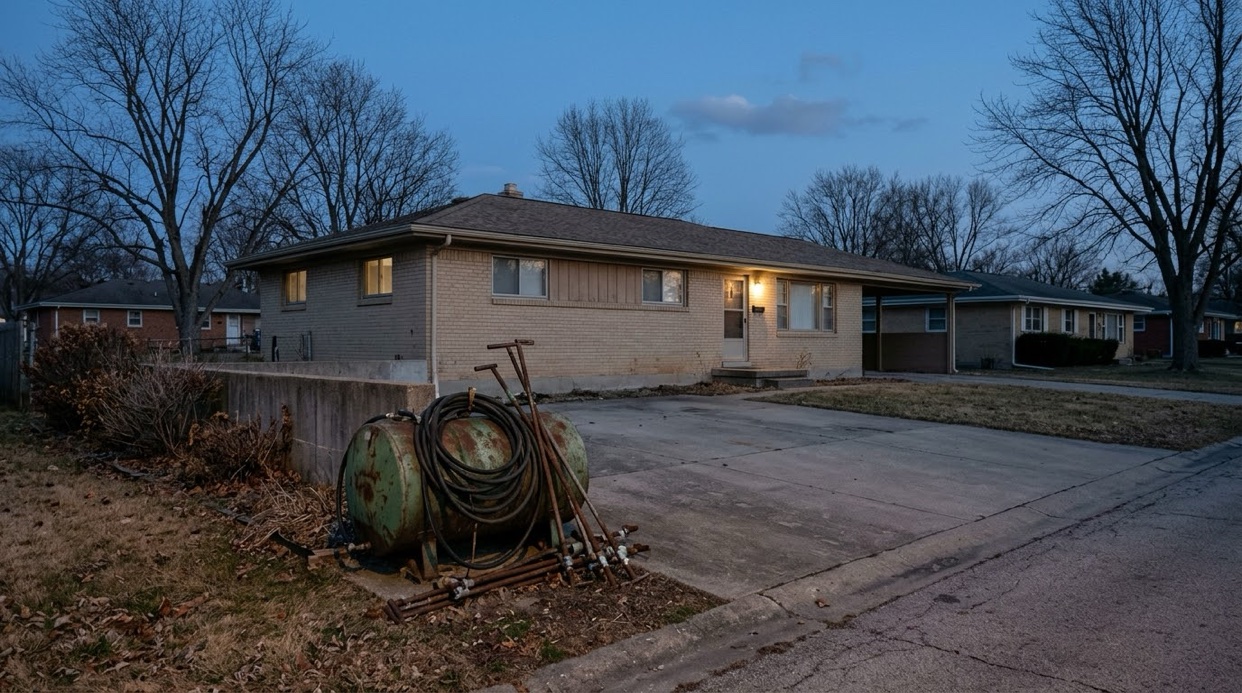
Chlordane is a synthetic organochlorine pesticide that saw massive use across the United States from the late 1940s through the 1980s. It was applied on crops like corn and citrus, on residential lawns, and on golf courses — but its primary legacy is as a subterranean termiticide. Millions of homes had liquid chlordane injected directly into the soil around their foundations and under concrete slabs to barrier-proof the structure against termites. I’ve been working in water treatment since 1994, and in all that time, the chlordane questions have never stopped coming from people in those houses — because the chemical outlasted everything that was supposed to end it.
Concerns over long-term environmental persistence, bioaccumulation, and serious health risks led the U.S. Environmental Protection Agency (EPA) to phase it out step by step: most uses were canceled first, termite control was the last use standing, and all uses have been banned since 1988.
How It Gets Into Your Water
The EPA’s own one-line summary of how chlordane gets into drinking water is “residue of banned termiticide” — and that says it. Chlordane binds tightly to organic matter in soil, but it breaks down at an extraordinarily slow pace. Because of that persistence, legacy applications remain in the ground surrounding older homes, historical farm plots, and commercial sites for decades after the last treatment.
Over long periods, rainwater infiltration and soil erosion can slowly carry chlordane through subsoil layers into underlying aquifers. Chlordane also converts in the environment — and inside living organisms — into stable breakdown byproducts, most notably heptachlor epoxide and oxychlordane. These transformation products are as persistent as chlordane itself, and they remain in local groundwater and private drinking wells long after the original chemical was applied.
What It Can Do to Health
The health effects the EPA lists for long-term exposure above the limit are liver or nervous system problems, and an increased risk of cancer. Because the EPA treats chlordane as a carcinogen, its health goal (MCLG) is zero — there is no level the agency considers completely safe.
Public systems monitor for chlordane as part of their required testing. If you are on a private well near an older, termite-treated home or former farmland, testing is up to you — a certified laboratory can include chlordane and its breakdown products in a pesticide panel on a sample of your water.
The EPA Drinking-Water Limit
Public water utilities are legally required under the Safe Drinking Water Act to monitor for chlordane and keep concentrations below strict federal safety levels:
- Maximum Contaminant Level (MCL): 0.002 mg/L (2 ppb)
- Maximum Contaminant Level Goal (MCLG): 0 mg/L (0 ppb)
The health goal is zero because the EPA considers chlordane a probable human carcinogen. The enforceable limit is set at 0.002 mg/L (2 parts per billion). Private well owners living near older, termite-treated structures or former agricultural land must rely on independent certified laboratory testing, as private wells are not covered by public utility monitoring.
Which Home Filtration Actually Removes It
If certified lab testing detects chlordane or its breakdown products in your water, standard sediment screens or simple pitcher filters will not provide adequate protection. You need treatment media capable of stripping synthetic organic chemicals out of solution:
- Activated Carbon (Granular Activated Carbon & Carbon Block): High-grade activated carbon is the primary and most effective residential defense against chlordane. As an organic compound, chlordane is drawn to and held by the massive internal surface area of carbon through adsorption as water flows through the filter bed.
- Reverse Osmosis (RO): A point-of-use reverse osmosis system works as a high-performance backstop. The RO membrane physically rejects complex organic molecules, while the system’s integrated pre-carbon and post-carbon filter stages adsorb remaining chemical compounds.
Understanding Certification Standards
Never rely on vague packaging claims like “improves taste” or “reduces chemicals.” You need independent certification data to verify that a system actually removes persistent pesticides — and you need to know what the seal actually covers:
- NSF/ANSI Standard 53: This is the health-effects standard for drinking water treatment units. In plain English: a unit certified under Standard 53 has been independently tested for the specific health-related contaminant reduction claims listed in its certification — claims for things like pesticides and herbicides count only if they are named on that model’s list.
- NSF/ANSI Standard 58: This is the performance standard for reverse osmosis systems. It certifies that an RO system reduces total dissolved solids and the specific contaminants named in its certification — again, only the claims actually listed.
A certification logo proves the unit passed standardized laboratory testing, but you must read the system’s official Performance Data Sheet. That documentation must explicitly list chlordane by name under its verified reduction claims. If chlordane is missing from the data sheet, you cannot rely on the filter to take it out of your glass.
Facts first, then filter. — Steve
Leave a Reply