
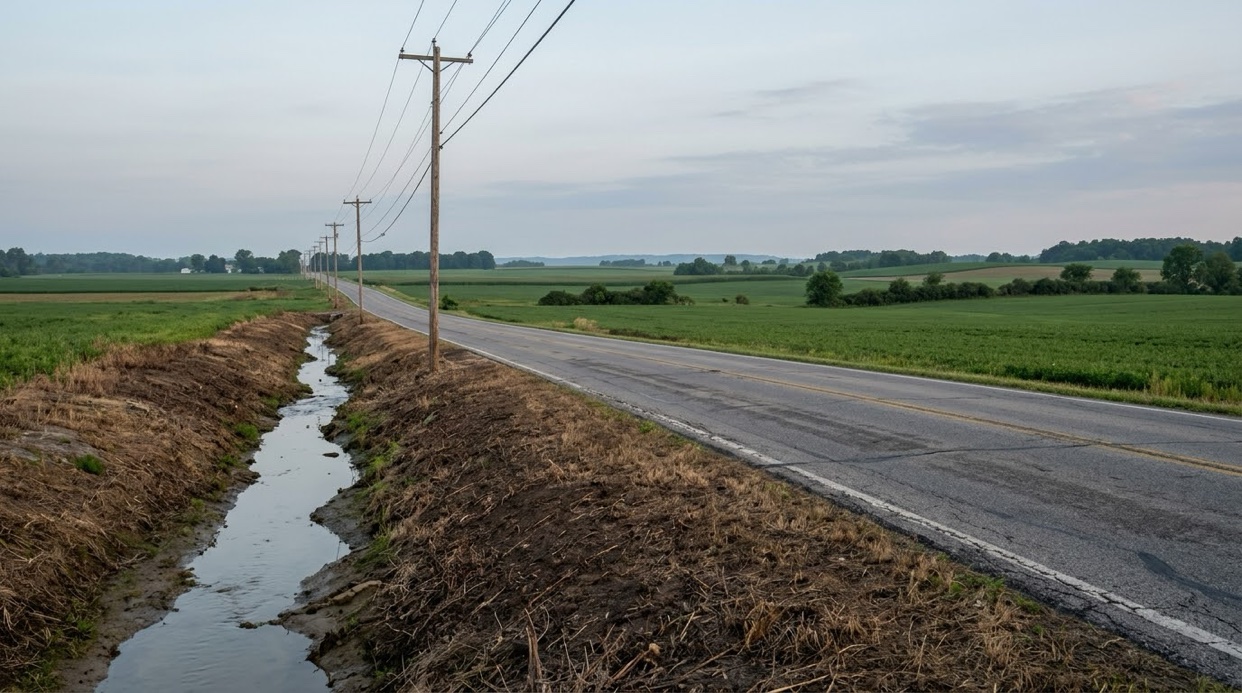
Dalapon is an herbicide, but it is not the kind most people think of when they hear the word "pesticide." It is not typically sprayed across acres of corn or soybean fields. Instead, dalapon is used primarily to clear unwanted grasses and brush along rights of way — the narrow strips of land along roadsides, railroad tracks, utility lines, and drainage ditches where nobody is growing food. That unusual application is its defining trait. Because it is designed to keep utility lines clear and drainage paths open, large volumes can be applied directly to land bordering public roadways and water courses.
Where Dalapon Comes From
When herbicides are applied along roads and drainage ditches, they sit on the soil and plant surfaces until the weather changes. According to the U.S. Environmental Protection Agency (EPA), the listed source of dalapon in drinking water is runoff from herbicide used on rights of way.
After a heavy rainstorm, water washes over these treated rights of way, picking up residual chemicals. The runoff carries the herbicide directly into nearby streams, rivers, and drainage networks. Over time, or during sustained rainfall, dalapon can also soak deep into the soil and leach downward into groundwater, eventually reaching the underground aquifers that feed municipal intake pipes and private drinking water wells.
Health Effects: What the Science Says
When looking at water quality reports, it is important to keep health risks in perspective. The EPA's stated health effect for long-term exposure to dalapon at levels above the federal limit, using the EPA's exact words, is minor kidney changes.
To be clear: this is one of the mildest health effect statements in the entire EPA drinking-water table. It is worth telling you that plainly so you do not panic if you see a mention of dalapon on a local report. The EPA does not list severe organic failure or major system breakdown for this compound under its standard regulatory summary — it specifically notes minor kidney changes. While any chemical presence above federal standards warrants attention and cleanup, dalapon does not carry the same heavy health warnings as many other industrial contaminants.
EPA Regulatory Standards
The EPA sets strict benchmarks for public water systems to ensure trace chemicals remain within safe limits. Below are the official figures established for dalapon in drinking water.
Dalapon EPA Quick Facts
- EPA Health Goal (MCLG): 0.2 mg/L
- EPA Enforceable Limit (MCL): 0.2 mg/L (200 parts per billion)
- Listed Source: Runoff from herbicide used on rights of way
- Stated Health Effect (above limit): Minor kidney changes
Notice that the EPA health goal (MCLG) and the enforceable limit (MCL) are the exact same number: 0.2 mg/L. Unlike some contaminants where the health goal is set to zero, the EPA determined that a health goal of 0.2 mg/L provides an adequate margin of safety, making the practical enforcement limit match the health goal precisely.
How Dalapon Is Removed from Water
If testing reveals dalapon in your water supply, standard mechanical filtration will not solve the problem. Ordinary sediment filters, mesh screens, and standard drop-in string cartridges are designed only to catch solid particles like rust, sand, and silt. They do not remove dissolved herbicides like dalapon, which pass right through pore spaces on a molecular level.
The standard and proven treatment method for removing dalapon from drinking water is granular activated carbon (GAC).
Activated carbon works through a process called adsorption. The carbon media contains millions of microscopic pores and a massive surface area that attracts and traps organic chemicals, pulling dissolved herbicides out of the water as it flows through the tank or cartridge. Point-of-entry whole-house carbon filtration systems or point-of-use under-sink activated carbon units are effective solutions for restoring clean, clear water to your home.
Facts first, then filter. — Steve
Leave a Reply