
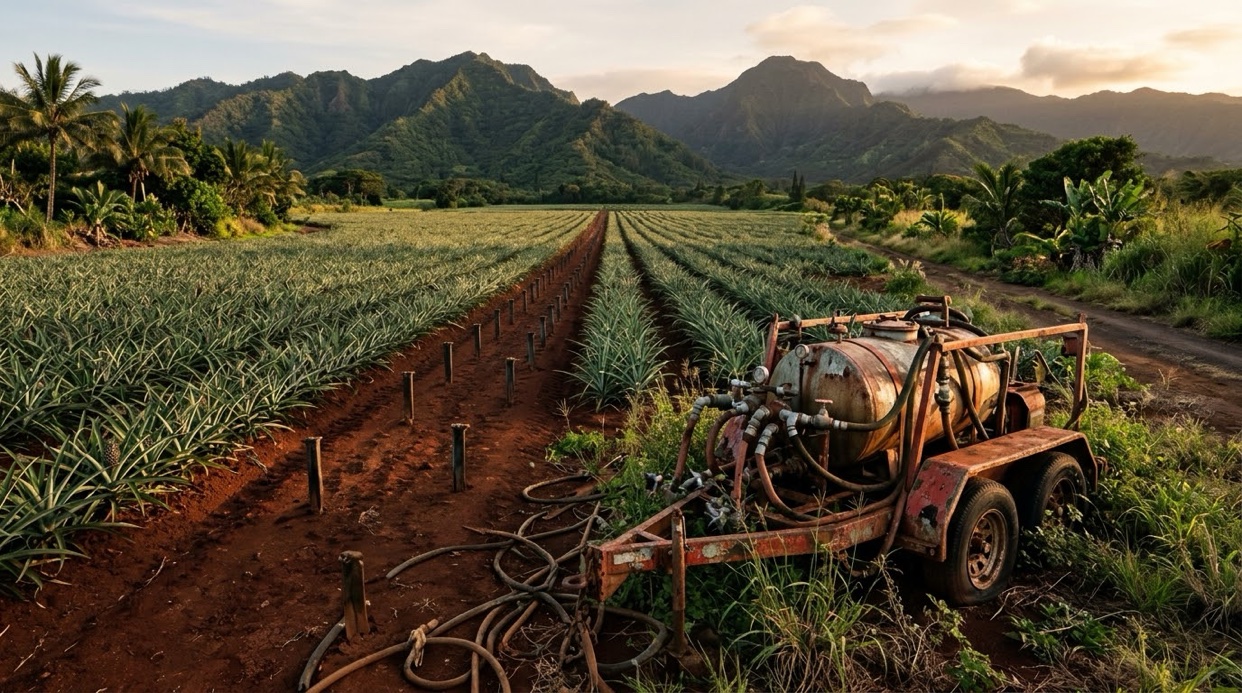
DBCP (1,2-dibromo-3-chloropropane) is a halogenated hydrocarbon that was widely manufactured and applied as a soil fumigant and nematicide starting in the 1950s. Agricultural operations injected it directly into the ground to protect cash crops like pineapples, citrus fruits, grapes, and cotton from microscopic root-damaging worms. It gained national notoriety in the late 1970s when factory workers at chemical manufacturing plants producing DBCP were found to have high rates of infertility and abnormally low sperm counts due to occupational exposure. Working in water treatment since 1994, I’ve watched DBCP stay on well-testing panels in farm country long after most people assumed it was gone — this is why.
Following those disclosures, the U.S. Environmental Protection Agency (EPA) suspended DBCP registrations in 1977, Hawaii pineapple use excepted. All registrations of end-use products were canceled in 1979 — again except for use as a soil fumigant against nematodes on pineapples in Hawaii. That last use was canceled in 1985, and with it, DBCP was done in American agriculture.
How It Gets Into Your Water
DBCP is a dense, volatile liquid that does not bind tightly to soil particles. When it was applied to agricultural fields over decades, rainfall and irrigation water washed the chemical straight down through topsoil into underlying aquifers. The EPA’s own listed source for DBCP in drinking water is “runoff/leaching from soil fumigant used on soybeans, cotton, pineapples, and orchards.”
Once inside an aquifer, DBCP breaks down at an exceptionally slow rate. In a cool aquifer — around 15 °C — its half-life has been estimated at about 141 years. Because of this extreme persistence, DBCP continues to turn up in groundwater and private drinking wells located near historic farmland, commercial orchards, and pineapple plantations decades after the last legal application.
What It Can Do to Health
The health effects the EPA lists for long-term exposure above the limit are, in its words, “reproductive difficulties; increased risk of cancer.” The agency’s consumer fact sheet puts the long-term picture as kidney damage and antifertility effects, plus cancer — matching the infertility first discovered in the men who made the chemical. Because the EPA considers DBCP a probable human carcinogen, its health goal for DBCP in drinking water is zero.
Public systems test for DBCP where the federal rule requires it. If you are on a private well near historic farmland or old orchards, no testing requirement covers your supply — a certified laboratory panel is the only way to know.
The EPA Drinking-Water Limit
Under the Safe Drinking Water Act, public water supplies are legally required to test for DBCP and maintain levels below federal limits. The federal standard took effect in 1992:
- Maximum Contaminant Level (MCL): 0.0002 mg/L (0.2 ppb)
- Maximum Contaminant Level Goal (MCLG): 0 mg/L (0 ppb)
The health goal (MCLG) is set to zero because there is no known safe level of exposure to a probable carcinogen. The enforceable legal limit (MCL) is set as close to that goal as utilities can reliably measure and achieve. If you get your water from a private well near historic agricultural land, municipal testing does not cover your supply, making independent laboratory testing your responsibility.
Which Home Filtration Actually Removes It
If testing confirms DBCP in your supply, you need treatment equipment built specifically for organic chemical adsorption.
- Granular Activated Carbon (GAC) and Carbon Block: This is the primary and most effective home treatment technology for stripping DBCP out of drinking water. DBCP is an organic chemical compound that readily adheres (adsorbs) to the vast internal surface area of high-grade activated carbon as water flows through the filter bed.
- Reverse Osmosis (RO): A point-of-use RO system acts as an excellent multi-barrier backstop. While the RO membrane itself rejects large molecules, quality residential RO units incorporate pre-carbon and post-carbon filter stages that work together to trap synthetic organic chemicals like DBCP.
Understanding Certification Standards
Never assume a home filter removes a specific chemical just because the box mentions “carbon” or “clean water.” You need independent certification data to verify performance — and every seal needs translating, because the seal’s name alone doesn’t tell you what was tested:
- NSF/ANSI Standard 53: This is the health-effects standard for drinking water treatment units. In plain English: a unit certified to Standard 53 has been independently tested for the specific health-related contaminant reduction claims named in its certification — which can include specific pesticides, herbicides, and volatile organic chemicals (VOCs). The standard’s name by itself guarantees nothing; the claim list is what counts.
- NSF/ANSI Standard 58: This is the performance standard for reverse osmosis systems. In plain English: it certifies that an RO system reduces total dissolved solids and the specific contaminants named in its certification — only those named, not everything in the water.
A filter’s official certification documentation must explicitly name DBCP (or 1,2-dibromo-3-chloropropane) under its reduction claim listing. If the performance data sheet does not name the chemical directly, the filter cannot be trusted to clear it from your glass.
Facts first, then filter. — Steve
Leave a Reply