
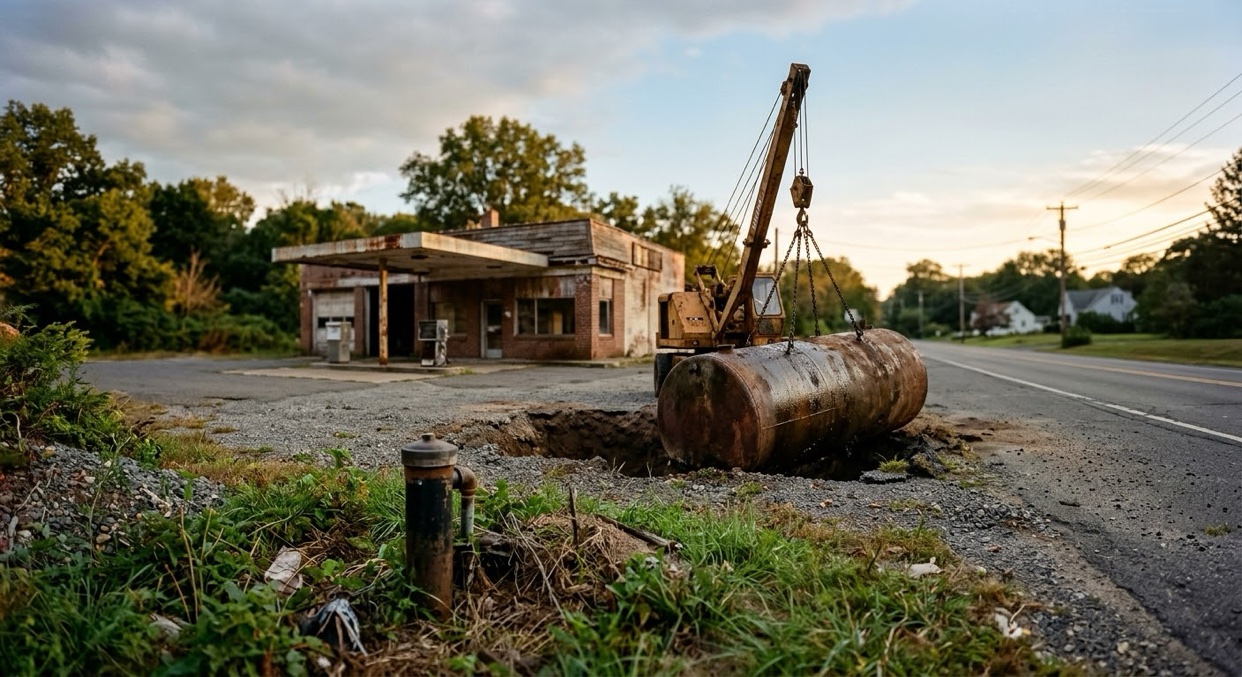
If your certified drinking water laboratory report reveals a detection of ethylbenzene, you are looking at a compound with a very different background than the herbicides and agricultural pesticides found in farming regions. Ethylbenzene is an aromatic hydrocarbon intimately tied to the petroleum, fuel, and chemical manufacturing industries.
Understanding what ethylbenzene is, how it enters water supplies near fuel storage sites, and the dual treatment technologies designated to reduce it ensures your water strategy is built on chemical reality rather than panic.
1. What Is Ethylbenzene?
Ethylbenzene is a volatile organic compound (VOC) and a naturally occurring constituent of crude oil and refined petroleum products, including automotive gasoline.
Unlike agricultural chemicals designed for weed or insect control, ethylbenzene is an industrial compound used primarily as a chemical intermediate. Its primary industrial roles include:
- Styrene Production: Over 99 percent of the ethylbenzene produced — EPA’s figure — is used as the foundational raw material to manufacture styrene, which is then processed into synthetic rubber, food packaging, insulation, and rigid plastics (polystyrene).
- Commercial Formulations: It is also blended into automotive gasoline, aviation fuels, industrial solvents, paints, surface coatings, lacquers, inks, and adhesives.
Because ethylbenzene is a core ingredient in fuels and industrial coatings, it is classified as a petroleum-derived volatile organic compound rather than a farm chemical.
2. How It Gets Into Water (And Its Warning Sign)
Ethylbenzene enters drinking water supplies through industrial releases or fuel leaks rather than field spraying.
The primary pathways into domestic water sources include:
- Leaking Underground Storage Tanks (LUSTs): Aging underground gasoline tanks at service stations and commercial fuel depots can corrode, releasing petroleum directly into surrounding soils.
- Petroleum Spills & Pipelines: Surface fuel spills, pipeline leaks, or improper disposal of industrial solvents can seep down through topsoil.
- Industrial Discharges: Wastewater releases or chemical spills from styrene manufacturing facilities, chemical plants, or commercial printing operations.
The Groundwater Connection and Smell Warning
Because ethylbenzene binds only moderately to soil and moves with groundwater readily, it represents a primary groundwater concern for private well owners living near active or historical gas stations, bulk fuel terminals, or industrial spill sites.
Unlike many tasteless, odorless pesticides, ethylbenzene can announce itself — and earlier than most people expect. Published odor thresholds for ethylbenzene in water start as low as a few parts per billion and top out around 130 ppb, and even the taste threshold (roughly 72–200 ppb) sits below the legal limit of 700 ppb. In plain terms: your nose can catch this chemical at levels far below the EPA ceiling. A sweet, gasoline-like smell in well water is an early warning to test — not proof, by itself, that the legal limit has been breached.
3. Understanding the EPA Limits: MCL vs. MCLG
Under the authority of the Safe Drinking Water Act, the U.S. Environmental Protection Agency (EPA) establishes federal standards to regulate volatile organic chemicals in drinking water. For ethylbenzene, those standards are set as follows:
Maximum Contaminant Level (MCL): 0.7 mg/L — 700 parts per billion (ppb)
Maximum Contaminant Level Goal (MCLG): 0.7 mg/L — 700 parts per billion (ppb)
To understand how these safety ceilings protect your household, it helps to review the regulatory terms:
Maximum Contaminant Level Goal (MCLG): The level of a contaminant in drinking water below which there is no known or expected risk to human health. It is a strictly health-based target that includes an ample margin of safety without considering treatment costs or technical equipment limits.
Maximum Contaminant Level (MCL): The highest concentration of a contaminant legally allowed in public drinking water systems. MCLs are enforceable federal standards set as close to the MCLG as feasible, taking into account analytical capabilities and treatment technologies.
For ethylbenzene, the EPA set both the health goal (MCLG) and the enforceable limit (MCL) at the exact same level: 0.7 mg/L (700 ppb).
4. What Health Effects Regulators Documented
When federal health agencies evaluated ethylbenzene to establish safety limits, regulatory reviews focused on toxicological studies evaluating the long-term impact of exposure above the 0.7 mg/L threshold.
The health risk EPA documents for a lifetime of exposure above the MCL is damage to the liver, kidneys, central nervous system, and eyes. Regulatory exposure limits are set to ensure that daily ingestion over a lifetime remains far below levels that could trigger that organ damage.
5. How a Homeowner Finds Out
You cannot rely on guesswork to quantify ethylbenzene in your drinking water.
Over-the-counter DIY test strips and store-bought colorimetric drop kits cannot measure ethylbenzene. Standard test strips are designed only for basic parameters like hardness, pH, total dissolved solids, or free chlorine — they lack the chemical sensitivity required to measure volatile hydrocarbons.
To accurately detect and quantify ethylbenzene:
- Order a Certified Laboratory Test: Send a water sample to an EPA-certified laboratory and request a Volatile Organic Chemical (VOC) panel (such as EPA Method 524.2 or 502.2). Ethylbenzene is a standard line item on certified VOC panels.
- Verify Testing Instrumentation: Certified labs use purge-and-trap gas chromatography — with mass spectrometry on Method 524.2 — to measure volatile hydrocarbons down to single-digit parts per billion.
- Investigate Fuel Odors Promptly: While lab testing is required for precise measurement, any sweet or gasoline-like smell coming from well water is an immediate signal to stop drinking the water and order a certified VOC test panel right away.
- Check Municipal Reports: If you are on a public utility, review your provider’s annual Consumer Confidence Report (CCR), which details any detected volatile organic chemicals in the municipal supply.
6. What Removes Ethylbenzene
Because ethylbenzene is a volatile compound, the EPA designates TWO Best Available Technologies (BAT) for its removal: Packed Tower Aeration (Air Stripping) and Granular Activated Carbon (GAC). Reverse osmosis also helps at the tap, with a caveat explained below.
1. Packed Tower Aeration (Air Stripping)
Because ethylbenzene is volatile — meaning it readily transitions from a liquid state into a gas — aeration works by transferring the chemical out of the water and into the air.
How Air Stripping Works: In a packed tower — the utility-scale form of this EPA technology — raw water is sprayed downward over a column filled with high-surface-area plastic packing material while a blower forces air upward through the column. Home air-stripping and aeration units apply the same principle at a smaller scale.
Volatilization: As the water breaks into thin films over the packing material, the dissolved ethylbenzene evaporates out of the water droplets into the passing airstream and is vented outside. Aeration is particularly effective as a whole-house entry treatment for well water with high VOC levels.
2. Granular Activated Carbon (Adsorption)
Granular Activated Carbon (GAC) tanks and solid carbon block filters capture ethylbenzene using adsorption.
How Adsorption Works: Adsorption is a chemical surface attraction, not a mechanical screen. Thermal activation creates millions of microscopic pores within the carbon, generating an enormous surface area — roughly 1,000 square meters per gram, with typical activated carbons running about 500 to 1,500.
The Bonding Process: As water flows through the carbon bed, dissolved ethylbenzene molecules are attracted to the carbon matrix and lock onto its internal pore walls, allowing purified water to pass through.
Capacity Limits: Carbon media has a finite binding capacity. Once all bonding sites are occupied, saturation occurs and “breakthrough” can happen. Timely media rebedding or filter cartridge replacement is mandatory to maintain protection.
3. Reverse Osmosis (Membrane Separation)
Point-of-use Reverse Osmosis (RO) systems push water under pressure through a dense, semi-permeable membrane film. An RO membrane is not a sieve with holes sized to block molecules — it works by solution-diffusion, and how much ethylbenzene it turns back depends heavily on the membrane: measured rejection runs from roughly three-quarters on older cellulose-acetate membranes to over 95 percent in industrial membrane demonstrations. That spread is exactly why the honest advice is this: in a home RO system, the carbon pre- and post-filters are the proven ethylbenzene barrier, and the membrane is a supporting player — never rely on the membrane alone for a volatile organic.
Mechanical Straining vs. Chemical Adsorption
Homeowners must understand the fundamental difference between physical particle filtration and chemical treatment. A sediment filter does its work by mechanical straining — it traps suspended solids like dirt, rust, and silt. Carbon and aeration work on an entirely different principle: chemical adsorption binds dissolved molecules to the carbon surface, while volatilization strips them out of the water into air.
A standard sediment filter — regardless of its micron rating (e.g., 5-micron or 1-micron) — cannot remove ethylbenzene. Ethylbenzene is fully dissolved in the water at a molecular level. Removing it requires technologies engineered for gas volatility (air stripping), chemical surface attraction (activated carbon), or membrane separation (reverse osmosis).
7. Translating Equipment Certifications
When evaluating water treatment systems for volatile organic chemical reduction, you will frequently see independent performance standards cited on product labels. Whenever an equipment manufacturer claims an NSF standard, it is vital to translate what that standard actually measures in plain English:
- NSF/ANSI Standard 53 (Drinking Water Treatment Units – Health Effects): A Standard 53 “VOC reduction” claim works by surrogate testing — the laboratory actually challenges the filter with chloroform, and ethylbenzene is one of the chemicals on the standard’s surrogate list, credited with greater than 99 percent reduction calculated at the point where the chloroform breaks through at 95 percent. In plain English: the claim is real, but it was earned against a stand-in chemical chosen to represent the whole VOC family, not by running ethylbenzene itself through that specific filter.
- NSF/ANSI Standard 58 (Reverse Osmosis Drinking Water Treatment Systems): This standard verifies that a point-of-use reverse osmosis system meets material-safety and structural-integrity requirements, with TDS (total dissolved solids) reduction as its core performance claim. Any contaminant claim beyond that — including VOCs — is optional and applies only to the specific model tested, so check the model’s own performance data sheet rather than assuming the standard covers it.
Never accept vague marketing terms like “fuel-grade filter” or “complete chemical barrier.” Look for explicit certification to Standard 53 or Standard 58 covering VOC reduction.
8. The Honest Bottom Line
Ethylbenzene is a gasoline-family chemical with a relatively high safety ceiling (700 ppb) and a built-in odor warning that can trip at levels far below that ceiling.
For the vast majority of households, ethylbenzene will never appear on a water test. However, if your home relies on a private well located near gas stations, fuel storage tanks, or historical spill sites, it is one of the very first volatile organic chemicals to check on a laboratory panel. If it does turn up, two proven technologies — air stripping and activated carbon — are EPA’s designated best for bringing it down below the legal limit.
Facts first, then filter. — Steve
Leave a Reply