
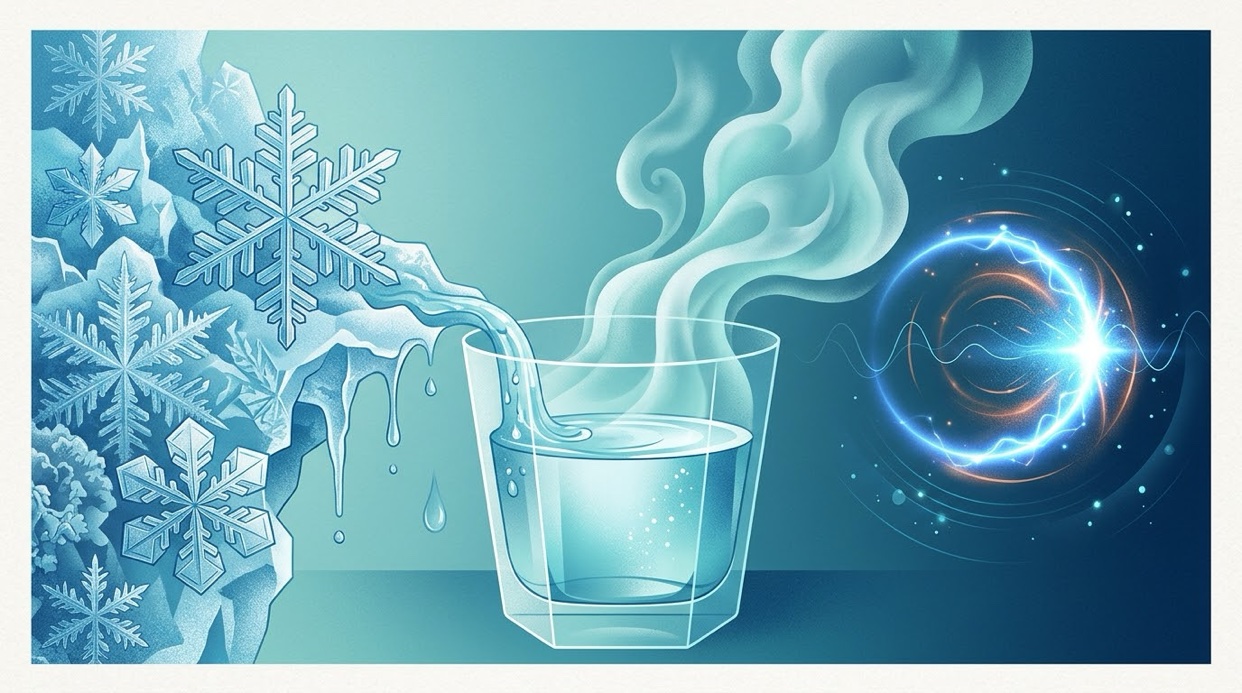
Water is the simplest thing on Earth, but it is also a complete shapeshifter. Most people know the big three: solid ice, liquid water, and vapor gas. But if you think ice is just ice, you are missing most of the story. The molecule in your drinking glass is capable of tricks that sound like science fiction.
1. The Ice in Your Freezer Is Only the Beginning
When you pop an ice cube out of a tray, you are holding just one specific version of solid water. It goes by the official name Ice Ih (hexagonal ice). It is the standard form of ice that builds up on your freezer walls, falls from winter clouds as snowflakes, and glazes over your driveway in January.
It forms under the normal atmospheric pressure we live in every day. The hydrogen and oxygen atoms line up in neat six-sided rings. That hexagonal lattice leaves a lot of empty space inside the structure, which makes standard ice lighter than liquid water.
Scientists have identified more than 20 different forms of solid ice so far. Each one has its own distinct crystal structure, density, and physical properties.
If you squeeze liquid water hard enough or freeze it under massive pressure, those six-sided rings collapse. The atoms scramble into entirely new shapes. They pack together into tiny cubes, dense squashed rhombohedrons, or completely random scrambled arrays.
Scientists label these exotic variations with Roman numerals—Ice II, Ice III, Ice IV, all the way up through the twenties. Every single one is solid water, but almost none of them would last a second on your kitchen counter.
2. Where the Exotic Ices Live
You will not find these extra forms of ice anywhere on the surface of Earth. They require extreme pressure, extreme temperature, or both. To visit them, you have to travel deep into the guts of giant planets or look out across the frozen moons of the outer solar system.
Miles beneath the icy crusts of moons like Jupiter’s Ganymede or Saturn’s Titan, the weight of outer ice layers creates crushing pressure on the deep water beneath. Down there, water gets squeezed into forms like Ice V and Ice VI. These ices are so dense that they would sink straight to the bottom of a glass of room-temperature water like a stone.
Then there are the truly strange states, like superionic ice (often called Ice XVIII).
Superionic ice forms under millions of atmospheres of pressure combined with intense heat—thousands of degrees Fahrenheit. It is not cold, and it is not clear. It is a hot, black solid.
Inside superionic ice, the pressure is so intense that the oxygen atoms lock into a solid rigid crystal grid, while the smaller hydrogen atoms break free and flow straight through that grid like a liquid. Because those positively charged hydrogen ions can move around freely, superionic ice conducts electricity just like a metal wire.
Astronomers believe vast layers of superionic ice exist deep inside giant icy planets like Neptune and Uranus. The movement of charged particles inside those massive layers of hot, solid ice may even generate the weird magnetic fields surrounding those distant worlds.
3. The Ladder of States
School textbooks teach the basic ladder of matter: solid at the bottom, liquid in the middle, gas at the top. Warm an ice cube up, and it melts into liquid. Warm the liquid up, and it boils away into gas.
Add enough energy to a gas, however, and you hit the fourth state of matter: plasma.
Plasma sounds exotic, but the concept is straightforward. Matter is made of atoms, which have a central nucleus surrounded by electrons. When you heat a gas to extreme temperatures or blast it with massive electrical energy, the atoms vibrate so violently that they strip apart. The electrons tear loose from their parent nuclei.
What you are left with is a superheated, glowing soup of freely floating charged ions and loose electrons. That charged soup is plasma.
Water reaches the plasma state right here on Earth whenever lightning strikes. When a bolt of lightning rips through humid air or hits a body of water, it flash-heats the water molecules to tens of thousands of degrees in a microsecond. The bonds holding the hydrogen and oxygen together rip apart, and the atoms split into a blinding streak of water plasma.
Out in space, inside the turbulent fiery atmospheres of young stars and deep cosmic nebulae, water molecules are constantly being broken apart into plasma and fused back together again. The same basic H2O molecule that fills your watering can can exist as a glowing, high-energy plasma state under the right cosmic conditions.
4. Back Down the Ladder to Your Kitchen
It is fun to think about black, electricity-conducting ice inside Neptune, but back on Earth, homeowners only ever deal with one solid form of water: ordinary freezer ice.
That single form carries one bizarre physical property that sets it apart from almost every other chemical substance on Earth: water expands when it freezes.
Most liquids shrink and become denser as they drop in temperature and turn solid. Their molecules pack tighter together. If water behaved like a normal liquid, ice cubes would sink straight to the bottom of your glass, and lakes would freeze from the bottom up in winter, killing everything swimming in them.
Instead, as liquid water cools down past 39°F (4°C), its molecules start lining up into that wide, hollow hexagonal lattice. By the time it hits 32°F (0°C) and turns solid, it has expanded in volume by roughly 9 percent.
That 9 percent expansion is an incredible natural force. Liquid water trapped inside a sealed copper pipe or a home irrigation line will freeze from the outside in. As the ice forms, it expands and pushes outward with thousands of pounds of pressure per square inch. It does not matter how thick the metal pipe is—the expanding ice will split the pipe wide open every single time.
Understanding that expansion is rule number one of home maintenance in cold climates. Insulate your exposed pipes, drain your outdoor spigots before the first hard frost, and keep your thermostat set above 55°F even when you go on vacation.
5. Why Any of This Matters
Why should a homeowner care about superionic ice or lightning plasma?
Because it shows you the true nature of the substance flowing out of your tap. The exact same simple molecule—two tiny hydrogen atoms hooked to one oxygen atom—behaves like a completely different material at every single step of the ladder. It can be a floating ice cube, a solvent liquid, an invisible vapor gas, a dense planetary solid, or a high-energy glowing plasma.
Out of all those exotic forms and states across the universe, home water treatment works on just one single step of the ladder: the liquid.
When water is in its liquid state at normal Earth temperatures, it is the ultimate solvent. It dissolves minerals from surrounding rock, absorbs gases from the air, and carries suspended particles wherever it flows. Filtration is simply the art of taking that liquid state—after it has picked up iron, hardness minerals, or chemicals on its journey—and stripping out the extra baggage before it reaches your glass.
Water is a wild, beautiful chemical miracle. It runs in a single unbroken chain from a delicate snowflake on your porch to the superheated interior of a star. Respect what it can do, protect your pipes when it freezes, and keep learning what makes it tick.
Facts first, then filter. — Steve
Leave a Reply