
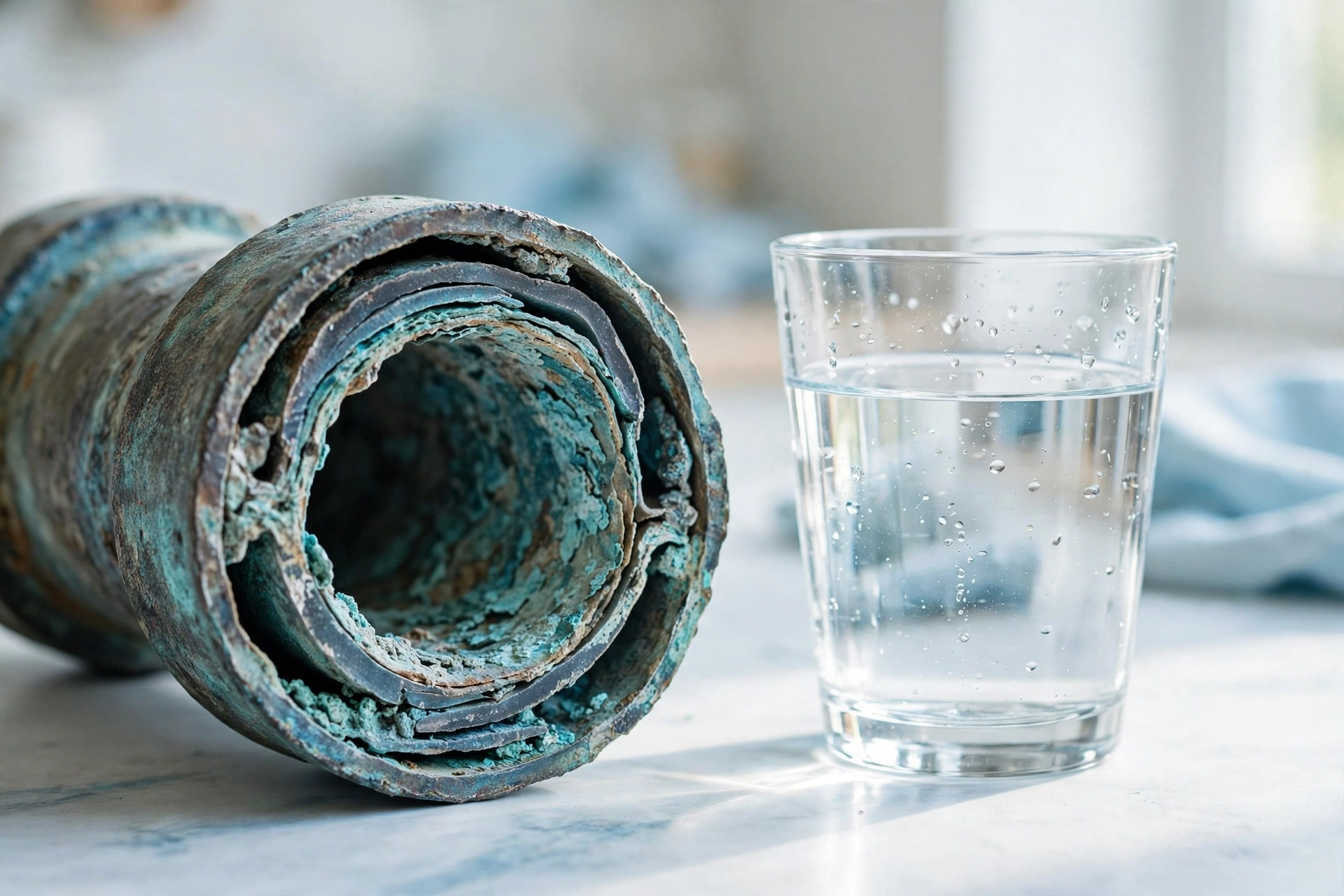
Lead in your tap water almost never comes from the reservoir or the well. It comes from the last stretch — your pipes.
If your home was built before 1986, you may have a lead service line (the pipe from the street to your house), lead solder on copper pipes, or brass faucets and fixtures that contain lead. When water sits in those pipes, especially if it’s acidic or low in minerals, it corrodes the metal and lead leaches in. Hot water leaches faster than cold. First-draw water in the morning is typically the worst.
You can’t see it, taste it, or smell it. That’s the problem.
The health picture, honestly
Lead is a neurotoxin. The EPA and CDC agree there is no known safe level of lead in a child’s blood. The EPA’s health goal for lead in drinking water — the Maximum Contaminant Level Goal — is zero, because the science shows no safe level of exposure.
That doesn’t mean one glass will hurt you. It means there’s no threshold below which we can say “this is fine,” especially for kids under six, infants on formula, and pregnant people. In children, even low levels are linked to brain and nervous system effects, lower IQ, learning and behavior problems, and hearing loss. In adults, it’s tied to higher blood pressure, kidney problems, and cardiovascular effects. Lead also accumulates — it’s stored in bone and can be released years later.
The number you’ll hear most is 15 parts per billion (ppb). That’s the EPA action level under the Lead and Copper Rule: if more than 10% of tap samples in a system exceed 15 ppb, the utility has to take additional steps like corrosion control and public notification. It is a trigger for the utility to act — it is not a “safe/unsafe” line for your faucet. Zero is the health goal. Fifteen is the management trigger. Don’t confuse them. And that trigger is tightening: under the 2024 Lead and Copper Rule Improvements, the action level drops to 10 ppb effective November 1, 2027.
Flint: the cautionary tale
In 2014, the city of Flint, Michigan switched its drinking water source to the Flint River — a cost-saving move. The critical mistake: the new water wasn’t treated with corrosion control. Flint River water was more corrosive than the previous supply, and it stripped the protective mineral coating inside the city’s lead service lines. Lead poured into thousands of homes.
Children were exposed to elevated lead levels. An outbreak of Legionnaires’ disease followed — eventually tied to the same water change. Officials dismissed residents’ complaints for over a year before the state acknowledged the crisis. It became a national scandal, criminal charges, and a federal emergency declaration.
The lesson for your home: Flint’s source water wasn’t full of lead — the pipes were. Change the water chemistry without corrosion control and safe pipes turn dangerous. That’s why corrosion control is now federal law under the Lead and Copper Rule, and why this article keeps coming back to the same point: lead is a plumbing problem. Your pipes, your water chemistry, your test.
Newark did it right — and fast
Closer to home: Newark had its own lead crisis in 2017, when the city’s corrosion control faltered and lead levels spiked in household tap water. The city responded with new corrosion treatment — and then went further.
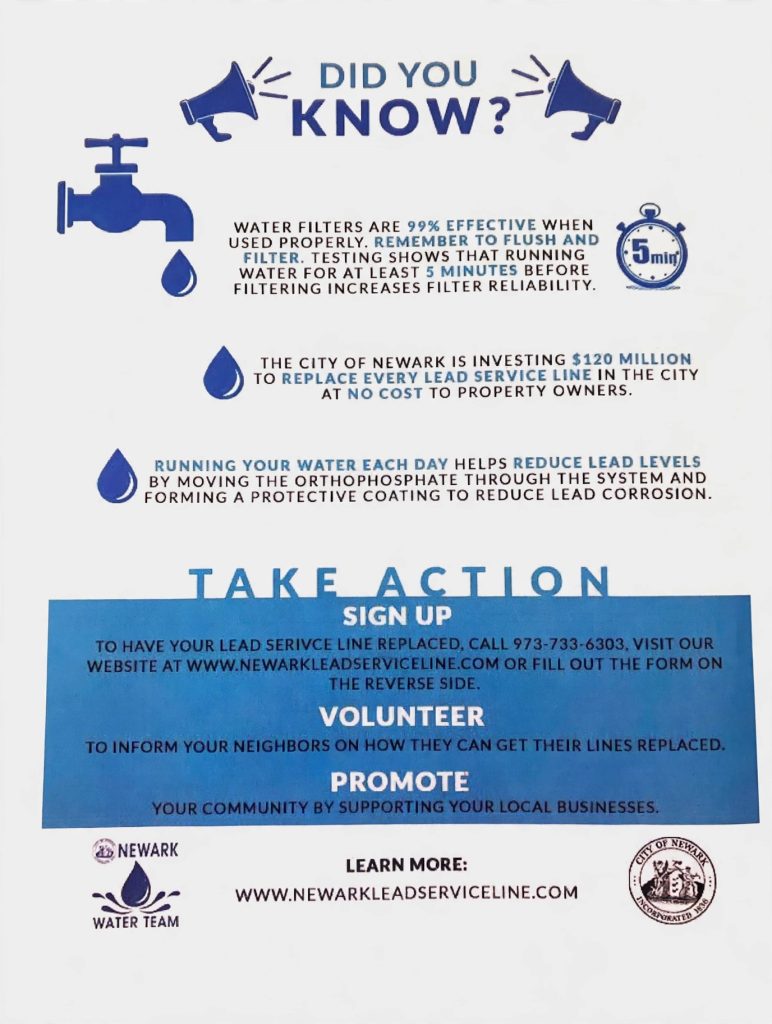
Under Mayor Ras Baraka, Newark committed to replacing every lead service line in the city — more than 23,000 of them — starting with a $120 million investment at no cost to property owners. The final program cost is usually quoted around $190 million, though with funding coming from several sources and the scope growing as crews found more lead lines than the original estimate, nobody quotes a single exact figure. Done block by block, in under three years: a job experts said would take a decade.
The city’s own flyers explained the science plainly: running your water each day moves orthophosphate through the system, forming a protective coating inside pipes that keeps lead from leaching. That’s corrosion control in one sentence.
I sat in on a meeting at the center in Newark. The lesson I took home: replacement is the permanent fix, and it can be done fast when a city decides to do it. Until your street gets its turn, a certified filter at the tap is what protects your family tonight.
How to test
Start free: ask your water utility if you have a lead service line and check your annual water quality report. Many utilities will test your tap for free or for a small fee if you ask.
For your own result, use a certified lab. Collect a first-draw sample (water that’s sat in the pipes 6+ hours, usually first thing in the morning) and a flushed sample — the difference tells you if it’s your plumbing. Home strips are not reliable for lead at these low levels. Spend the money on a lab test once; it’s the only number worth acting on.
While you wait: run the cold tap 30 seconds to 2 minutes after long stagnation, always use cold water for drinking and cooking, and clean your faucet aerators regularly — they trap lead particles. If you have — or might have — a lead service line, flush longer; some utilities advise up to 5 minutes, so follow your utility’s guidance for your line type.
What actually removes it
Certified carbon block filters (NSF/ANSI 53 for lead reduction). Look for the certification specifically for lead — not just “taste and odor.” Pitcher, faucet-mount, and under-sink carbon blocks certified to Standard 53 are proven to reduce lead to 5 ppb or less — that’s the current NSF/ANSI 53 pass level, tightened from the old 10 ppb. Carbon blocks that pass this test are typically built around a 0.5-micron pore size — fine enough to trap lead particles a standard 1- or 5-micron filter misses. One distinction worth knowing: an absolute rating means the filter catches 99.9% of particles that size, while a nominal rating means only most of them — for a health claim, absolute is the number that counts.
Reverse osmosis (NSF/ANSI 58). RO is the other proven route and removes lead very effectively, along with a wide range of other contaminants. Good choice if your test shows multiple issues, not just lead. For scale, RO membranes run about 0.0001 micron — roughly ten thousand times finer than that 0.5-micron carbon block.
What does NOT remove it:
- Boiling. Boiling does not remove lead — it concentrates it as water evaporates. Never boil to “fix” lead.
- A basic sediment filter or water softener. Neither is designed or certified for lead.
- A standard carbon filter certified only for chlorine taste and odor (Standard 42). If it doesn’t say Standard 53 for lead, don’t assume it does the job.
- Letting it sit. Unlike chlorine byproducts, lead doesn’t off-gas.
Replacing lead pipes and fixtures is the permanent fix, and utilities are now required to replace lead service lines under the 2024 Lead and Copper Rule Improvements — but that timeline runs for years. A certified filter at the tap protects you now.
What I’d buy
Treatment type: an NSF/ANSI 53-certified carbon block filter for lead reduction (pitcher or under-sink, depending on your flow needs) — or a reverse osmosis system certified to NSF/ANSI 58 if you want broader coverage.
The bottom line
Lead is a plumbing problem, not a source-water problem — which means your house, not the city report, decides your exposure. Test first-draw, filter with something actually certified for lead, and don’t boil it. That’s the whole game.
Start here: What’s In Your Water? — learn how to read your water report and test your own tap.
Leave a Reply