
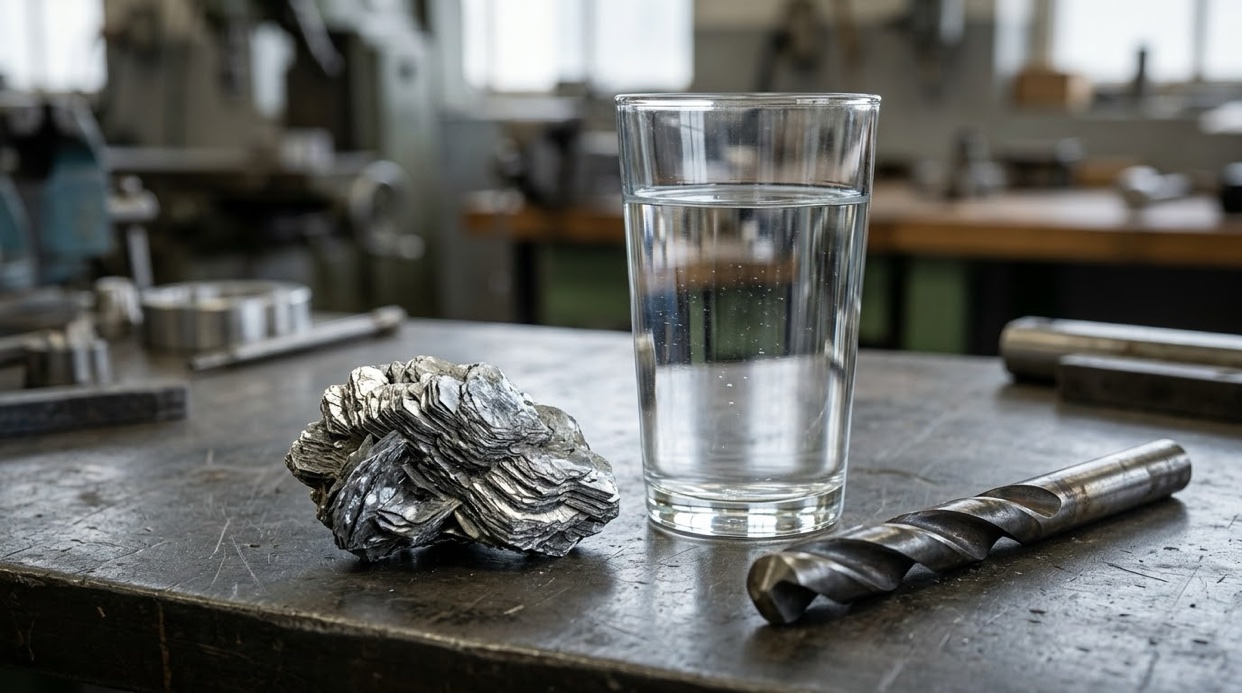
If you take a look at the periodic table, you will spot molybdenum sitting at element number 42. It is a metal with a tongue-twister name and a quiet double life: industry mines it for steel, and your body uses a trace of it to stay alive.
I’m Steve, and I spend my days helping homeowners make sense of what comes out of their taps. Molybdenum is one of the elements I file under “nutrient first” — most people who find it on a water report have never heard of it, and the honest story is calmer than the name sounds. Here is a clear, honest breakdown of what molybdenum is, how it gets into drinking water, what it means for your health, and what you can do about it, without any sales hype or scare tactics.
1. What Molybdenum Is and Where It Comes From
Molybdenum is a metal that occurs naturally in rock and soil. It is an essential nutrient in trace amounts — and at the same time a genuinely useful industrial metal:
- Steel Alloys and Industry: Molybdenum is mined for steel alloys and industrial uses, where it earns its keep in hard-working metal.
- A Copper Connection: It sometimes comes out of the same mining operations that produce copper — the two metals can share the same ground.
So the molybdenum in a water report has two possible authors: the geology under your feet, and the mining that geology sometimes attracts.
2. How It Gets Into Drinking Water
Molybdenum reaches drinking water the natural way, with mining adding its share:
- Natural Deposits: Molybdenum is natural in rock and soil, and groundwater in the right geology carries it. Water moving slowly through molybdenum-bearing rock dissolves traces of it, the way groundwater picks up so many of the elements in this series.
- Mining: Where molybdenum is mined — including operations that also produce copper — mining activity can add to what local water carries.
3. What It Can Do to a Person’s Health: A Nutrient First
This one is a nutrient first, and I want to lead with that because it is the truth of the element.
- The Nutrient Side: Your body uses trace molybdenum in enzymes — the workhorse proteins that run your chemistry. Molybdenum is not an intruder your body has no use for; it is a required trace nutrient, normally arriving through food.
- The Water Side: The amounts in drinking water are normally small. A molybdenum result on a lab report is a piece of information, not an alarm — and there is no federal standard against which the number is judged.
If a test ever comes back high and you want the level reduced, that is a reasonable homeowner preference, and standard treatment handles it. But nobody should lose sleep over a normal trace result for an element their body actually uses.
4. The Federal Picture: No Federal Standard
Molybdenum currently has NO federal drinking-water limit — no EPA Maximum Contaminant Level (MCL).
No federal standard exists for it. That means public water systems are not working against a molybdenum limit, and a homeowner reading a lab report has no official federal number to compare the result against.
So the honest way to read a molybdenum result is with the element’s own story in mind: it is an essential trace nutrient, the amounts in drinking water are normally small, and the choice to treat it is a preference — one that good equipment makes easy if you decide on it.
5. How a Homeowner Can Test Their Water
You cannot see, taste, or smell molybdenum at normal levels. The only way to know whether it is in your water — and how much — is laboratory analysis.
- Skip DIY Home Test Strips: Over-the-counter dip strips are fine for basic pH or free chlorine, but they cannot measure trace metals like molybdenum down at these levels.
- Use a Certified Laboratory: Send a sample to a state-certified drinking water laboratory, and ask for molybdenum specifically if it is not on the standard panel. Labs measure trace metals with precise instruments such as ICP-MS.
6. How to Remove Molybdenum from Drinking Water
If a certified lab test comes back high and you want the level reduced, standard treatment handles it.
Effective Removal Technologies
- Reverse Osmosis (RO): An under-sink point-of-use Reverse Osmosis system is the most dependable home method. RO pushes water through a semi-permeable membrane that rejects dissolved metals, including molybdenum, while letting purified water pass through.
- Ion Exchange: Molybdenum in water can also be reduced by ion exchange treatment — the same family of technology used in water softeners — which swaps dissolved ions out of the water.
The Honest Truth About Carbon Filters
Standard activated carbon filters are excellent for chlorine, taste, and odor, but they do not reliably remove dissolved metals like molybdenum on their own.
Pre-Filtration and Micron Ratings
While sediment pre-filters cannot catch dissolved molybdenum, they protect your RO membrane or ion exchange equipment from silt, rust, and sand.
When selecting pre-filters, pay attention to micron ratings:
- Micron Rating: A micron measures pore size. A 5-micron or 1-micron sediment pre-filter is standard practice ahead of an under-sink RO membrane.
- Nominal vs. Absolute Rating:
- Nominal Rating: Traps approximately 60% to 85% of particles at that micron size under standard flow.
- Absolute Rating: Traps 99.9% or more of particles at the specified micron size under strict lab test conditions.
Using an absolute-rated pre-filter gives your treatment equipment consistent physical protection over time.
The Bottom Line
Molybdenum in drinking water is a nutrient first: an essential trace element your body uses in enzymes, reaching water from natural deposits and mining. It has no federal drinking-water limit, and the amounts in water are normally small. If a test comes back high and you want it reduced, reverse osmosis or ion exchange will handle it.
Leave a Reply