
Oxidation is fundamentally about a chemical handoff. In plain English, an oxidant is a chemical thief that steals electrons from whatever it touches. When that oxidant meets a dissolved contaminant in your water, it forces an electron transfer. That transfer changes the contaminant’s chemical identity entirely, turning a dissolved, invisible substance into something else—usually a solid particle that a physical filter can catch, or a form that another treatment step can remove.
It is vital to understand one baseline rule of water chemistry right from the start: oxidation changes things; by itself, it removes nothing.
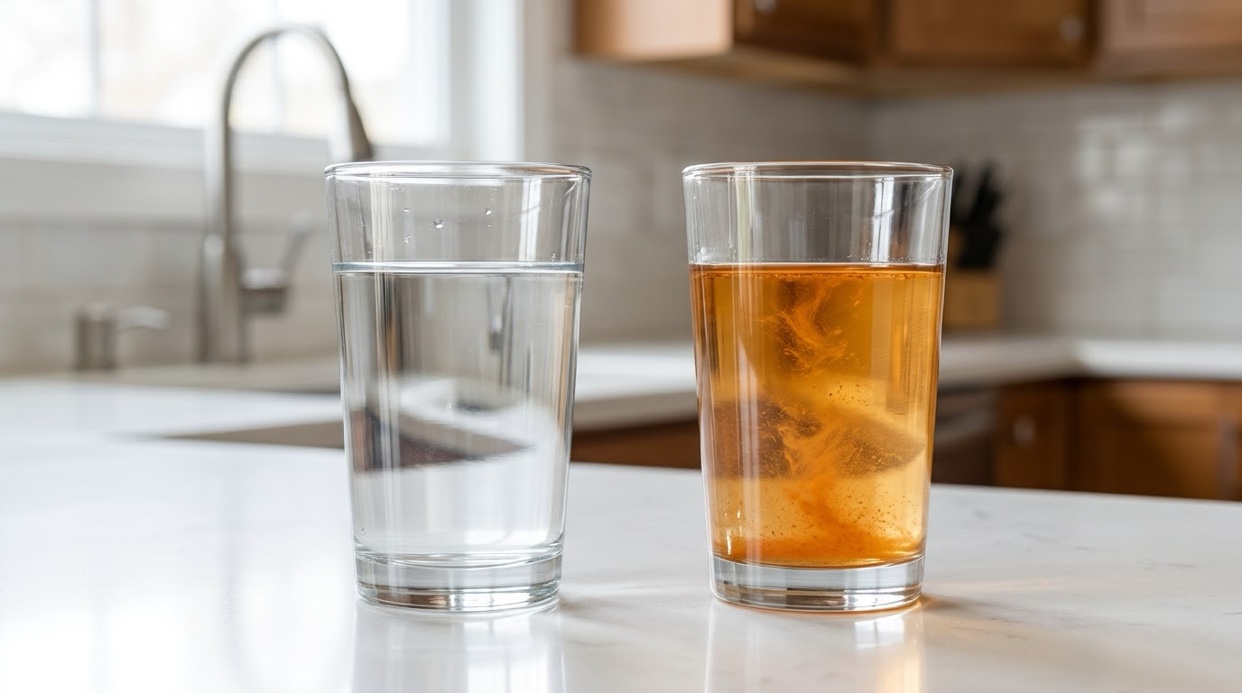
When you oxidize dissolved iron, for instance, you don’t make the iron disappear from the water pipe. You simply change its form from a clear, dissolved liquid into tiny solid rust specks. If you stop at the oxidation step without a physical filter downstream, your water will come out of the tap looking like clear tea that slowly turns rusty brown as it sits in a glass. Oxidation does the heavy chemical lifting, but a physical media bed is always required to finish the job and catch the debris.
The Oxidants Used in Water Treatment
Water treatment professionals rely on several different oxidants, ranging from the mildest, most natural option to some of the most aggressive chemical agents available. Ordered roughly from weakest to strongest in terms of oxidizing power, here is what is actually used in the field and where each belongs:
- Air (Oxygen): The mildest and most natural oxidant available. Oxygen from the air is introduced via aeration or air-injection systems. It is inexpensive and chemical-free, but its oxidizing strength is limited, making it ideal only for water with straightforward, easy-to-treat levels of dissolved iron, sulfur, or carbon dioxide.
- Potassium Permanganate: A powerful solid chemical (typically purple crystals dissolved into a solution tank) often paired with manganese greensand filters. It is exceptionally effective at driving the oxidation of iron and manganese, but it requires careful handling because it is a strong skin irritant and stains surfaces purple if spilled.
- Chlorine: A robust, traditional disinfectant and oxidant. Whether fed in liquid sodium hypochlorite form or gas, chlorine aggressively attacks dissolved metals, sulfur, and microorganisms. It is widely used because it leaves a residual disinfectant trace in the water to protect distribution lines, though it can create chemical taste issues if not managed properly.
- Hydrogen Peroxide: A clean-burning liquid oxidant that breaks down into water and oxygen, leaving no chemical taste or harmful residuals behind. It is increasingly popular in residential well treatment for heavy sulfur or iron loads because it packs a strong oxidative punch without adding chlorine or heavy salts to the water.
- Ozone (O₃): The strongest, fastest-acting oxidant used in water treatment. Ozone is an unstable gas generated on-site by passing oxygen through a high-voltage electrical discharge. It destroys contaminants instantly, breaks down organic compounds, and reverts back to ordinary oxygen gas, but it requires specialized, expensive generation equipment and precise engineering control.
What Oxidation Genuinely Handles
Oxidation is a targeted chemical tool designed to conquer specific water quality problems that physical filters alone cannot touch:
- Dissolved Iron: This is oxidation’s most famous job. Underground water under pressure holds ferrous iron in a clear, dissolved state. When an oxidant is introduced, it strips electrons from the iron, converting soluble ferrous iron into solid ferric iron (rust).
- Manganese: Similar to iron, dissolved manganese creates dark, greasy black stains on laundry and plumbing fixtures. Air alone is often too slow to oxidize manganese effectively, requiring stronger chemical oxidants like chlorine, peroxide, or permanganate to force it out of solution.
- Hydrogen Sulfide: This is the notorious gas responsible for the rotten-egg smell in well water. Oxidants react instantly with hydrogen sulfide, converting it into harmless, odorless sulfate or solid sulfur particles that a filter can easily trap.
- Arsenic (As(III)): Arsenic exists in groundwater in two primary forms. Trivalent arsenic (As(III)) passes right through many standard residential filters. Oxidation converts As(III) into pentavalent arsenic (As(V)), which standard iron-media filters and reverse osmosis systems can effectively catch and remove.
- Disinfection: Strong oxidants like chlorine, ozone, and peroxide attack the cell walls and genetic material of living pathogens, inactivating bacteria, viruses, and parasites to make raw water microbiologically safe to drink.
What Oxidation Does NOT Do
Because oxidation is often marketed as a cure-all water treatment, it is equally important to be clear about its limitations:
- It Does Not Remove Contaminants by Itself: As emphasized earlier, oxidation is a transformation step, not a removal step. If you do not follow an oxidation system with a proper physical barrier or filter, the oxidized metals and particles remain suspended in your water.
- It Does Not Reduce Hardness: Oxidation has zero effect on dissolved calcium and magnesium ions. It will not soften hard water, stop scale buildup in water heaters, or reduce total dissolved solids.
- It Does Not Eliminate Nitrates or Salts: Dissolved chemical ions like sodium, chlorides, and agricultural nitrates do not undergo the electron transfer required for standard oxidation to capture them.
- It Does Not Stop PFAS: Per- and polyfluoroalkyl substances (“forever chemicals”) are largely immune to standard residential oxidants and pass straight through oxidation-filtration trains unless treated with specialized granular activated carbon or high-pressure membrane separation.
The Critical Partner: Contact Time and Downstream Filters
An oxidation system is only as good as the engineering that surrounds it. Two factors dictate whether an oxidation setup actually works in a home or a city plant:
- Contact Time: Oxidation is not instantaneous for every contaminant. A chemical reaction requires time—often measured in minutes—for the oxidant to thoroughly collide with and react with dissolved iron, sulfur, or arsenic. If water rushes past an injection point too quickly, the reaction finishes downstream inside your home’s copper piping rather than in the treatment tank, ruining fixtures.
- The Downstream Media Filter: Once oxidation turns dissolved minerals into solid particles, those solids must be physically filtered out. This requires a dedicated backwashing media filter—such as catalytic carbon, multi-media sand, or specialized synthetic media—matched to the correct micron rating to trap the newly formed precipitate before it reaches your faucets.
The Order Matters: The Oxidation Train
A chemical-feed oxidation system is plumbed in a strict order, and the order is not optional. First the oxidant is fed into the water line. Next comes a retention tank, which simply holds the water long enough to give the chemical its full contact time to finish reacting. Then a backwashing filter catches everything that was oxidized — the rust, the manganese, the sulfur particles — and flushes them down the drain. Only after that comes the carbon filter, whose job after chlorination is to remove the chlorine itself, along with taste and byproducts, before the water moves on to any other equipment. Skip the backwashing filter and send oxidized water straight into carbon — a shortcut installers take all the time — and the carbon bed fouls with rust and solids it was never built to catch.
One more rule, and it’s about knowing your media: manganese greensand is built to work with an oxidant feed. In a continuous-regeneration setup, chlorine — or permanganate — is fed ahead of the filter on purpose, and enough of it has to survive the trip through the bed: greensand’s maker calls for 0.5 to 1.0 mg/L of free chlorine still present in the water leaving the filter. That oxidant is what keeps the media’s coating alive; a greensand bed starved of oxidant is the one that fails — coating exhausted, and manganese leaking into the treated water. The media chlorine truly ruins is Birm, a different black granule that looks nearly the same in the tank — its maker warns that chlorination depletes Birm’s coating and caps free chlorine at under 0.5 ppm. Same-looking media, opposite rulebooks. A dealer should know which one is in the tank before he chooses the oxidant — and so should you.
The Honest Downsides and Maintenance
Maintaining an oxidation system takes work. Unlike a passive whole-house filter cartridge, active oxidation systems require mechanical vigilance:
- Chemical Feed Upkeep: Systems that use liquid chlorine, hydrogen peroxide, or potassium permanganate rely on chemical metering pumps, solution tanks, and float valves. If a feed pump loses prime, runs dry, or clogs with mineral scale, the oxidation stops immediately.
- Byproducts and Taste: Chemical oxidants like chlorine can leave lingering tastes or react with natural organic matter in well water to form unwanted disinfection byproducts if over-fed. Proper monitoring and carbon polishing are often necessary.
- Backwashing Waste: Because oxidation creates a heavy load of solid particulate matter, the downstream filter must routinely backwash. This means gallons of water are flushed down the drain during each regeneration cycle, requiring a drain line capable of handling the volume.
Who Oxidation Systems Are Actually For
In the real world, complex oxidation systems are rarely found in homes connected to municipal water utilities. City water plants handle massive-scale oxidation using ozone or chlorine before the water ever leaves the treatment facility.
Instead, residential oxidation systems are built primarily for private well owners. If your well water smells like rotten eggs, stains your laundry yellow or black with iron and manganese, or contains stubborn trivalent arsenic, an engineered oxidation and filtration system is often the only reliable way to bring your water back to clarity.
Bottom Line
Oxidation is a powerful, scientifically proven cornerstone of water treatment. It performs a specific, vital chemical function: stealing electrons to transform invisible, dissolved trouble into filterable solids or harmless compounds. Respect oxidation for what it is—a chemical transformer, not a magic vacuum—pair it with adequate contact time and a proper backwashing filter, and you will understand how clean water is actually made.
Facts first, then filter. — Steve
Leave a Reply