
It usually begins with a small card in your mailbox or a polite knock at your front door. The person standing on your porch offers a free, no-obligation water quality test for your home. They are polite, professional, and seemingly concerned about your family’s health.
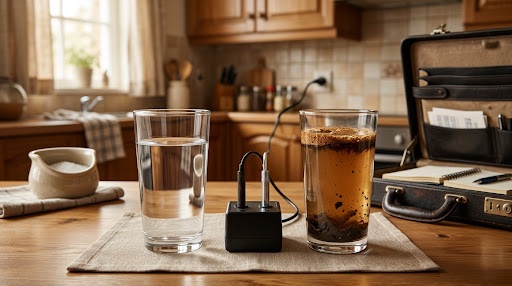
Once invited into your kitchen, the salesperson clears a small spot on your table and asks for two glasses of tap water. Out of a briefcase comes a small gadget with metal prongs and a plug. Within two minutes of starting the test, your tap water turns into a dark, murky sludge that looks like sewage.
If this has happened at your kitchen table, you are not alone. Homeowners — particularly seniors — sit through this exact demonstration every year. It is frightening to look into a glass of water you drink every day and see it turn into a bubbling brown mess. But before you sign a contract for thousands of dollars to fix a problem you did not know you had, you need to understand one crucial truth: you have just been shown a parlor trick, not a scientific water test.
The Demonstration: Turning Your Tap Water to Sludge
The salesperson sets up the test using two glasses. One glass is filled directly from your kitchen faucet. The second glass contains water the salesperson brought with them—usually pure reverse-osmosis or distilled water.
They plug a small electrical device, often called a water precipitator or electrolyzer, into your wall outlet. The device has metal rods—usually one made of iron and one made of aluminum—that stick down into each glass. The salesperson flips a switch, and an electrical current passes through both liquids.
Almost immediately, the glass containing your tap water begins to change color. It goes from clear to yellow, then to dark green or rusty brown. Foamy brown sludge rises to the top, and black flakes settle to the bottom. Meanwhile, the glass containing the salesperson’s filtered water stays almost completely clear.
The salesperson points at the dark sludge in your glass with a look of grave concern. They tell you that this brown gunk represents the hidden chemicals, toxins, sewage, and heavy metals floating in your tap water. They ask you if you would let your grandchildren drink that glass of brown sludge. Shocked and alarmed by what your own eyes just saw, many homeowners agree on the spot to buy expensive treatment equipment.
What Is Really Happening: The Science of the Trick
The brown sludge in that glass did not come from your municipal water supply or your private well. The device created it right in front of your eyes out of its own metal prongs.
The rod that does the damage is made of iron. (The kit’s other rod is often aluminum — it makes a pale, milky gel. The iron rod makes the brown rust you remember.) When an electric current flows through tap water, a natural process called electrolysis occurs. Electricity travels through the water by using the harmless, naturally occurring minerals already dissolved in it—like calcium, magnesium, sodium, and potassium.
As the electrical current flows between the rods, it causes the iron rod to rapidly rust and dissolve into the water. The brown, black, and greenish sludge you see is literally rusting iron off the salesperson’s tool, mixed with your water’s natural minerals coming out of solution.
If you put that same device into a glass of pure, healthy mineral water bought from the grocery store, it would turn into the exact same disgusting brown sludge. The device does not reveal hidden filth; it manufactures rust.
Why the Filtered Glass Stays Clear
Why did the salesperson’s glass of water stay clear while yours turned brown?
The salesperson used distilled water or water treated by reverse osmosis. This type of water has had almost all of its naturally occurring minerals removed. Because minerals are what allow electricity to flow through water, distilled water cannot conduct an electrical current.
Without an electrical current flowing between the metal rods, the iron rod does not dissolve. No electricity means no chemical reaction, which means no rust.
This demonstration tests only one thing: whether your water contains dissolved mineral ions that conduct electricity. It tells you absolutely nothing about the safety, purity, or health of your drinking water.
In fact, this test is completely meaningless as a measure of safety:
- A glass of clean, crystal-clear water rich in healthy minerals will sludge up heavily in this test.
- A glass of distilled water contaminated with dangerous, invisible chemicals (like pesticides or arsenic) that do not conduct electricity would stay completely clear.
The demonstration proves nothing about contamination. It is designed to manipulate your visual perception, using basic chemistry to cause panic.
What an Honest Water Test Looks Like
A legitimate water-treatment professional will never use a parlor trick to scare you into a purchase. Real water testing relies on laboratory science, calibrated meters, and certified standards.
An honest water evaluation includes:
- Certified Laboratory Analysis: For serious health concerns—like lead, bacteria, nitrates, or synthetic chemicals—water samples must be collected in sterile containers and sent to a state-certified laboratory. True chemical testing takes time; it cannot be done with a wall plug and two metal rods in two minutes.
- Proper Use of a TDS Meter: A Total Dissolved Solids (TDS) meter measures the concentration of dissolved minerals in parts per million. An honest technician will explain that a high TDS reading usually just means hard mineral water, not toxic contamination.
- Verified Product Certifications: Legitimate water filters are tested and certified by independent bodies like NSF International or the Water Quality Association (WQA) — and an honest professional will say, in plain English, what a seal actually covers. An NSF/ANSI 53 seal means a filter was tested against health-related contaminants like lead. An NSF/ANSI 58 seal covers reverse-osmosis systems and the specific contaminants each one is proven to reduce. If someone names a seal but cannot tell you what it means, that is the sellers’ shorthand. An honest professional will show you the official certification documents listing the exact contaminants a system is proven to remove.
Red Flags to Watch For at Your Door
Protect yourself and your home by keeping an eye out for these common warning signs:
- Unsolicited Free-Test Cards: Postcards in your mail offering a “free home water inspection” or asking you to fill out a survey to win a prize often come from high-pressure sales companies.
- In-Home Visual Demonstrations: Any test that relies on dramatic color changes, precipitating sludge, or burning reactions right at your kitchen table is a sales show, not science.
- Same-Day High Pressure: Salespeople who insist that a price discount is valid “only for today” or who urge you to sign a contract before they leave your house.
- Claims That City Water Is Poison: Honest professionals respect public water utilities. If a salesperson claims municipal tap water is actively dangerous or illegal to drink, step back.
- Refusal to Leave Written Results: A legitimate technician will leave a clear, written record of any field test numbers for you to evaluate on your own time.
If It Already Happened to You
If you have sat through one of these demonstrations and feel panicked or pressure-sold into buying a system, take a deep breath. You are in control of your home and your finances.
- Do Not Decide at the Table: Tell the salesperson clearly that you never make financial commitments on the same day. A reputable business will gladly leave their proposal with you and wait for your decision.
- Ask for Written Data: Ask for the exact laboratory data or certified testing that backs up their claims about your water supply.
- Check Your Cancellation Rights: If you signed a contract in your home under pressure, federal law (the FTC’s Cooling-Off Rule) and most state laws give you three business days to cancel sales of $25 or more made at your residence. You can cancel for a full refund without penalty.
- Get a Second Opinion: Contact your municipal water authority for their annual water quality report (CCR), or hire an independent, state-certified laboratory to test your water objectively.
Why Honest Professionals Refuse This Trick
Those of us who have spent our careers studying water chemistry and building real treatment systems despise the electrolysis trick. It hurts the reputation of our trade, degrades public trust in safe drinking water, and takes advantage of homeowners who are simply trying to protect their families.
Water quality is a serious science. It deserves honest answers, precise measurements, and straightforward advice. If a system is truly needed to solve a hardness problem, an odor issue, or a specific contaminant, the facts will speak for themselves without needing a cheap electrical trick to scare you.
Facts first, then filter. — Steve
Related reading: How to Spot an Honest Water Treatment Company
Before You Sign: The Door-to-Door Water Test Checklist
Keep this sheet near your front door. Use it if a salesperson offers to test your water at home.
During the Visit
Check YES or NO for each item:
- YES / NO — Did they arrive because of a “free water test” postcard or prize survey?
- YES / NO — Did they use a plug-in gadget that turned your tap water brown or muddy?
- YES / NO — Did they say your city water is poisonous, dangerous, or illegal?
- YES / NO — Did they refuse to leave your test results in writing?
- YES / NO — Are they pressuring you to sign a contract today?
If you checked YES to any of these, stop and do not sign anything.
What the Brown Water Really Is
- The brown sludge comes from the salesperson’s device, where the iron metal prong dissolves under an electric current.
- The device only measures if water carries electricity, which normal healthy minerals allow it to do.
- This demonstration proves nothing about water safety or real contamination.
Say This
Read these three sentences aloud to politely and firmly end the pressure:
- “I never sign contracts or make big home decisions on the same day.”
- “Please leave your written quote and test results on the table so I can review them.”
- “Thank you for your time, but I am ending our meeting now.”
Your 3-Day Safety Net
If you already signed a contract in your home today, do not panic. Federal law (the FTC Cooling-Off Rule) gives you three business days to cancel any sale of $25 or more made at your residence. You can cancel for a full refund without any penalty.
Get a Real Test
- Call your local water utility: Ask for a free copy of their annual Consumer Confidence Report.
- Use an accredited lab: Whether your water comes from a city system or a private well, a state-certified laboratory can test it for real.
- Remember the golden rule: An honest water professional leaves numbers in writing and never relies on a magic trick.
Facts first, then filter. — Steve
Leave a Reply