
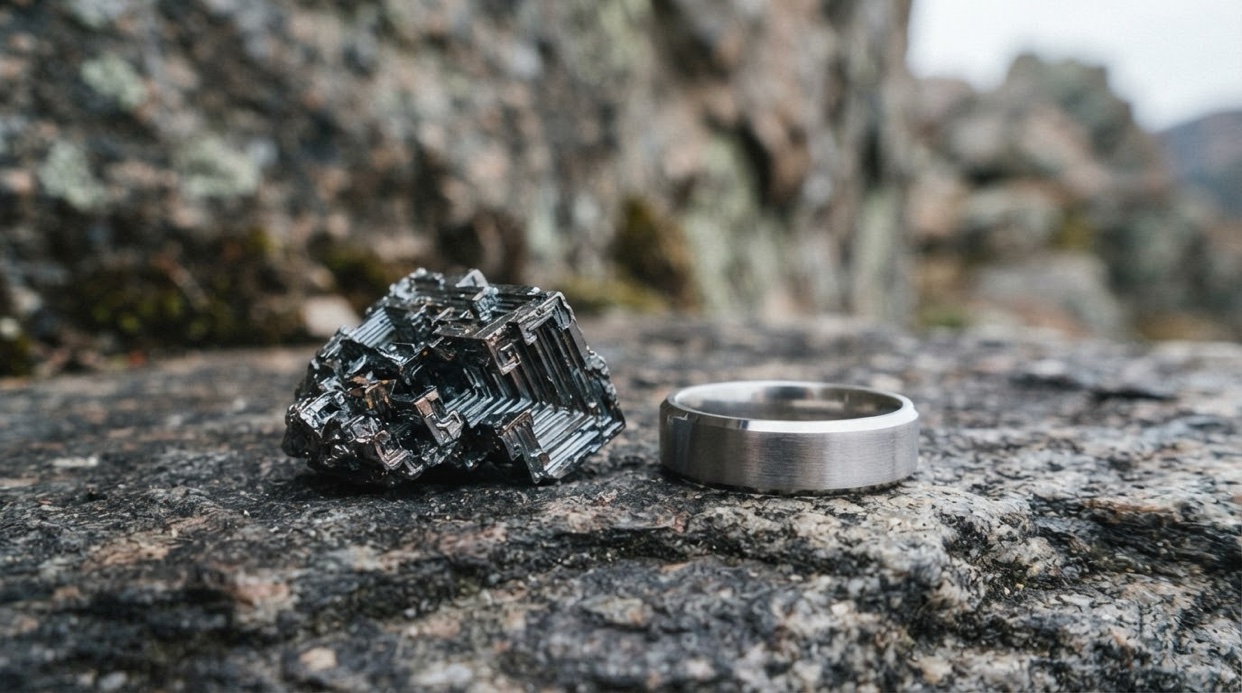
When a laboratory report reaches the bottom of the obscure tail of the contaminant list and prints germanium and titanium, homeowners often assume those entries belong with industrial metals and factory runoff. After a lifetime in professional water treatment, now spent teaching homeowners how to make sense of their test results without getting pulled into alarmism, I look at these final two entries as a quiet landing. This is the last stop in our look at the obscure tail, and it brings us straight back to the ground beneath our feet.
The Family
After hundreds of compounds—solvents, fats, flavors, gases—the list ends with two raw elements, metals straight off the periodic table. No factory invented either of them; the Earth’s crust did. One launched the electronic age and then was replaced. The other is so agreeable to the human body that surgeons install it on purpose. When a lab prints germanium and titanium on a water report, it is reading geology.
The Names
Because there are only two elements here at the finish line, it helps to give each one a full look so you know what the printout actually represents:
- Germanium — Element 32, a metalloid, sitting between metals and nonmetals. Its fame is historical: the first transistor, built at Bell Labs in 1947, was made of germanium, and the early electronic age ran on it before silicon took the job. Today it works in fiber optics, infrared lenses, and specialized solar cells. In nature it hides at trace levels in zinc ores, in coal, and in some mineral soils and springs—never concentrated, always a whisper of the rock. Its one brush with health headlines came from pills, not water: germanium compounds sold as dietary supplements caused documented cases of kidney damage in the 1980s and 1990s and drew FDA warnings—a story about concentrated doses in a bottle, told in the health section below.
- Titanium — Element 22, the strong, light metal of aircraft and spacecraft, famous for refusing to corrode. Its biography in the body is the opposite of a contaminant’s: titanium is the implant metal—bone plates, dental implants, joint replacements—chosen because human tissue tolerates it so well. Its oxide, titanium dioxide, is the world’s white pigment, in paints, sunscreens, and formerly in foods; Europe removed it as a food additive in 2022 over questions about its nanoparticle form, while the United States still permits it—a food debate, at food quantities, about a powder, which the health section keeps in its proper place. The metal itself barely dissolves in water at all.
Why They Are in the Water at All
Both are geology first. Germanium weathers out of certain rocks and coals and rides groundwater at trace levels; a detection is a signature of the aquifer’s rock, not of any spill.
Titanium is everywhere in the crust—one of the most common metals in rock—and reaches water mostly as microscopic particles of its oxide eroded from soil, plus traces near pigment and metal industries; because the metal and its oxide dissolve so poorly, what a lab finds is a faint mineral fingerprint. No homeowner test targets either one; they surface on broad laboratory scans of the water’s mineral content.
The Numbers
Neither element has a federal drinking-water limit—no Maximum Contaminant Level (MCL) and no Maximum Contaminant Level Goal (MCLG)—and no EWG health guideline exists for either. Neither has a federal drinking-water health assessment setting a level of concern for the trace amounts geology delivers.
Here is the plain boundary: these are two of the names on the list where the absence of a number reflects the absence of a drinking-water problem anyone has ever documented, rather than an unstudied industrial chemical.
Health Framing
At a general level, titanium’s record is biocompatibility: the body tolerates the solid metal so well that medicine builds with it, and the only live debate—Europe’s food-additive removal—concerns its oxide powder eaten as an ingredient, not trace mineral detections in water.
Germanium’s record is a lesson in dose and form: the documented kidney cases came from people swallowing concentrated germanium supplement products day after day—grams of a manufactured compound—not from the trace elemental amounts in drinking water, for which no health assessment sets a concern. The core lesson is simple: the same element can be a pill problem and a water non-event, because dose and form are everything.
What Removes Them
Metals are a different department from the organic compounds we looked at earlier, where carbon is the go-to tool: particulate titanium oxide is caught by ordinary sediment filtration; dissolved metals yield to reverse osmosis, whose membrane pores—on the order of a ten-thousandth of a micron—reject metal ions along with everything else dissolved, and to ion exchange, which swaps dissolved metal ions out of the water.
The Bottom Line
The list ends where the whole subject begins—on the periodic table. A transistor’s grandfather and the metal in a million hips and knees, both delivered by rock and rain at levels no regulator has ever needed to number. Geology’s signature, not industry’s spill.
Facts first, then filter. — Steve
Leave a Reply