
Understanding Aldicarb and Its Breakdown Products in Drinking Water: Sources, Regulations, and Health Impacts
What Aldicarb Is
In agricultural history, few pesticides have generated as much regulatory complexity as aldicarb. Chemically, aldicarb belongs to a class of pesticides known as carbamates, and functionally it served as both a systemic insecticide and a nematicide.
To break those terms down into plain English: a systemic pesticide is one that a plant absorbs through its roots and distributes throughout its entire system — stems, leaves, and fruit — so the whole plant becomes toxic to pests that feed on it. As an insecticide, it targeted crop-eating insects; as a nematicide, it targeted nematodes, which are microscopic, thread-like worms that attack plant roots underground.
Because aldicarb was highly potent, it was never sold or applied as a liquid spray that could drift in the wind. Instead, it was formulated exclusively as small, dry granules worked directly into the soil, sold commercially under the trade name Temik.
Once those granules entered damp soil and groundwater, aldicarb did not stay a single chemical for long. Through natural chemical reactions with oxygen and water, the parent chemical breaks down into two closely related chemicals: aldicarb sulfoxide and aldicarb sulfone. Because these two breakdown products form directly from aldicarb and travel right alongside it through soil and water, scientists and regulators always evaluate and discuss all three chemicals together as a single family.
How It Gets Into Drinking Water
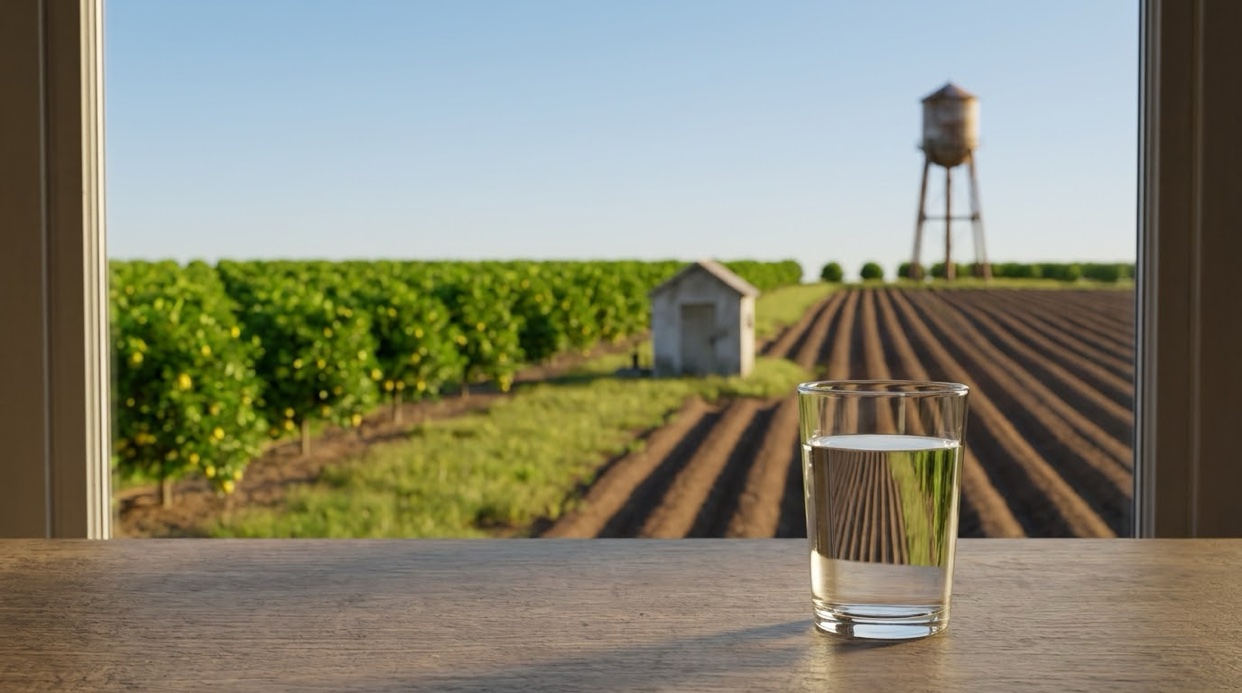
The path from farm field to drinking water well was driven by how aldicarb was used and how water moves through the earth. Farmers applied aldicarb granules into the soil season after season, particularly on major crops including citrus and potatoes.
When rain fell or irrigation water soaked into those treated fields, the water dissolved the granules and carried both the parent chemical and its two breakdown products downward past the root zone. Unlike heavy chemicals that lock permanently onto clay or organic matter at the surface, aldicarb, aldicarb sulfoxide, and aldicarb sulfone move easily with water. Over time, these residues percolated down through the soil layers and reached underground aquifers in farming regions. That downward movement is how an agricultural soil pesticide became a drinking-water concern — specifically for private wells and local groundwater supplies located near historically treated fields.
The Numbers: The Limits That Were Set, Then Stayed
If you try to look up the federal drinking-water limit for aldicarb today, you will run into one of the strangest administrative stories in Environmental Protection Agency (EPA) history. To understand it, you have to look at what happened in 1991 and 1992.
In 1991, the EPA officially set federal drinking-water standards for all three chemicals in this family. First, the agency established MCLGs (Maximum Contaminant Level Goals — the non-enforceable health benchmarks at which no known or expected adverse health effects occur) at 0.001 mg/L — which equals 1 part per billion — for each of the three chemicals.
Next, the agency set enforceable MCLs (Maximum Contaminant Levels — the legal limits that public water systems cannot exceed). Look closely at the exact numbers the EPA set in 1991:
- Aldicarb: 0.003 mg/L (3 parts per billion)
- Aldicarb sulfone: 0.002 mg/L (2 parts per billion)
- Aldicarb sulfoxide: 0.004 mg/L (4 parts per billion)
Pay close attention to the order of those numbers: the legal limit set for the breakdown product aldicarb sulfone (0.002 mg/L) is actually lower than the limit set for the parent chemical aldicarb (0.003 mg/L), while aldicarb sulfoxide was set slightly higher (0.004 mg/L).
However, those limits never took effect. In May 1992, before enforcement ever began, the EPA stayed — meaning officially paused or suspended — all three limits during legal challenges and litigation. In the agency’s own official words, these three chemicals “are considered regulated chemicals; however their MCLs are stayed and no monitoring is required.”
That administrative stay was never lifted. Because the limits remain suspended, you will not find aldicarb, aldicarb sulfoxide, or aldicarb sulfone listed in the EPA’s current table of enforceable drinking-water standards, and no public water system has ever been federally required to test for them.
In place of those stayed legal limits, the EPA issued a Health Advisory of 7 parts per billion for each aldicarb residue. A Health Advisory is non-enforceable technical guidance meant to help state and local officials evaluate water quality — not a binding legal cap. Put simply, the regulatory status of this trio comes down to a single phrase: regulated on paper, stayed in practice, guided by an advisory.
Health Effects
In summary terms, aldicarb and its two breakdown products affect the nervous system. Specifically, they work by inhibiting an enzyme called cholinesterase. Under normal conditions, nerve cells release chemical signals to communicate with one another or with muscles, and cholinesterase acts as the off-switch that clears those signals away once the message is delivered. When aldicarb residues temporarily block that enzyme, nerve signals keep firing longer than intended.
According to the EPA’s official summary, the health effects resulting from exposures above the agency’s benchmark are neurological, and they are rapidly and completely reversible once exposure stops and the body clears the compound. Regarding long-term cancer risk, the EPA states that the scientific evidence is inadequate to determine whether aldicarb or its breakdown products have the potential to cause cancer in humans.
How a Homeowner Finds Out
Because the federal drinking-water limits were stayed and no routine monitoring is required, you will never see aldicarb, aldicarb sulfoxide, or aldicarb sulfone listed on a public water utility’s annual Consumer Confidence Report (the yearly water-quality summary sent to customers).
For a homeowner — particularly someone relying on a private well located near farmland where citrus, potatoes, or other crops were historically treated with Temik — getting a real answer requires targeted testing. You cannot detect these chemicals with a standard hardware-store test strip or a basic water mineral panel. Instead, you need to submit a water sample to a state-certified laboratory that uses specialized analytical methods designed specifically for carbamate pesticides.
What Removes Them
If laboratory testing reveals legacy residues of aldicarb or its breakdown products in well water, proven treatment mechanisms can remove them.
The primary solution is granular activated carbon (GAC). In fact, the EPA’s own federal best-available-technology table (40 CFR 142.62) names granular activated carbon — and only granular activated carbon — as the designated treatment technology for all three compounds: aldicarb, aldicarb sulfoxide, and aldicarb sulfone. Granular activated carbon works through adsorption, a physical process in which organic molecules cling tightly to the vast internal network of microscopic pores inside carbon granules as water flows through the filter bed.
Reverse osmosis (RO) also rejects these molecules. A reverse osmosis system uses household water pressure to push water through a semi-permeable membrane with openings so fine that organic pesticide molecules are physically blocked from passing through and are flushed away down the drain in the reject stream.
The Honest Bottom Line
To understand where aldicarb stands today, it helps to look at the final chapter of its commercial history. In August 2010, the EPA announced an agreement with the manufacturer, Bayer, to phase out and end aldicarb use in the United States for good. Uses on citrus and potatoes were eliminated first, manufacturing ended completely on December 31, 2014, and all remaining U.S. agricultural uses ended by August 31, 2018.
That timeline changes how a homeowner should think about risk. Nobody is applying new Temik granules to American fields anymore. Whatever aldicarb, aldicarb sulfoxide, or aldicarb sulfone might be detected in groundwater today is legacy residue left over from the decades when it was applied.
At the same time, because federal MCLs were stayed in 1992 and routine testing is not required, public reports will not tell you whether legacy residues linger near old agricultural land. If your well sits in a historical farming area and you want certainty, skip the guesswork: test through a certified lab for carbamate pesticides, and rely on proven granular activated carbon or reverse osmosis if treatment is needed.
Facts first, then filter. — Steve
Leave a Reply