
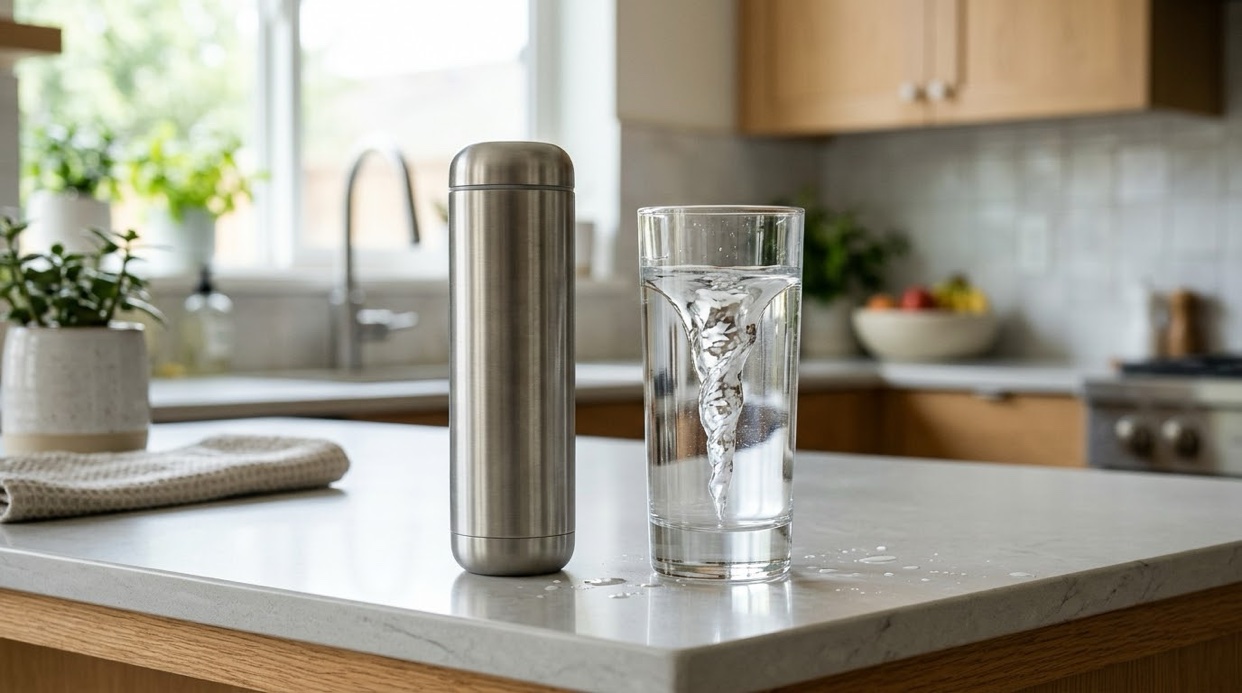
Every few months, a homeowner sends me a link to a sleek metal cylinder or a glass funnel and asks if it will fix their tap water. They have usually been reading about “structured water”—sometimes called hexagonal water, coherent water, or living water—and they want to know if it can replace their water softener, their carbon filter, or their reverse osmosis system.
After spending a lifetime in professional water treatment, designing, installing, and troubleshooting systems that actually make bad water safe and usable, I have learned to look past the brochures and look at the physics and the paperwork. When you do that with structured water, the story gets very simple, very fast.
The Pitch
If you spend ten minutes on a structured-water website, you will hear a compelling story. The pitch goes like this: water in nature—tumbling over rocks in a mountain stream—is full of life and energy. By the time municipal water or well water is pushed through miles of straight pipes, pressurized, and chemically treated, it supposedly becomes “chaotic,” “stressed,” or “dead.”
Sellers claim that passing your tap water through a specialized vortex device mimics that mountain stream. As the water spins and tumbles inside the unit, the molecules are supposedly rearranged into a neat, orderly, “hexagonal” cluster. According to the marketing, this restructured water is easier for your cells to absorb, tastes smoother and sweeter, makes houseplants and gardens thrive, and reduces hard-water scale buildup in your pipes and appliances. It sounds effortless, natural, and almost magical.
The Device Itself
When you strip away the marketing language and put the hardware on a workbench, a structured-water device is remarkably straightforward. It is a passive tube containing engineered internal flow forms—usually a series of geometric spheres, fins, or curved chambers designed to force the water to spin in opposing vortexes as water pressure pushes it through.
Water goes in one end, swirls around the internal shapes, and comes out the other end. Nothing is added to the water, and nothing is removed from it. There is no electricity, no filter media, no activated carbon, no ion-exchange resin, and no moving parts. Because nothing gets trapped inside, there are no cartridges to replace and no drain lines to hook up.
Manufacturers sell these flow-form tubes in three common configurations for the home:
- Portable units: These look like double-ended funnels or wands. You hold them over a pitcher or a glass and pour your tap water through them by hand, letting gravity pull the water through the internal swirling chambers.
- Under-sink units: These are compact cylinders, typically a few inches long, plumbed directly into the cold-water supply line beneath your kitchen sink before the water reaches your faucet.
- Whole-house units: These are larger, heavy-duty metal pipes—often stainless steel or copper—installed on the main water line where water enters your house, forcing every gallon used in your showers, washing machine, and sinks to pass through the vortex chamber.
The Seller’s Own Words
Over the years, regulatory agencies, advertising watchdogs, and basic chemistry have forced companies in this space to be much more careful about what they put in writing. You do not have to take my word for what these devices do and do not do. You can read the fine print straight from Natural Action, the best-known structured-water company on the market.
Their own Frequently Asked Questions page contains remarkable admissions. Let us look at their exact words and translate what each statement means for your home.
“It is not a contaminant-removal filter.”
That is as plain as day. If there is something in your water that should not be there—sediment, rust, bacteria, industrial runoff, or agricultural chemicals—this device will let it pass right through untouched. It is a flow-form pipe, not a barrier.
“Natural Action structuring devices do not remove these substances.”
This statement specifically addresses chlorine, fluoride, lead, and PFAS. Those are the exact contaminants most homeowners are trying to get out of their drinking water. If your city water smells like a swimming pool because of chlorine, it will still have that chlorine in it after passing through the vortex. If your older home has lead pipes, or if your local water supply has PFAS, the lead and PFAS are still in your glass.
“Natural Action does not claim that its systems permanently rearrange water molecules into a fixed hexagonal structure.”
For years, the entire premise of this industry rested on the idea that these devices lock water into a stable hexagonal shape. In reality, liquid water molecules form and break hydrogen bonds trillions of times per second. You cannot freeze liquid water into a permanent geometric shape at room temperature by spinning it in a tube, and the company’s own FAQ now explicitly steps back from claiming that it does.
“There is currently insufficient high-quality human clinical evidence to establish that Natural Action structured water improves cellular hydration compared with ordinary safe drinking water.”
“Cellular hydration” is one of the biggest buzzwords in water marketing. In plain English, this sentence means there is no solid clinical proof that structured water hydrates your body any better than plain, clean tap water. Your body absorbs water through normal biological processes, and swirling the water beforehand has not been proven to change how your cells take it in.
“Natural Action structured-water devices are not conventional ion-exchange softeners. They do not remove calcium or magnesium from the water.”
Hard water is caused by dissolved calcium and magnesium minerals. A true water softener uses ion-exchange resin to physically remove those minerals from your water so they cannot form crusty white scale on your faucets, ruin your water heater, or leave soap scum on your shower doors. If a device does not remove calcium or magnesium, your water is still chemically hard.
“Filter First. Structure Last.”
This is the company’s own slogan, and it tells you everything you need to know. Even the industry leader is telling you that structuring cannot do the job of filtration. You have to clean your water first using proven treatment technology before you even think about running it through one of their devices.
When the biggest name in the structured-water industry puts all of these disclaimers on its own website, it means the debate is effectively over. The company itself is telling you that its hardware does not purify water, does not soften water, does not permanently alter water’s molecular structure, and is not clinically proven to hydrate you better.
The Seal Test
If you ever want to know whether a water treatment gadget actually works, do not read the testimonials on the sales page. Look for an independent, third-party certification seal—specifically from NSF International or the Water Quality Association (WQA)—and look up the exact standard number it is certified under.
In the water treatment industry, certifications are everything. For example, NSF/ANSI Standard 42 covers aesthetic effects like reducing chlorine taste and odor. NSF/ANSI Standard 53 covers health-related contaminants like lead, cysts, and volatile organic compounds. NSF/ANSI Standard 58 covers reverse osmosis systems for reducing things like fluoride, arsenic, and total dissolved solids. NSF/ANSI Standard 44 verifies that a water softener actually removes hardness minerals. When a product carries one of those seals, it means an independent lab tested the hardware, verified the materials are safe, and proved the device actually does what it claims to do.
When you apply the seal test to structured-water devices, you hit a wall. A device might carry a basic material-safety certification (like NSF/ANSI 61 or 372, which simply confirms the metal or plastic housing will not leach lead or toxins into your water), but there is no certified performance claim. Nothing is certified because nothing is removed, and there is no scientific or industry standard anywhere that tests for “structure.” In water treatment, the absence of a performance seal is itself the finding.
The Real Risk
Whenever I talk about structured water, people assume my biggest objection is the price tag. Whole-house vortex units and countertop systems are not cheap, and spending hundreds or thousands of dollars on a fancy pipe is certainly frustrating.
But the purchase price is not the real risk. The real risk is false confidence.
Water quality problems are often invisible, tasteless, and odorless. You cannot taste lead. You cannot smell PFAS. You cannot see low-level bacterial contamination in a clear glass of water. When a homeowner buys a structured-water device believing it “revitalizes” or “purifies” their supply, they often check “water treatment” off their to-do list. They skip testing their well. They skip installing an activated carbon block or a reverse osmosis membrane. They serve unfiltered water to their family thinking they have protected them, when in reality, they have installed a passive tube that let every single contaminant straight through.
The Fair Shake
I want to be completely fair here. Taste and mouthfeel are personal. Water is remarkably complex to our senses, and factors like temperature, aeration, and turbulence can subtly change how water feels on your tongue right after it comes out of a spout.
If you have already tested your water, installed proper filtration to remove whatever contaminants are in your supply, and you still want to pour your clean water through a vortex funnel or attach a flow-form tube because you enjoy the taste or how it feels to drink—that is your money and your choice. I have no quarrel with anyone who likes how their water tastes. My objection has never been to the people buying these devices; my objection is to claims that mislead homeowners into thinking a passive swirl can replace real water treatment.
The Bottom Line
Structured-water devices are passive plumbing fittings that spin water without removing contaminants, softening hard minerals, or permanently changing water’s molecular structure—and the industry’s own fine print admits as much. If you want safe, clean, great-tasting water at home, start with a certified water test and proven filtration built for your specific water chemistry, and never rely on a vortex to do a filter’s job.
Facts first, then filter. — Steve
Leave a Reply