
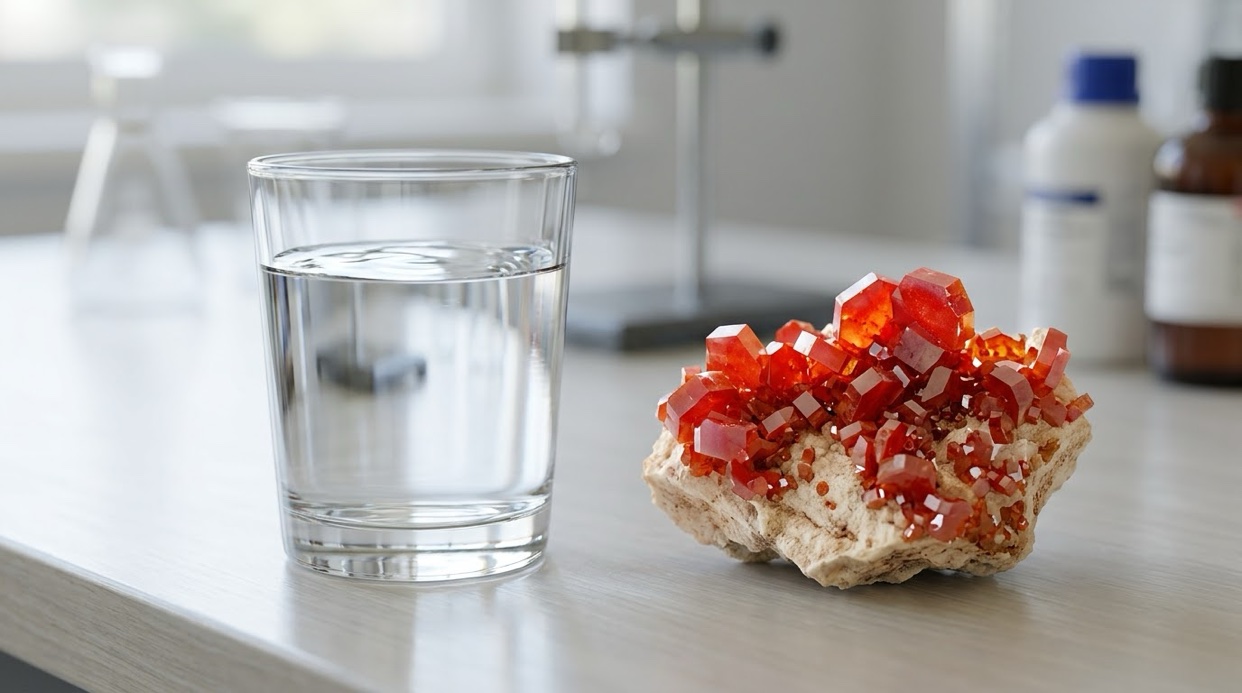
If you take a look at the periodic table, you will spot vanadium sitting at element number 23. It is a trace metal that lives quietly in the Earth’s crust — in rock and soil — and most homeowners have never heard of it until the day it turns up on a water test report.
I’m Steve, and I spend my days helping homeowners make sense of what comes out of their taps. Vanadium is a good example of why I tell people not to panic at an unfamiliar name: this is an element the regulators are still studying, not one with an alarm attached to it. Here is a clear, honest breakdown of what vanadium is, how it gets into drinking water, what the federal picture actually looks like, and what you can do about it if it shows up in your home.
1. What Vanadium Is and Where It Comes From
Vanadium is a naturally occurring trace metal found in the Earth’s crust, in rock formations, and in soil. “Trace” is the right word for it — it is spread through geology in small amounts rather than concentrated in many places.
Industry knows vanadium well, even if homeowners do not:
- Steel and Alloys: Vanadium is used in steel and alloys, where it helps make metal tougher.
- Fuel and Refining: Vanadium also turns up around fossil-fuel burning and refining.
So vanadium has two homes: the natural one in rock and soil, and the industrial one around steel, fuel, and refining.
2. How It Gets Into Drinking Water
Vanadium reaches drinking water by the slow, ordinary route — and by the industrial one:
- Natural Leaching (The Main Route): Groundwater moving slowly through the right rock picks vanadium up — the same way it picks up iron or manganese. Water that sits in contact with rock for a long time dissolves traces of what the rock is made of, and wells drawing on that geology can carry it to the tap.
- Industry’s Share: Steel and alloy production, and activity around fossil-fuel burning and refining, can add vanadium to the water picture in industrial areas.
3. What It Can Do to a Person’s Health: Keep the Scale in Mind
Here is where I ask you to keep the scale in mind, because that is the honest frame for vanadium: this is a watch-list element, not an alarm.
The U.S. Environmental Protection Agency studies vanadium because it shows up in water surveys — when researchers sample drinking water, vanadium is one of the elements that turns up. Being studied is not the same as being declared dangerous. It means the agency is gathering the information it would need before deciding whether a federal standard is warranted.
What that means for your kitchen tap is simple: there is no federal verdict on vanadium in drinking water yet, and I am not going to invent one for you. If a test shows vanadium in your water, you are looking at an element under study — worth knowing about, worth watching, and, if you prefer, worth removing. It is not a reason to stop drinking your water tonight.
4. The Federal Picture: A Limit That Does Not Exist Yet
Vanadium currently has NO federal drinking-water limit in the United States — no EPA Maximum Contaminant Level (MCL).
Here is the regulatory background you should know:
- The Study List: Vanadium is on the EPA’s list of contaminants being studied for possible regulation. The agency keeps an eye on elements like this while it decides whether a standard is needed.
- No Standard Yet: Because no federal standard exists, there is no official number to compare a home test result against.
So if vanadium appears on your lab report, the honest comparison is not “over the limit” or “under the limit” — there is no limit. The real question is whether you are comfortable with an unregulated trace element in your water, knowing the regulators have it under study.
5. How a Homeowner Can Test Their Water
You cannot see, taste, or smell vanadium at the levels involved here. The only way to know whether it is in your water — and how much — is laboratory analysis.
- Skip DIY Home Test Strips: Over-the-counter dip strips are fine for basic pH or free chlorine, but they cannot measure trace metals like vanadium down at these levels.
- Use a Certified Laboratory: Send a sample to a state-certified drinking water laboratory, and ask for vanadium specifically — it is not part of every standard panel. Labs measure trace metals with precise instruments such as ICP-MS.
6. How to Remove Vanadium from Drinking Water
If a certified lab test shows vanadium and you would rather not have it there — some homeowners simply prefer that, and that is a perfectly good reason — standard treatment handles it.
Effective Removal Technologies
- Reverse Osmosis (RO): An under-sink point-of-use Reverse Osmosis system is the most dependable home method. RO pushes water through a semi-permeable membrane that rejects dissolved metals, including vanadium, while letting purified water pass through.
- Ion Exchange: Vanadium in water can also be reduced by ion exchange treatment — the same family of technology used in water softeners — which swaps dissolved ions out of the water.
The Honest Truth About Carbon Filters
Standard activated carbon filters are excellent for chlorine, taste, and odor, but they do not reliably remove dissolved metals like vanadium on their own.
Pre-Filtration and Micron Ratings
While sediment pre-filters cannot catch dissolved vanadium, they protect your RO membrane or ion exchange equipment from silt, rust, and sand.
When selecting pre-filters, pay attention to micron ratings:
- Micron Rating: A micron measures pore size. A 5-micron or 1-micron sediment pre-filter is standard practice ahead of an under-sink RO membrane.
- Nominal vs. Absolute Rating:
- Nominal Rating: Traps approximately 60% to 85% of particles at that micron size under standard flow.
- Absolute Rating: Traps 99.9% or more of particles at the specified micron size under strict lab test conditions.
Using an absolute-rated pre-filter gives your treatment equipment consistent physical protection over time.
The Bottom Line
Vanadium in drinking water is an earth-bound trace element that arrives mostly through rock and groundwater, with industry adding its share. It has no federal limit, and it sits on the EPA’s study list for possible regulation — a watch-list element, not an alarm. If a test shows it and you want it out, reverse osmosis or ion exchange will handle it.
Leave a Reply