
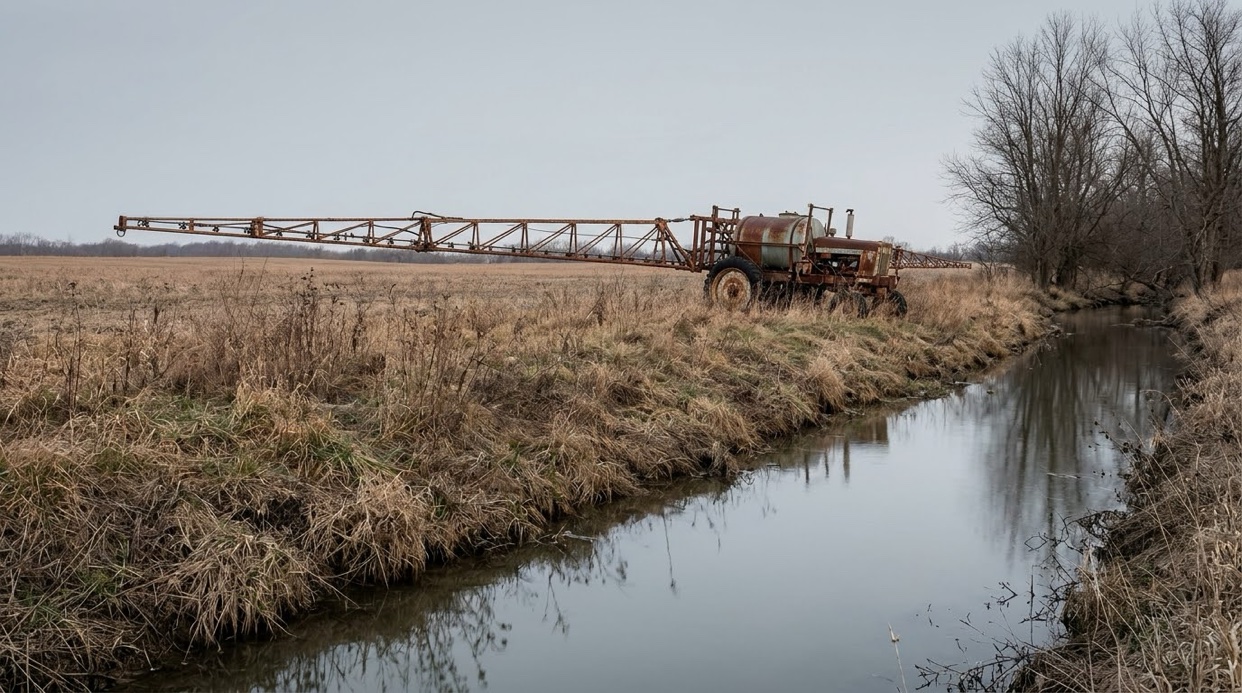
2,4,5-TP — commonly known as Silvex — is a synthetic phenoxy herbicide. For decades, it was widely manufactured and sprayed to control woody plants, brush, and broadleaf weeds. Agriculture and land managers applied it across rice crops, bluegrass turf, sugarcane fields, rangelands, and residential lawns.
Because of its chemical stability and historical heavy use, understanding what Silvex is and how it continues to move through soil and groundwater helps homeowners protect their drinking water supply.
Where It Comes From and Why It Is Still Found Today
The Environmental Protection Agency (EPA) lists the primary source of 2,4,5-TP in drinking water as residue of a banned herbicide. Its use has been banned since 1985 — EPA's own fact sheet says so in those words.
You might wonder how a chemical nobody has sprayed in decades still ends up in water today. The drinking-water regulation itself became effective in 1992 — seven years AFTER the ban. That gap tells you everything you need to know about this compound: this is a legacy-residue contaminant. The standard exists to police what is still washing out of soil and old application sites, not a product anyone can buy today.
When Silvex was sprayed over large agricultural areas or lawns, significant amounts settled into topsoil. Over long periods, rainwater and ground moisture slowly break down soil particles, dissolving residual herbicide molecules and leaching them downward. Once these residues reach underground aquifers, they break down extremely slowly due to the lack of sunlight and microbial activity. Private wells drawing from shallow aquifers and municipal intakes downriver from historical agricultural areas can still detect these lingering traces as they wash through the watershed.
2,4,5-TP (Silvex) Drinking Water Standards (EPA Facts)
- EPA Health Goal (MCLG): 0.05 mg/L
- EPA Enforceable Limit (MCL): 0.05 mg/L (50 parts per billion)
- Comparison: The health goal and the limit are the same number.
- Stated Health Effect: Liver problems (at levels above the limit).
- Regulatory Status: Banned since 1985; drinking water standard effective in 1992.
Health Effects of 2,4,5-TP (Silvex)
Federal regulatory agencies monitor 2,4,5-TP in drinking water to protect long-term public health. The EPA sets enforceable limits for public water suppliers based on health risk evaluations.
- Liver Problems: The EPA's stated health effect of drinking water containing 2,4,5-TP at levels above the limit over long periods is liver problems.
- Goal vs. Limit: Unlike carcinogens — where the health goal is set at zero — the EPA set both the health goal (MCLG) and the enforceable limit (MCL) at 0.05 mg/L (50 parts per billion). The health goal and the limit are the same number, meaning public systems are required to maintain water quality at or below the health benchmark.
If a public water supply exceeds this limit, the utility must take corrective action to reduce concentrations and notify customers in accordance with federal regulations.
How to Remove 2,4,5-TP (Silvex) from Water
If a certified water test reveals 2,4,5-TP in your well or tap water, standard sediment filters will not help. Ordinary sediment filtration only removes physical particulates such as sand, silt, rust, and pipe debris. Dissolved herbicides pass straight through particle filters because the chemical molecules are dissolved entirely into the liquid water.
Granular activated carbon (GAC) is the standard treatment method for this kind of herbicide.
How Granular Activated Carbon (GAC) Works
Granular activated carbon works through a process called adsorption. Carbon material — often derived from coconut shells, wood, or coal — is processed at extreme temperatures to create millions of microscopic pores, giving it a massive internal surface area.
When water flows through a bed of granular activated carbon:
- The water carries dissolved herbicide molecules into contact with the carbon particles.
- Natural chemical forces attract organic compounds like 2,4,5-TP to the internal carbon walls.
- The chemical molecules stick tightly to the carbon surface, trapping the herbicide inside the filter media while allowing clean water to pass through.
GAC treatment can be applied as a whole-house point-of-entry (POE) filter to clean all incoming water, or as an under-sink point-of-use (POU) system focused specifically on drinking and cooking water.
To keep your water safe, always start by testing your water through an accredited laboratory to confirm the exact levels of any chemical contaminants before choosing a filtration system.
Facts first, then filter. — Steve
Leave a Reply