
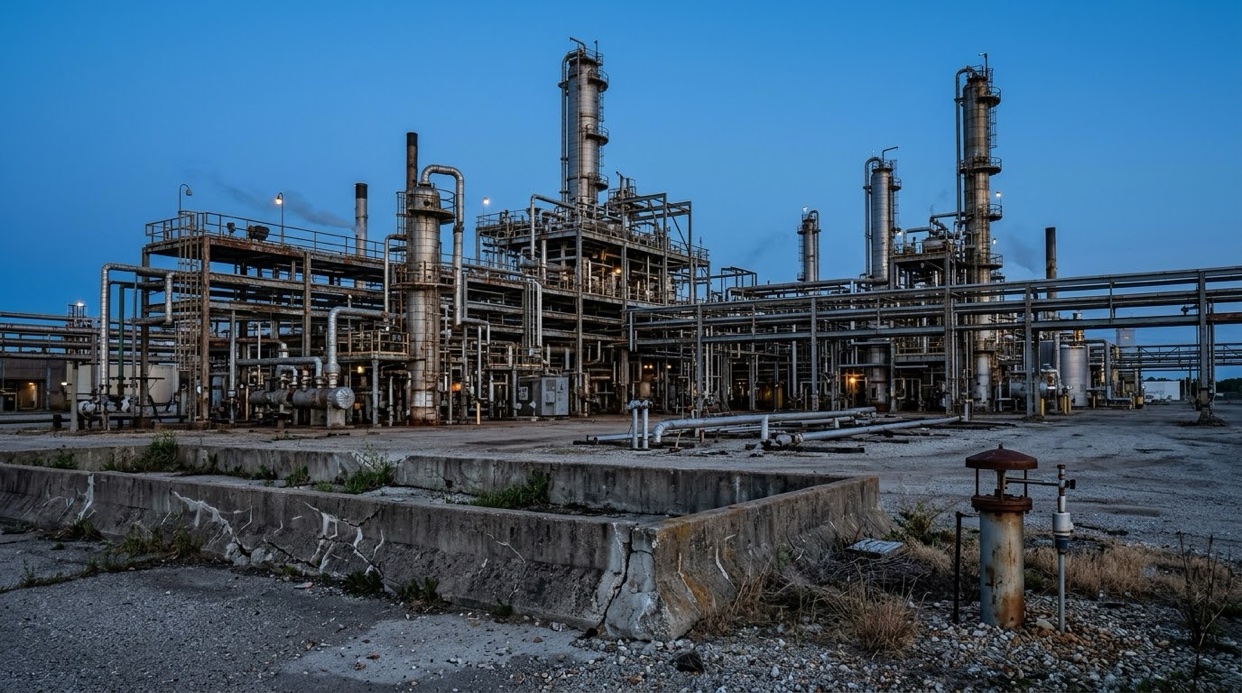
1,1,2-Trichloroethane is the lesser-known sibling of 1,1,1-trichloroethane, but after working in water treatment since 1994, I’ve learned that lesser-known doesn’t mean less important. While 1,1,1-trichloroethane got most of the public attention as a widespread industrial degreaser, 1,1,2-trichloroethane was working behind the scenes in chemical plants. If you’ve been reviewing a municipal water quality report or analyzing private well testing data for volatile organic compounds (VOCs), this is a solvent you need to understand.
How It Gets Into Your Water
Unlike its sibling, 1,1,2-trichloroethane was never a household name or a shelf product you’d buy at a hardware store. Instead, industry used it primarily as a chemical intermediate — a key building block in manufacturing vinylidene chloride and other chlorinated products — as well as an industrial solvent for dissolving fats, oils, waxes, and resins. The EPA’s listed source for it in drinking water is discharge from industrial chemical factories.
Even though it wasn’t used in everyday consumer items, it was produced, handled, and stored at the exact same types of industrial facilities, chemical factories, and hazardous waste disposal sites. Decades of accidental surface spills, underground tank leaks, and unlined landfill disposal allowed the chemical to seep into the ground. Once it hits the earth, 1,1,2-trichloroethane passes through soil layers and migrates straight into groundwater. Because it resists natural degradation, it persists in underground aquifers for years, creating long-lasting contamination plumes that travel toward municipal supply wells and private residential wells.
What It Can Do to Health
The health effects the EPA lists for long-term exposure above the limit are liver, kidney, or immune system problems. The federal focus is what chronic exposure does over years — drinking water above the safety limit for an extended period, not a one-time sip. The EPA also classifies 1,1,2-trichloroethane as a possible human carcinogen (Group C in its IRIS assessment), based on liver tumors in animal studies.
Public systems test for VOCs routinely. If you are on a private well near an old chemical plant or waste site, testing is up to you — a certified laboratory can run a VOC panel on a sample of your water.
The EPA Drinking-Water Limit
Federal standards for 1,1,2-trichloroethane are enforced under the Safe Drinking Water Act. The EPA has established the following limits for public water supplies:
- Maximum Contaminant Level Goal (MCLG): 0.003 mg/L (or 3 ppb). This is the non-enforceable health benchmark set at a level where no known or expected adverse health risks occur.
- Maximum Contaminant Level (MCL): 0.005 mg/L (or 5 ppb). This is the legally enforceable federal standard that public water utilities are required by law to meet and maintain.
One state note, because it matters locally: New Jersey goes further. Its state MCL for 1,1,2-trichloroethane is 3 ppb — stricter than the federal 5 ppb, which remains the baseline everywhere else.
Which Home Filtration Actually Removes It
If lab testing shows 1,1,2-trichloroethane in your water, standard pitcher filters, sediment screens, and typical ion-exchange water softeners won’t do a thing to pull it out. You need media specifically engineered for volatile organic chemicals:
- Granular Activated Carbon (GAC) & Solid Carbon Block: Carbon filtration is your primary frontline defense. Organic chemical molecules like 1,1,2-trichloroethane are physically adsorbed onto the massive porous surface area of activated carbon as water flows through the filter bed.
- Reverse Osmosis (RO): A point-of-use reverse osmosis system acts as a reliable backstop. RO units incorporate high-density carbon pre- and post-filters alongside a semi-permeable membrane, giving you multiple barriers of protection against VOC pass-through.
Understanding Certification Standards
Don’t buy a water filter based on flashy boxes, vague marketing claims, or general statements like “reduces chemicals.” You need third-party proof — and you need to know what each seal actually covers:
- NSF/ANSI Standard 53: This is the health-effects standard for drinking water treatment units. In plain English: a unit certified to Standard 53 has been independently tested for the specific health-related contaminant reduction claims named in its certification. The standard’s name by itself guarantees nothing; the claim list is what counts.
- NSF/ANSI Standard 58: This is the performance standard for reverse osmosis systems. In plain English: it certifies that an RO system reduces total dissolved solids and the specific contaminants named in its certification — only those named, not everything in the water.
A seal proves the unit was tested under the standard’s protocol; it does not mean it removes every contaminant. You must look at the manufacturer’s official Performance Data Sheet or the independent certification directory (from NSF, WQA, or IAPMO) and verify that 1,1,2-trichloroethane is explicitly listed by name with a certified reduction claim. If it isn’t listed on the sheet, don’t rely on it.
Facts first, then filter. — Steve
Leave a Reply