
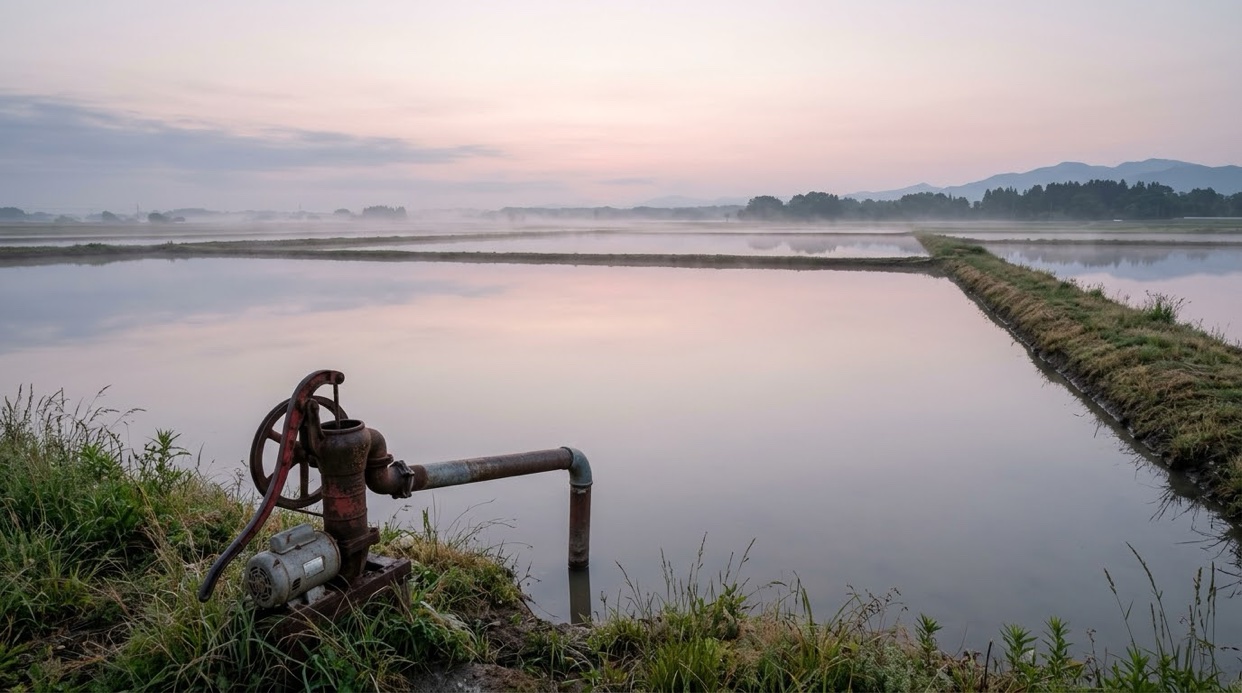
Carbofuran is a broad-spectrum carbamate pesticide that was manufactured and widely used for decades under various commercial trade names, most notably Furadan. Agricultural operators used it to target root-damaging pests, soil insects, and nematodes across a range of crops, particularly on fields planted with rice and alfalfa. Because carbofuran is water-soluble and highly toxic to birds, mammals, and aquatic life, its movement into local water sources has long been a key focus of environmental safety standards.
Understanding what carbofuran is, how it acts in soil, and how it migrates into groundwater is essential for protecting private well systems and rural tap water.
Where It Comes From and How It Moves into Water
The Environmental Protection Agency (EPA) lists the primary source of carbofuran in drinking water as leaching of soil fumigant used on rice and alfalfa.
When carbofuran was applied directly to agricultural soils, rain and irrigation water dissolved the active chemical compounds. In sandy or low-organic soils, carbofuran resists binding to dirt particles. As water percolates downward through soil layers, it carries the dissolved pesticide along with it, eventually reaching underground aquifers.
Once in groundwater — where cold temperatures and lack of sunlight slow down natural chemical degradation — carbofuran residues can persist for extended periods, ultimately drawn into domestic drinking water wells or surface water intakes located down-gradient from treated farmland.
The Regulatory Twist: A Legal Limit on a Discontinued Pesticide
There is a distinct twist in carbofuran's regulatory story that every homeowner should understand.
The drinking-water limit for carbofuran remains fully on the books and enforceable today. However, the pesticide itself was taken off the market years ago.
EPA concluded the risks from carbofuran were unacceptable and revoked all of its food tolerances, with the final rule taking effect December 31, 2009. Nobody can legally use it in the United States anymore, so like the other legacy chemicals it is now about residues washing out of soil, not new spraying. Public water suppliers must still test for it and comply with federal limits, but any detection in water today represents historical environmental persistence rather than active agricultural application.
Carbofuran Drinking Water Standards (EPA Facts)
- EPA Health Goal (MCLG): 0.04 mg/L
- EPA Enforceable Limit (MCL): 0.04 mg/L (40 parts per billion)
- Comparison: The health goal and the limit are the same number.
- Stated Long-Term Health Effect: Problems with blood, nervous system, or reproductive system.
- Primary Contaminant Source: Leaching of soil fumigant used on rice and alfalfa.
- Pesticide Regulatory Status: Food tolerances revoked by EPA (final rule effective Dec 31, 2009); illegal for U.S. agricultural use.
Health Effects of Carbofuran
To shield consumers from chronic exposure risks, federal drinking water rules mandate strict safety limits for public water supplies.
The EPA establishes maximum contaminant standards based on toxicology data and health assessments:
- Target System Impacts: EPA's stated health effect of drinking water containing carbofuran at levels above the limit over long periods includes problems with blood, nervous system, or reproductive system.
- Goal vs. Limit: The EPA set both the non-enforceable health goal (MCLG) and the enforceable limit (MCL) at 0.04 mg/L, which is 40 parts per billion. The health goal and the limit are the same number. Unlike known carcinogens — where the health goal is set at zero — the health goal for carbofuran is explicitly 0.04 mg/L.
If testing indicates that a public water utility exceeds the 40 parts per billion limit, the utility must notify the community and take immediate engineering steps to lower concentrations below the legal ceiling.
How to Remove Carbofuran from Drinking Water
If a certified water test reveals carbofuran in your well or tap water, standard sediment filtration will not clean it up. Ordinary particle filters — such as string-wound, pleated, or spun polypropylene cartridges — only strain out physical solids like sand, silt, rust, and pipe scale. Because carbofuran dissolves entirely into water at a molecular level, it passes straight through physical filter pores.
Granular activated carbon (GAC) is the standard treatment method for this kind of pesticide.
How Granular Activated Carbon Works
Granular activated carbon filters remove dissolved synthetic organic chemicals through a process called adsorption.
- Microscopic Structure: Carbon media — typically manufactured from coconut shells or high-grade coal — is treated at high temperatures to create millions of tiny pores and internal channels, providing massive internal surface area.
- Molecular Attraction: As water flows through the carbon bed, organic chemical molecules like carbofuran are attracted to the carbon's surface.
- Trapping the Contaminant: The pesticide molecules bind tightly to the carbon walls inside the microscopic pores, locking the chemical inside the media while clean water passes through to your home fixtures.
Granular activated carbon can be installed as a whole-house point-of-entry (POE) system to treat all water coming into the home, or as an under-sink point-of-use (POU) system focused specifically on cooking and drinking water.
Always confirm the presence and concentration of contaminants through a certified water testing laboratory before selecting and installing home water treatment equipment.
Facts first, then filter. — Steve
Leave a Reply