
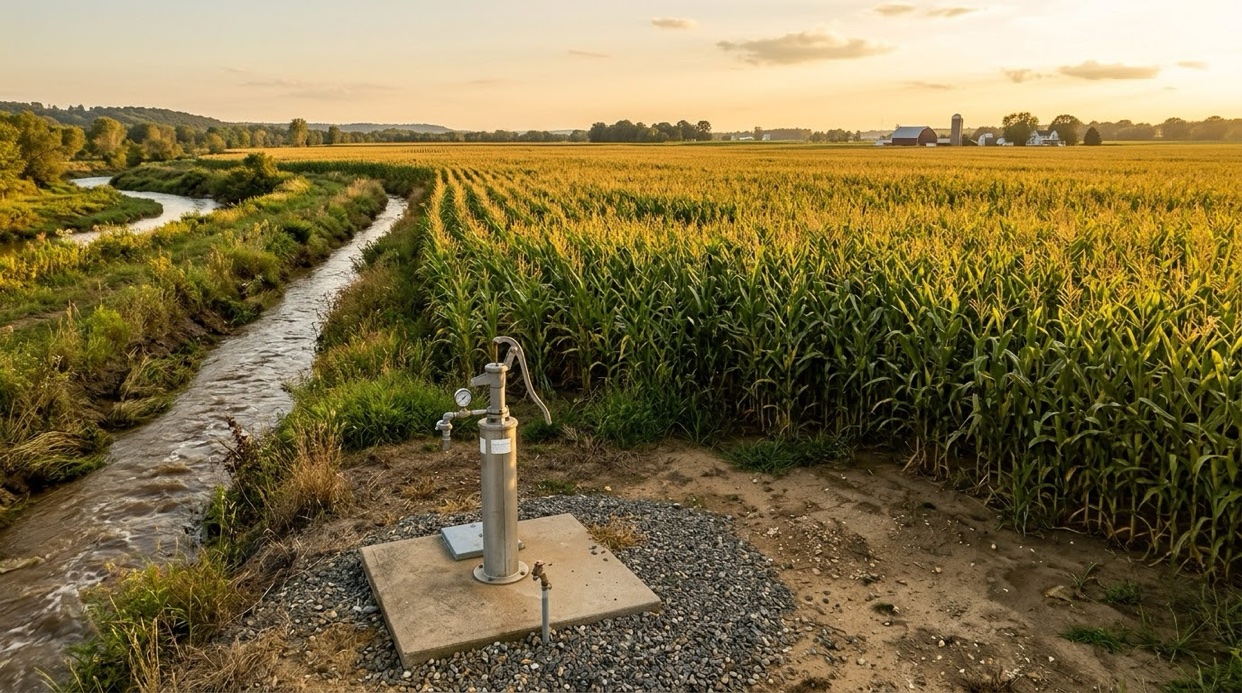
Alachlor is a synthetic agricultural herbicide widely sold under the trade name Lasso. Farmers spray it on row crops — primarily corn, sorghum, and soybeans — to prevent grass and broadleaf weeds from competing with growing plants. An EPA fact sheet once called it the second most widely used herbicide in the United States, reflecting its heavy application across millions of acres of farmland.
Understanding how alachlor behaves once applied to fields — and how it migrates off crop rows — is vital for rural residents who rely on private wells or local surface waters for drinking water.
Where It Comes From and How It Enters Water
The Environmental Protection Agency (EPA) lists the primary source of alachlor in drinking water as runoff from herbicide used on row crops.
When agricultural operators apply alachlor to fields in late spring or early summer, the chemical sits on topsoil and target foliage. Farm-country runoff occurs when heavy rainstorms hit recently treated fields. The rainwater carries surface soil and dissolved herbicide directly into nearby streams, rivers, and reservoirs used for public drinking water intakes.
In addition to surface runoff, alachlor also moves straight down through the dirt. Rainwater and irrigation water dissolve the compound, causing it to leach through coarse or sandy soils into underground water tables. Over time, this leaching contaminates rural groundwater reserves. EPA's groundwater records found detections above the limit in at least 15 states, proving that local soil profiles across farm country allow the chemical to reach drinking water wells.
Crucially, alachlor is NOT banned. While its use has shifted over time, it remains an active agricultural chemical in current production and use, not an obsolete chemical from the past.
Alachlor Drinking Water Standards (EPA Facts)
- EPA Health Goal (MCLG): Zero — because of cancer risk, EPA's goal for this chemical is no amount at all.
- EPA Enforceable Limit (MCL): 0.002 mg/L (2 parts per billion)
- Stated Health Effects (Above Limit): Eye, liver, kidney or spleen problems; anemia; increased risk of cancer.
- Long-Term Effects: Damage to the lining of the nose and eyelids.
- Groundwater Records: EPA found detections above the limit in at least 15 states.
- Regulatory Status: Alachlor is NOT banned.
Health Effects of Alachlor
Because of its chemical toxicity, federal drinking water rules set very low regulatory limits for alachlor to shield homeowners from chronic health risks.
The EPA enforces health benchmarks based on animal studies and human exposure data:
- Cancer Risks: Because of cancer risk, EPA's goal for this chemical is no amount at all (MCLG of zero). The EPA classifies alachlor as a carcinogen, meaning long-term exposure carries an increased risk of cancer.
- Organ Systems and Blood: EPA's stated health effects at levels above the limit include eye, liver, kidney or spleen problems, as well as anemia.
- Tissue Damage: Long-term effects also include damage to the lining of the nose and eyelids.
Public water utilities must test for alachlor regularly. If testing shows levels above the 2 parts per billion limit, the water company is required to notify consumers and apply advanced treatment to clear the supply.
How to Remove Alachlor from Drinking Water
If lab testing reveals alachlor in your well or drinking water, simple sediment filters will not solve the problem. Ordinary sediment filtration only strains out suspended physical debris — like rust, sand, silt, and pipe scale. Dissolved herbicides like alachlor are completely mixed into the water at a molecular level and pass right through mechanical screen filters.
Granular activated carbon (GAC) is the standard treatment method for removing dissolved herbicides.
How Granular Activated Carbon (GAC) Works
Granular activated carbon treats organic agricultural chemicals using a process called adsorption.
Carbon media — derived from raw materials like coconut shells or high-grade coal — is baked at extremely high temperatures to create millions of microscopic cracks, pores, and internal chambers. This process gives a small handful of carbon the surface area of an entire football field.
When water flows through a tank or cartridge filled with granular activated carbon:
- The water pushes dissolved herbicide molecules into direct contact with the carbon grains.
- Natural molecular attraction causes organic compounds like alachlor to stick firmly to the inner surfaces of the carbon pores.
- The herbicide molecules stay trapped inside the filter media while purified water flows out to your taps.
GAC systems can be installed as point-of-entry (POE) whole-house systems to treat all incoming well water, or as point-of-use (POU) systems under the kitchen sink to purify drinking and cooking water.
Before purchasing filtration equipment, always have your water tested by an accredited laboratory to confirm exact contaminant levels.
Facts first, then filter. — Steve
Leave a Reply