
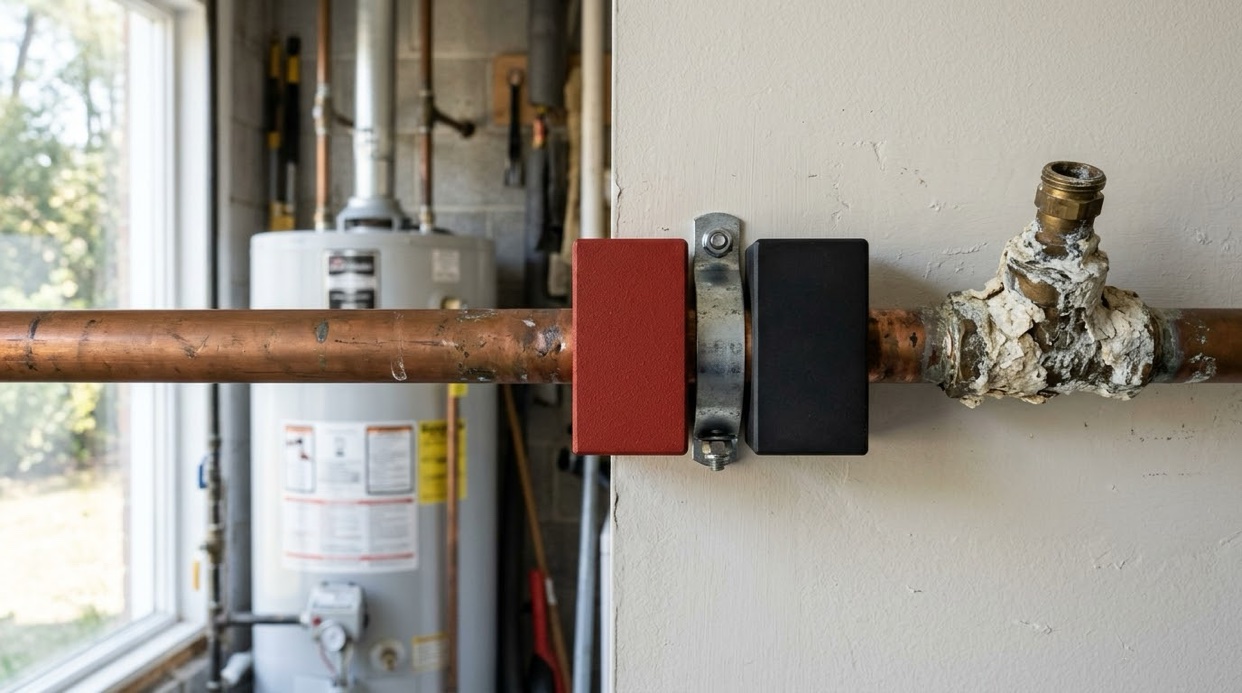
Every time a homeowner gets tired of hauling forty-pound bags of salt down the basement stairs, they start looking for an alternative. Sooner or later, an ad pops up promising to solve their hard-water problem with a pair of magnets.
After spending a lifetime in the water treatment trade—testing residential supplies, rebuilding fouled valves, and replacing scaled-up water heaters—I get asked about magnetic water softeners almost every week. Homeowners want to know if they can skip the salt tank, skip the drain line, and still protect their plumbing. To answer that honestly, we have to look past the sales brochure and examine what is actually happening inside your pipes.
The Pitch
The pitch for magnetic water softeners—often marketed as magnetic descalers or salt-free water conditioners—is designed to hit every frustration a homeowner has with traditional water softening.
Sellers claim that if you strap powerful magnets onto your main incoming water pipe, the magnetic field will alter the behavior of the hardness minerals flowing through it. Instead of clumping together and baking onto the inside of your pipes, water heater elements, and showerheads as crusty white scale, those minerals supposedly stay suspended in the water and wash harmlessly down the drain. According to the marketing, you get all the benefits of soft water with zero salt, zero chemicals, zero maintenance, zero wastewater, and nothing to ever refill or replace. It is pitched as a permanent, install-it-and-forget-it fix.
The Devices
When you take one of these systems out of the box, there is not much to look at. Depending on the style, the hardware generally falls into one of three categories:
- Clamp-on permanent magnets: These are pairs of heavy-duty magnets housed in plastic or metal blocks that you strap, bolt, or zip-tie directly onto the outside of your main cold-water line. You do not cut the pipe, and the hardware never actually touches your water.
- Inline magnetic housings: These are short metal or composite pipe sections containing internal magnets that you plumb directly into your water line so the water flows past the magnetic elements.
- Electronic descalers: These are the close cousins to permanent magnets. Instead of static blocks, you wrap an insulated wire coil around the outside of your pipe and plug it into a small wall-mounted control box, which pulses an electrical current through the wire to create a changing electromagnetic field.
Regardless of which version you buy, the operational reality is the same: nothing is added to your water, and nothing is removed from it. There is no filtration media, no resin bed, no cartridge to swap out, and nothing to test or service.
The Physics, in Plain English
To understand why these devices fall short, you first have to understand what “hard water” actually is. Water hardness is not floating grit or sand. It is dissolved calcium and magnesium minerals—specifically, positively charged calcium and magnesium ions—completely dissolved in the water, much like sugar dissolved in hot tea.
In water treatment, true softening means those dissolved hardness minerals are physically removed from your water. A traditional ion-exchange water softener uses a tank filled with negatively charged resin beads. As hard water flows through the tank, the resin grabs onto the calcium and magnesium ions and trades them for sodium or potassium ions. The hardness minerals stay trapped in the tank until the system regenerates and flushes them down the drain.
A magnet strapped to the outside of a pipe cannot pull dissolved calcium and magnesium ions out of the water rushing past it inside. Even if a magnetic field briefly nudges a charged particle as it moves through the pipe, that particle is not trapped, filtered, or removed. It keeps right on flowing into your water heater, your dishwasher, and your faucets.
You do not need a laboratory to verify this. Any homeowner can run a simple before-and-after check using a standard drop-count hardness test kit. Measure the hardness of your water in grains per gallon before the magnet, and then measure it at a faucet after the magnet. You will get the exact same number. By definition, your water is still hard, because everything that made it hard is still in it.
What Controlled Testing Found
When you point out that the hardness minerals are still in the water, magnetic softener sellers usually pivot. They will tell you that the magnet does not remove the calcium, it changes its crystal shape—turning stubborn, sticky calcite crystals into smoother, less adhesive aragonite crystals.
To back this up, sellers often point to laboratory demonstrations showing crystal changes under very specific, controlled bench conditions. The problem is that a real home plumbing system is not a laboratory bench. Water sits stagnant in pipes overnight, heats up to high temperatures inside water heaters, depressurizes at faucets, and evaporates on shower doors.
When independent researchers have put magnetic treatment devices to the test under realistic conditions—including controlled evaluations conducted for the U.S. Army Corps of Engineers—they have not found consistent, reliable reductions in scale formation. Furthermore, any temporary change in how crystals form while water is inside a magnetic field tends to fade quickly once the water leaves that field and sits in your plumbing. In a real house, the minerals still precipitate out of the water and still form scale.
The Seal Test
Whenever you are evaluating any water treatment product, there is one reliable way to separate proven engineering from wishful thinking: look for an independent, third-party performance certification from NSF International or the Water Quality Association (WQA), and check the exact standard number on the label.
Real water softeners are tested and certified to NSF/ANSI Standard 44. That standard specifically verifies cation-exchange efficiency and actual hardness-mineral reduction. When a softener carries an NSF/ANSI 44 seal, it means an independent laboratory ran hard water through the unit and verified that it actually removes calcium and magnesium.
No magnetic water softener or electronic pipe-wrap descaler carries an NSF/ANSI 44 certification, because none of them remove hardness minerals. Some inline housings might carry a basic material-safety certification—confirming the metal or plastic casing will not leach toxins into your drinking water—but there is no certified softening or scale-prevention performance claim behind them. In the water business, the absence of a performance seal is itself the finding.
The Real Risk
People often think the downside to buying a magnetic descaler is simply wasting money on hardware that does not work. That is frustrating enough, especially when some whole-house electronic models carry hefty price tags.
However, the bigger issue is false confidence. When a homeowner straps a magnet to a basement pipe and believes the house is protected from hard water, they stop looking for real solutions. Meanwhile, invisible calcium scale keeps building up inside their water heater—insulating the heating elements, forcing the unit to work harder, and shortening its lifespan. Tankless water heaters, which have narrow heat-exchanger passages, are especially vulnerable and can suffer permanent damage or voided warranties when fed untreated hard water. By the time you notice the crusty buildup on your fixtures or a drop in hot water pressure, the damage inside your appliances is already done.
The Fair Shake
I want to be fair to the homeowners who buy these devices, because the reasons they want them are completely legitimate. Traditional ion-exchange water softeners require ongoing maintenance, consume bags of salt, discharge salty regeneration water down the drain, and are even restricted or banned in a few municipalities concerned about brine discharge into local wastewater systems. Looking for a salt-free alternative makes total sense.
That is why it is important to separate the salt-free water treatment family honestly. There is a legitimate, proven technology on the market called Template-Assisted Crystallization (TAC). Unlike magnets, TAC systems use a specialized physical media bed inside a tank that water must actually flow through. That media creates microscopic nucleation sites that convert dissolved hardness minerals into stable, microscopic crystals that stay suspended in the water and do not stick to pipes. TAC systems do not soften water either—the minerals are still present—but they rely on a real physical mechanism and have passed independent third-party testing for scale reduction.
Magnetic softener sellers frequently borrow the scientific plausibility of legitimate salt-free conditioners like TAC to sell straps and wire coils. Do not confuse the two. A magnet on the outside of a pipe is not a TAC media bed.
The Bottom Line
Magnetic water softeners and electronic pipe-wrap descalers do not remove hardness minerals, do not carry certified softening performance ratings, and have not been shown in controlled real-world evaluations to reliably prevent scale in your home. If you have hard water and want to protect your plumbing and appliances, choose a proven, independently certified solution—whether that is a true NSF/ANSI 44 ion-exchange softener or a verified template-assisted crystallization conditioner—rather than trusting a magnet to do a job physics will not allow.
Facts first, then filter. — Steve
Leave a Reply