
If you and I were leaning on your kitchen counter looking at all the different water filters on the market, it would be easy to get lost in the terminology. You hear terms like reverse osmosis, ultrafiltration, nanofiltration, and microfiltration thrown around as if they are all interchangeable.
They aren’t.
When homeowners ask me about microfiltration (often shortened to MF), I tell them to think of it as the foundational building block of membrane water treatment — the workhorse designed to handle the physical debris and larger particles in your water.
Here is my honest, plain-English breakdown of what microfiltration is, what it catches, and what it leaves behind.
What Microfiltration Actually Is
In the family of membrane filtration, microfiltration is the coarsest member.
While reverse osmosis and nanofiltration operate down at the invisible, chemical, and mineral level, microfiltration is a purely physical screen. Its job is to capture the suspended particles — the stuff floating around in the water that makes it look cloudy or dirty — down to things you can barely see with the naked eye.
There are no chemical reactions, no electricity needed, and no fancy ion-swapping tricks involved. Water is simply pushed through a porous membrane or filter media, and anything larger than the microscopic pores gets trapped on the surface or inside the filter matrix.
The Pore Size: 0.1 to 10 Microns
To understand what a microfilter can and cannot do, we have to look at its pore size.
In the water industry, we measure filter pores in microns (short for micrometers). A micron is one-thousandth of a millimeter. To put that in human terms: a single strand of human hair is roughly 70 microns in diameter. Fine beach sand might be 90 microns, while a grain of flour is around 30 microns.
A microfiltration pore rating generally sits between 0.1 micron and 10 microns — and where a filter falls on that scale makes a huge difference in what it stops:
- Coarse microfiltration (5 to 10 microns): mainly a heavy sediment filter, protecting your plumbing and appliances.
- Fine microfiltration (0.1 to 0.2 micron): approaching the edge of ultrafiltration, capturing extremely fine silt and micro-organisms.
The Forms It Comes In
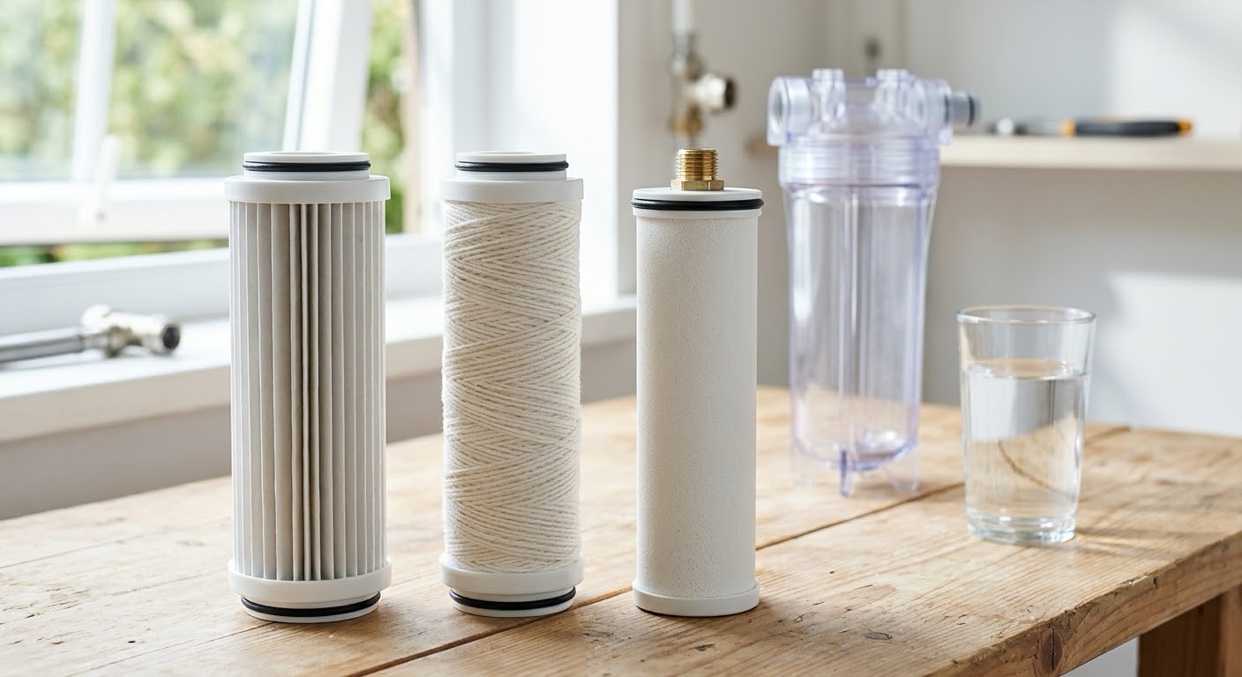
“Microfiltration” on a shelf can mean very different hardware, and the difference matters:
- Spun and string-wound sediment cartridges — the inexpensive work horses in most whole-house housings. They’re depth filters: the dirt gets caught inside the cartridge body, not just on a surface. Most carry a nominal rating.
- Pleated cartridges — a folded sheet of filter media with far more surface area, so they hold more dirt and flow better. Available in nominal and, at the fine end, absolute ratings.
- Ceramic candles — hard ceramic with microscopic pores, scrubbed clean and reused many times; a classic in gravity and countertop systems, often at 0.2–0.5 micron.
- True membrane modules — hollow-fiber or flat-sheet membranes with a controlled, absolute pore size, used where the rating has to be guaranteed.
Here’s the rating lesson that runs through this whole site: a nominal rating means the filter catches most particles at that size (often around 85%); an absolute rating means it stops essentially everything at that size. Same number on the box, very different promise.
What Microfiltration Removes Well
Because of its pore scale, microfiltration is fantastic at removing suspended solids and larger biological contaminants:
- Sediment, sand, and silt: on a well that gets cloudy after a heavy rain, or city water from old pipes shedding rust flakes, a microfilter clears that right up.
- Rust and pipe scale: particles of oxidized iron that cause orange tinting or gritty buildup are stopped cold.
- Algae and organic debris: suspended plant matter and organic cloudiness are trapped physically.
- Protozoan cysts: Giardia and Cryptosporidium are relatively large — roughly 4 to 15 microns across — and famously chlorine-resistant. But read the rating before you count on it: the proven cyst barrier is a 1-micron absolute filter, the kind certified for cyst reduction under NSF/ANSI 53 at 99.95%. A nominal 1- or 2-micron cartridge will catch plenty of cysts by size, but it doesn’t carry that guarantee — and cysts are exactly the wrong place to accept “most of them.”
The Honest Truth About Bacteria and Viruses
This is where I always like to be completely transparent with homeowners:
- Bacteria: most common waterborne bacteria range from about 0.2 to 2 microns. Run a tight microfilter rated at 0.1 to 0.2 micron and it will physically catch the vast majority of them. However, microfiltration as a category is generally not rated or certified as a complete biological safety barrier the way ultrafiltration is. Smaller bacteria can work their way through, especially as the filter wears, or if the rating creeps up toward 0.5 or 1 micron.
- Viruses: human enteric viruses are tiny — typically between 0.02 and 0.08 micron. They pass straight through a microfiltration membrane without even touching the sides.
If you have untreated, microbiologically unsafe water, never rely on microfiltration alone for safety.
What Microfiltration Does NOT Remove
The most important takeaway for any homeowner is this: microfiltration does not remove anything dissolved in the water.
If a contaminant has dissolved at a molecular level, it passes right through those pores alongside the water molecules. A microfilter will NOT touch:
- Total dissolved solids (TDS) and salts: sodium, chloride, and general mineral content remain unchanged.
- Hardness minerals: calcium and magnesium pass through completely — it will not stop limescale in your kettle or shower.
- Nitrates and fluoride: these microscopic dissolved ions slip right through.
- Dissolved heavy metals: soluble lead, arsenic, and copper cannot be physically strained out.
- Chemicals and taste: chlorine, pesticides, VOCs, and petroleum products pass straight through — unless the microfilter is built around an activated carbon core, which is the carbon doing that work, not the screen.
Where Microfiltration Fits in Your Home
Because microfiltration catches dirt and suspended particles so well, its primary job is protection and pretreatment:
- Whole-house sediment filters: placed right where water enters the house to protect your water heater, softener, and valves from grit.
- Pre-filters for advanced systems: placed upstream of reverse osmosis units and UV lamps. This one matters more than people realize — a UV lamp cannot disinfect cloudy water, because dirt particles create shadow zones where bacteria hide from the light. The microfilter’s clarity is what lets the UV do its job.
- Food and beverage production: breweries, bottlers, and food plants run MF at scale to polish water and protect equipment.
The Workhorse Nobody Brags About
Microfiltration is the cheapest filtration per gallon you’ll ever buy: big flow, tiny pressure drop, no wastewater, no electricity. That’s why it’s everywhere and why nobody makes commercials about it. But it has one non-negotiable: it clogs, and it needs replacing. A neglected, dirt-choked prefilter doesn’t just stop working — it strangles the pressure for every filter, membrane, and fixture behind it. Half the “my system stopped working” calls in this business turn out to be a $10 sediment cartridge somebody forgot for two years.
Microfiltration vs. Ultrafiltration in One Paragraph
Same idea, different hole size. Microfiltration is the screen with the bigger openings: it stops the grit, the rust, the algae, and the cysts. Ultrafiltration’s tighter screen — 0.01 to 0.1 micron — stops everything microfiltration stops, plus the bacteria and most of the viruses. If your problem is dirt, MF is the right-sized tool. If your problem is microbes, that’s UF’s department.
Bottom Line
Microfiltration is the ultimate physical strainer for your home’s water. It takes cloudy, gritty water and makes it visually crystal-clear while knocking out heavy sediment and — with a true 1-micron absolute filter — the protozoan cysts. Just remember its limits: it filters out the stuff floating in the water, not the chemicals and minerals dissolved in the water. Use it as a solid first line of defense, and pair it with carbon or reverse osmosis if you need to tackle taste, chemicals, or dissolved metals.
Technical claims checked against membrane industry references and the NSF/ANSI 53 cyst-reduction standard, October 2026.
Leave a Reply