
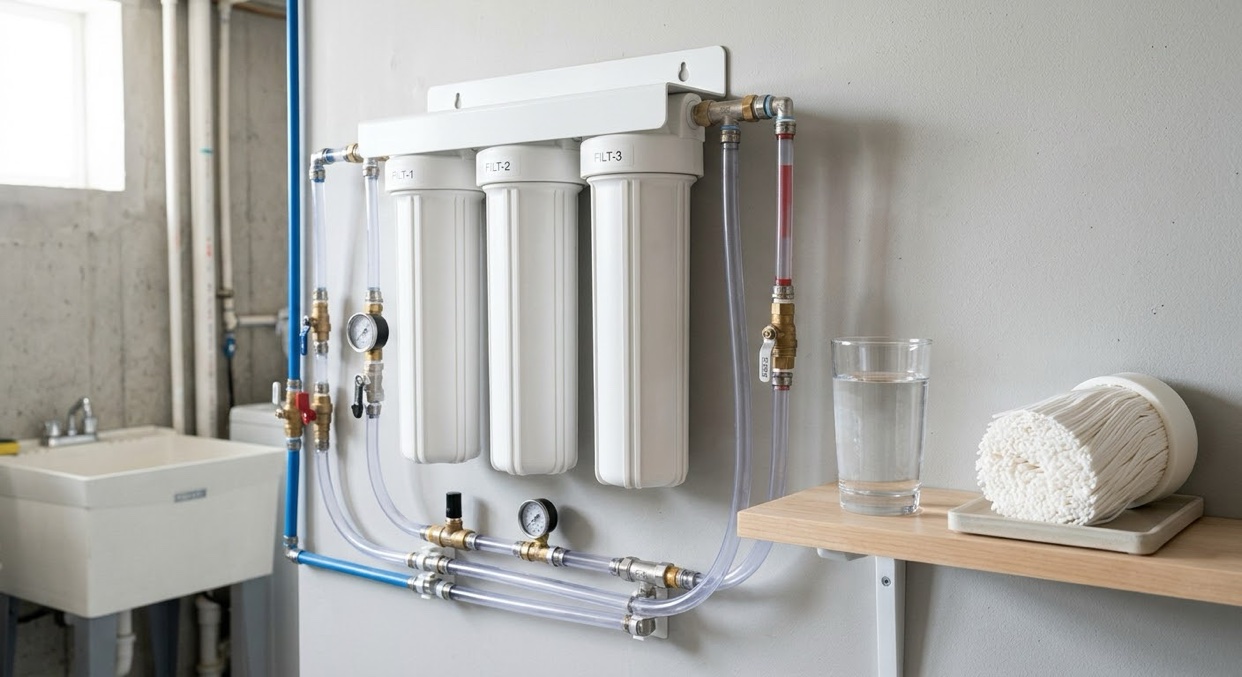
If we’re standing in your kitchen and you’re looking at water treatment options, you’ve probably heard of reverse osmosis. But every now and then, I talk to homeowners who are looking at an ultrafiltration system — often called UF for short.
People usually ask me: “Steve, is this like reverse osmosis, or is it something else entirely?”
It is something else. And if you understand what it does and what it doesn’t do, you can save yourself a lot of money and pick the exact right tool for your water. Here is the honest, plain-English breakdown of ultrafiltration.
What Ultrafiltration Actually Is
At its core, ultrafiltration is remarkably simple. Think of it as an extremely fine physical screen.
There are no chemical treatments happening inside a UF system, and there are no electrical-charge tricks like you see in some specialized membranes. It is purely physical sieving. Water is pushed through a microscopic barrier, and anything too big to fit through the holes stays behind on the dirty side.
If you want a clean, polished physical barrier that stops suspended particles and living bugs without changing the fundamental chemistry of your water, ultrafiltration is that tool.
The Pore Size: 0.01 to 0.1 Micron and Hollow Fibers
To understand how UF works, we have to talk about scale. A micron (short for micrometer) is one-thousandth of a millimeter. To put that in perspective, a single strand of human hair is about 70 microns wide.
An ultrafiltration membrane typically has a pore size ranging from 0.01 to 0.1 microns.
Inside a UF filter housing, the membrane isn’t just a flat sheet. It is made of thousands of tiny hollow fibers — essentially microscopic straws. The pores are built right into the walls of those fibers. Water flows around or through the fibers, passes through the walls, and comes out the clean side, while the contaminants stay trapped on the dirty side.
What UF Removes Well
Because those pores are down in the 0.01 to 0.1 micron range, ultrafiltration is a powerhouse when it comes to physical clarity and biological safety. Here is what it catches:
- Sediment and turbidity: fine silt, rust flakes, sand, dirt, and cloudiness are removed.
- Bacteria: bacteria like E. coli and coliforms are massive compared to a UF pore, so they are blocked — published removal figures run above 99.99%.
- Protozoan cysts: tough single-celled parasites like Giardia and Cryptosporidium — several microns across, and famously chlorine-resistant — are filtered out completely.
- Most viruses: viruses are much smaller than bacteria, and here is the honest detail: it depends on which end of the UF range your membrane sits at. A tight UF membrane at 0.01 micron catches even the smallest viruses (about 0.02 micron) by size, and tight UF systems are credited with removing over 99.9% of viruses. A looser membrane up near 0.1 micron can let the smallest viruses through. If a known viral problem is your main worry, check the membrane’s actual rating — or pair UF with disinfection.
- Algae and large organic molecules: suspended organic matter, colloids, and large molecules are stripped right out.
What UF Does NOT Remove At All
Now comes the most important honest point in this entire article: ultrafiltration does not change the chemistry of your water.
Because UF is strictly a physical screen based on size, anything dissolved in the water passes right through as if the membrane wasn’t even there. An ultrafiltration system will NOT remove:
- Salts and total dissolved solids (TDS): your TDS meter will read exactly the same before and after.
- Hardness minerals: calcium and magnesium pass right through, so UF will not stop your kettle from scaling up.
- Nitrates and fluoride: dissolved ions slide right through the membrane.
- Dissolved heavy metals: lead, copper, or arsenic dissolved in the water won’t be touched. (Metals stuck to particles are another story — UF catches the particles.)
- Sugars, alcohol, chlorine, and small chemicals: anything soluble and small — including most VOCs — is too small for physical sieving.
If your water has chemical contamination, high hardness, or excessive dissolved solids, ultrafiltration by itself is the wrong solution.
How UF Cleans Itself: Dead-End, Cross-Flow, and Backflushing
UF systems run in one of two basic ways. In a dead-end design, all the water goes through the membrane and the trapped dirt builds up on the surface — simple, and common in home systems. In a cross-flow design, the water sweeps across the membrane surface, carrying much of the dirt away as it goes, which slows the buildup — common in larger and dirtier-water systems.
Either way, the trapped material has to come off, and that’s what backflushing is: the system periodically reverses the flow, pushing clean water backward through the fibers to blow the buildup off the surface and send it to drain. Bigger systems may add an occasional chemical cleaning on top of that. It’s also why UF doesn’t need a continuous wastewater stream like RO — there’s no reject water flowing while you filter, just a small backflush now and then on systems that have one. Many small under-sink units skip the drain connection entirely and rely on a replaceable module instead.
UF vs. a Regular Sediment Filter: Absolute vs. Nominal
A sediment filter and a UF membrane are both physical screens, so what makes UF different? Two things: how fine it is, and how honest its rating is.
Most cartridge filters carry a nominal rating — a 5-micron nominal filter might catch 85% of particles at 5 microns and let the rest through. A UF membrane’s rating is effectively absolute: the pores are the pores, and nothing larger than the largest pore gets past. That’s the difference between “most of the dirt” and a true barrier against bacteria and cysts — and it’s why you should always ask whether any filter’s micron rating is nominal or absolute.
Where UF Fits in Real Life
So, where does ultrafiltration shine?
It’s fantastic if your water source is already chemically safe but you want ironclad protection against dirt, cysts, and bacteria. It’s used:
- Whole-house (point of entry): high flow, low pressure drop, and no continuous drain stream make it a natural fit where the water enters the home.
- Under the sink: compact UF units polish drinking water and strip out microbes while leaving the minerals in.
- Municipal treatment plants: cities run UF at enormous scale as a physical barrier against cysts and bacteria.
- As a pre-filter before reverse osmosis: stripping out the suspended dirt and bacteria upstream protects the expensive RO membrane from clogging early.
UF vs. Nanofiltration and RO in One Paragraph
Ultrafiltration stops the things floating in your water — particles and microbes — and nothing else. Nanofiltration goes a step deeper and turns away specific dissolved minerals, mostly the double-charged ones like hardness and sulfate, while letting simple salts through. Reverse osmosis goes all the way and removes nearly everything dissolved, salts included. Same membrane family, three different jobs: screen, selective screen, and near-total barrier.
Bottom Line
Ultrafiltration is an incredible physical screen. It gives you crystal-clear water, wipes out bacteria and cysts, and leaves your minerals right where they are. It isn’t set-and-forget — the membrane needs its backflush or cleaning cycles and will eventually need replacing — but while it’s working, it’s one of the most reliable barriers in water treatment. Just remember: it filters the stuff floating in the water, not the stuff dissolved in the water. Match the filter to your actual water test, and you’ll never go wrong.
Technical claims checked against membrane manufacturer and industry references, October 2026.
Leave a Reply