
If you and I were standing in your kitchen talking about how to make sure your water is safe from bacteria and bugs, ultraviolet light usually comes up. A lot of homeowners look at a UV system and assume it’s the ultimate high-tech filter that cleans everything out of their water.
Let’s clear that up right out of the gate.
Here is my honest, plain-English breakdown of what ultraviolet disinfection actually is, how it works, and what it can and cannot do for your home.
What UV Disinfection Actually Is (It’s Not Filtration)
The most important thing to understand about an ultraviolet system is this: it is not filtration at all.
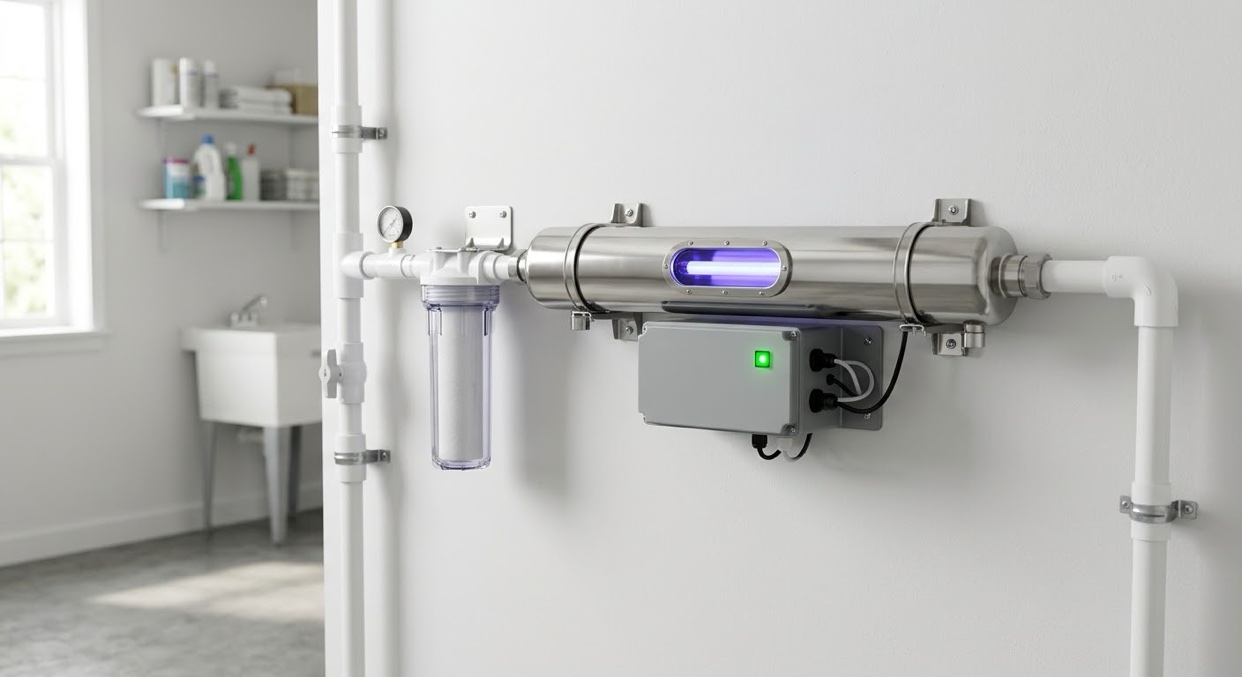
Nothing is physically removed from your water. When water flows through a UV system, it passes around an ultraviolet lamp housed in a clear quartz sleeve. There is no screen catching dirt, no chemical reaction changing the taste, and no minerals added or taken away. If your water has dirt, rust, or dissolved salt going into the UV chamber, that exact same dirt, rust, and salt comes out the other side.
Instead, what a UV system does is inactivate microorganisms.
Why do we use the word “inactivate” instead of “kill”? Because the bacteria, viruses, and parasites passing through the chamber aren’t physically removed or destroyed into nothingness — they are still right there in the water. What the UV light does is penetrate their cells and scramble their DNA (or RNA). Once that genetic material is scrambled, the organisms can no longer reproduce. And a pathogen that can’t multiply inside you can’t make you sick. It’s a clean, chemical-free way to make biological contaminants harmless.
The Wavelength That Matters: UV-C and the Dose Concept
Not all ultraviolet light does the job. For water treatment, the wavelength that matters is germicidal UV-C, right around 254 nanometers — the wavelength that disrupts microbial DNA most effectively.
We measure how well a system works by UV dose, measured in millijoules per square centimeter (mJ/cm²). Dose is a combination of how intense the lamp is and how long the water is exposed to it inside the chamber.
The standard that sorts the real systems from the toys is NSF/ANSI 55, for ultraviolet microbiological water treatment systems:
- Class A (40 mJ/cm²): for disinfecting water that may actually be contaminated — unsafe well water is the classic case. A Class A system must deliver at least 40 mJ/cm² and carry safety equipment: a UV intensity sensor and a flow restrictor or shut-off that reacts if the lamp fades.
- Class B (16 mJ/cm²): supplemental treatment only — for water that’s already municipally treated and safe, knocking down normally occurring nuisance bacteria. A Class B unit is not a disinfecting system for bad water, and it should never be sold as one.
What UV Handles Well (and the Adenovirus Honest Truth)
When a UV system is properly sized and delivering its rated dose, it is a powerhouse against biological threats:
- Bacteria: E. coli, coliforms, Salmonella and the rest are inactivated at ordinary doses.
- Protozoan cysts: Giardia and Cryptosporidium — which can shrug off chlorine — are easily inactivated by UV. Crypto in particular is famously chlorine-resistant but very UV-sensitive. This is UV’s star feature.
- Viruses: most waterborne viruses are inactivated effectively — including ones far too small for any screen to catch, because UV doesn’t care about size, only DNA.
The honest truth about adenovirus: not all viruses respond the same way. Adenovirus is the famous tough guy — its double-stranded DNA makes it significantly more resistant to UV than other viruses. A standard 40 mJ/cm² Class A system handles everyday bacteria and cysts brilliantly, but deep inactivation of adenovirus can require doses up toward 186 mJ/cm² — that’s the figure in the EPA’s own dose tables for 4-log virus credit. For a typical residential well, a properly maintained Class A system is excellent protection. Just know the exception exists.
What UV Does NOT Do At All
Read this part twice, because this is where UV gets oversold:
- It removes nothing. No sediment, no chemicals, no lead, no PFAS, no nitrates, no hardness. Your TDS meter will read exactly the same after the lamp as before it.
- It leaves no residual protection. This is the big tradeoff. Chlorine keeps working after treatment — it sits in your pipes and tank and keeps killing. UV treats the water for the split second it’s in front of the lamp, and then it’s done. Water can be recontaminated downstream — in a storage tank, a dirty faucet aerator, anywhere — and UV has nothing left to say about it. That’s the price of chemical-free disinfection, and you should choose it with your eyes open.
The Clarity Requirement: UV Needs Clear Water
UV light can only inactivate what it can reach. Anything that clouds the water — turbidity, sediment, even strong color — absorbs or blocks the light, and particles create literal shadows where microbes hide from the dose. That’s why:
- A sediment prefilter (around 5 micron) goes in front of every UV system. Non-negotiable.
- Hardness and iron must be managed. Both coat the quartz sleeve the lamp sits in, and a fouled sleeve strangles the light before it ever reaches the water. High-hardness or iron-bearing water needs treatment ahead of the UV, not after.
The Maintenance Truth
A UV system asks for two things, and skipping either quietly turns it into expensive plumbing jewelry:
- Replace the lamp about once a year — lamps are rated around 9,000 to 12,000 hours — even if it still glows. A UV lamp can shine a pretty blue and be putting out almost no germicidal UV-C. The glow is not the dose. The lamp’s output fades on a schedule whether you can see it or not.
- Clean the quartz sleeve periodically, so scale and film don’t block the light.
This is exactly why the better systems have intensity monitors and alarms: you cannot see UV dose with your eyes, so the machine has to watch it for you.
Sizing and Formats
UV systems are rated in gallons per minute (GPM) — and the rating is a promise about dose. Push water through faster than the rating and each drop spends less time in the light: under-dosed water, quietly unsafe. Size the unit for your home’s peak flow, not its average.
- Whole-house (point of entry): the classic well-water setup — one lamp treating everything as it enters the home.
- Under-sink units: small point-of-use systems for a single tap.
- UV-LED: the newer technology arriving in small units — instant on/off, no mercury lamp, long life. Promising and improving fast, though the big whole-house jobs still belong to traditional lamps for now.
Where UV Is Used
Well-water homes are UV’s biggest residential job — anywhere the water has no chlorine residual to protect it. Beyond the house: municipal treatment plants (especially for Crypto), hospitals, aquariums and ponds, and as a finishing stage on some reverse osmosis systems, polishing water that’s already been filtered.
Bottom Line
Ultraviolet disinfection is a brilliant, chemical-free way to protect your home against living pathogens. It adds nothing to your water, creates no wastewater, and leaves your minerals intact.
Just remember the golden rule: UV is a disinfectant, not a filter. It needs clear water in front of it, a fresh lamp inside it, and honest expectations around it — it will never remove a single thing from your water, and it protects nothing downstream. Pair it with the prefilter it needs, maintain the lamp it depends on, and you’ve got biologically safe water straight from the tap.
Technical claims checked against NSF/ANSI 55 requirements and EPA ultraviolet dose tables, October 2026.
Leave a Reply