
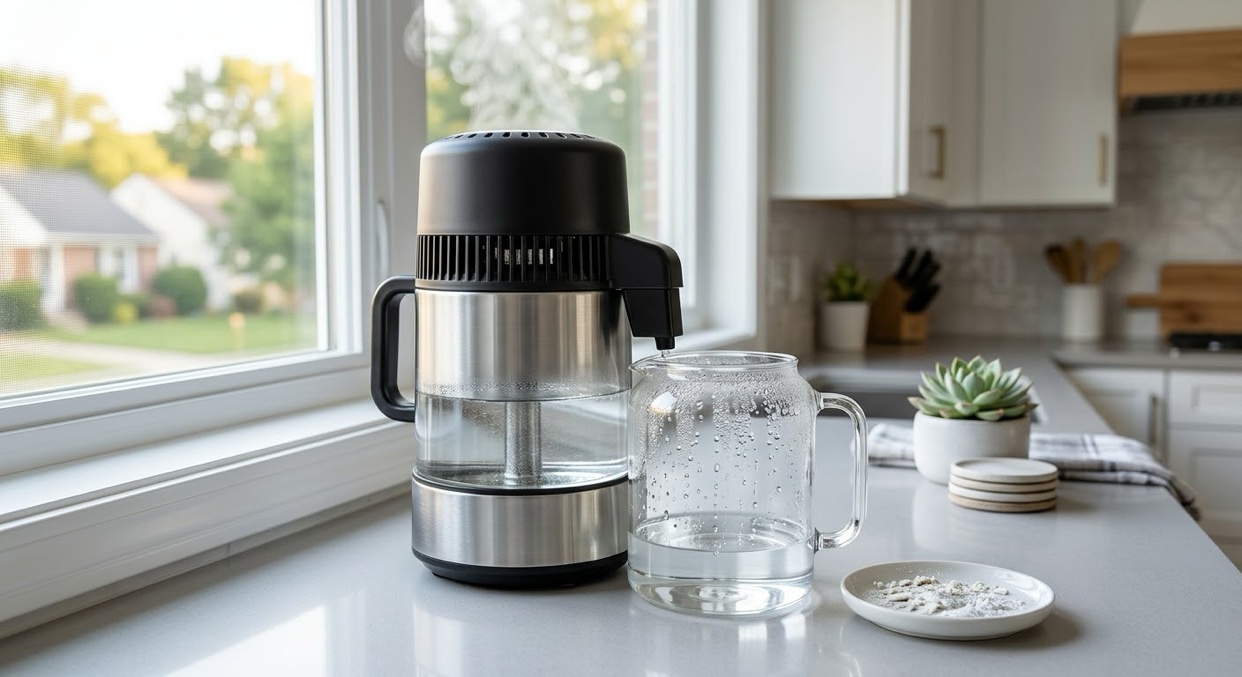
If you and I were standing in your kitchen talking about pure water, there is one method that always comes up sooner or later: distillation.
It is the oldest water purification method in human history. Long before we had synthetic membranes, carbon blocks, or electric pumps, people knew that if you boil water, catch the steam, and cool it back down into liquid, you get pure water. It is literally the exact same process the Earth uses to make rain: evaporation, condensation, and precipitation.
When homeowners ask me about countertop distillers, they want to know if it is worth the effort, what it actually removes, and why it tastes different. Here is my plain-English, honest breakdown of distillation.
How a Home Countertop Distiller Works, Step by Step
A residential countertop distiller is essentially a mini rainmaker that sits on your kitchen counter. It looks a bit like a tall coffee maker, and under the hood, it operates in four basic steps:
- The boiling chamber: you fill a stainless steel chamber with raw tap water and press start. An electric heating element heats the water to a rolling boil — 212°F (100°C).
- Evaporation: as the water turns to steam, it rises. Almost everything that can’t evaporate stays behind in the chamber: dissolved heavy metals, hardness minerals, dirt, and salts.
- The fan-cooled condenser coil: the steam travels through a coiled stainless steel tube while a small fan blows room air across it, cooling the steam back into liquid droplets.
- The carbon pod and storage jug: the condensed water drips through a tiny activated carbon post-filter pod and collects in a glass or plastic storage jug.
Why That Carbon Pod Matters
People often ask me: “Steve, if distillation removes everything, why do I need a carbon filter at the end?”
It comes down to boiling points. Certain chemicals — volatile organic compounds (VOCs), including chlorine byproducts like chloroform — boil at a lower temperature than water. When the water boils, those chemicals turn to gas right alongside the steam, ride through the coil, and condense back into your clean water. Good distillers fight this two ways: a volatile gas vent that lets the lightest gases escape before the steam condenses, and that little carbon pod at the exit, which traps what gets through and polishes the taste. A distiller with neither feature is not complete protection against VOCs — that’s the honest fine print.
What Distillation Removes
Distillation is ruthlessly effective because it separates the water from the contaminants, instead of trying to filter the contaminants out of the water:
- Heavy metals: lead, arsenic, mercury, and copper are left behind in the boiling chamber.
- Hardness and minerals: calcium, magnesium, and sodium cannot evaporate — total dissolved solids (TDS) drop to near 0 to 2 ppm.
- Nitrates and fluoride: these stay behind in the boiling basin.
- Living things: bacteria, viruses, parasites, and cysts like Giardia and Cryptosporidium are killed outright by the boiling itself, long before the steam condenses. Nothing living survives the process.
Distilled water comes out as some of the purest, lowest-TDS liquid you can produce at home.
What Distillation Does NOT Do Well (The Honest Tradeoffs)
For all that purity, distillation has real-world drawbacks:
- It is slow. A typical countertop unit takes about 4 to 6 hours to produce 1 gallon. A family drinking a gallon a day will keep a single unit working hard just to stay even.
- It uses real electricity. Boiling water is energy-hungry work: figure roughly 3 to 3.5 kilowatt-hours per gallon (an 800-watt unit running about 4 hours). Depending on your electric rates, that’s roughly $0.40 to $0.80 per gallon — real money compared to an RO system sipping line pressure.
- Heat and fan noise. Running a distiller is like running a small space heater and an exhaust fan in your kitchen for four hours. It warms the room and it hums.
- Scale buildup and cleaning. Everything the distiller removes stays behind in the chamber. On hard water, you’ll be dissolving thick white scale out of the bottom every few cycles with citric acid or vinegar. That’s not a defect — it’s the proof the machine is working — but it is a chore.
- Flat taste. Distilled water has no minerals, and minerals are most of what water’s flavor is. It tastes flat and neutral, which some people love and some find sterile. As it sits, it also absorbs carbon dioxide from the air and turns very slightly acidic (typically around pH 5.8 to 6.5) — harmless, but part of that flat character.
A quick word on the health claims you will hear in both directions — that distilled water is a miracle cure, or that it’s dangerous because it “leaches minerals from your body.” Both are hype. The serious discussion (including the World Health Organization’s) is about the minerals in your overall diet over a lifetime. Your minerals come overwhelmingly from food. A glass of distilled water is not a cure, and it is not a hazard.
Where Distillation Is Used
- Home countertop units for drinking water and emergency supplies of ultra-pure water.
- CPAP machines and humidifiers: manufacturers specify distilled water precisely so minerals don’t build up inside.
- Laboratories and medical facilities: autoclaves and lab work need water that leaves nothing behind.
- Steam irons and (historically) car batteries: anywhere mineral deposits would wreck the equipment.
- Ships: vessels have distilled their water for as long as there have been steam plants at sea.
Distillation vs. Reverse Osmosis
Both methods get you very pure water. They just take opposite roads to get there.
Countertop distillation
- Method: thermal — evaporation and condensation
- TDS reduction: near 100% (0–2 ppm)
- Speed: very slow — about a gallon per 4–5 hours
- Energy: high — about 3–3.5 kWh per gallon
- Wastewater: none — no drain stream
- Maintenance: frequent manual descaling of the boiling chamber
Under-sink reverse osmosis
- Method: pressure through a membrane
- TDS reduction: 90–98%
- Speed: fast, on demand from a pressurized storage tank
- Energy: low — runs on your home’s water pressure
- Wastewater: yes — roughly 1 to 4 gallons down the drain per gallon made, depending on the system
- Maintenance: periodic cartridge and membrane changes (6–12 months and beyond)
The one-line version: RO is faster and cheaper per gallon at the sink; distillation asks nothing of your plumbing, has no membrane to foul or replace, and will purify water so dirty or salty it would destroy a membrane — but it pays for that toughness in time and electricity.
Bottom Line
Distillation is an absolute powerhouse if you want guaranteed purity, zero wastewater, and a system that needs no plumbing installation. It is incredible for CPAP machines, irons, lead removal, or keeping an emergency supply of ultra-pure water.
But because of the electricity, the slow pace, the kitchen heat, and the chamber scrubbing, most homeowners find an under-sink reverse osmosis system more convenient for daily family drinking water. If you don’t mind the routine and you want pure water made the oldest way there is, a countertop distiller is hard to beat.
Technical claims checked against distiller manufacturer specifications and industry references, October 2026. (For the technically curious: NSF/ANSI 62 is the standard written specifically for drinking-water distillation systems.)
Leave a Reply