
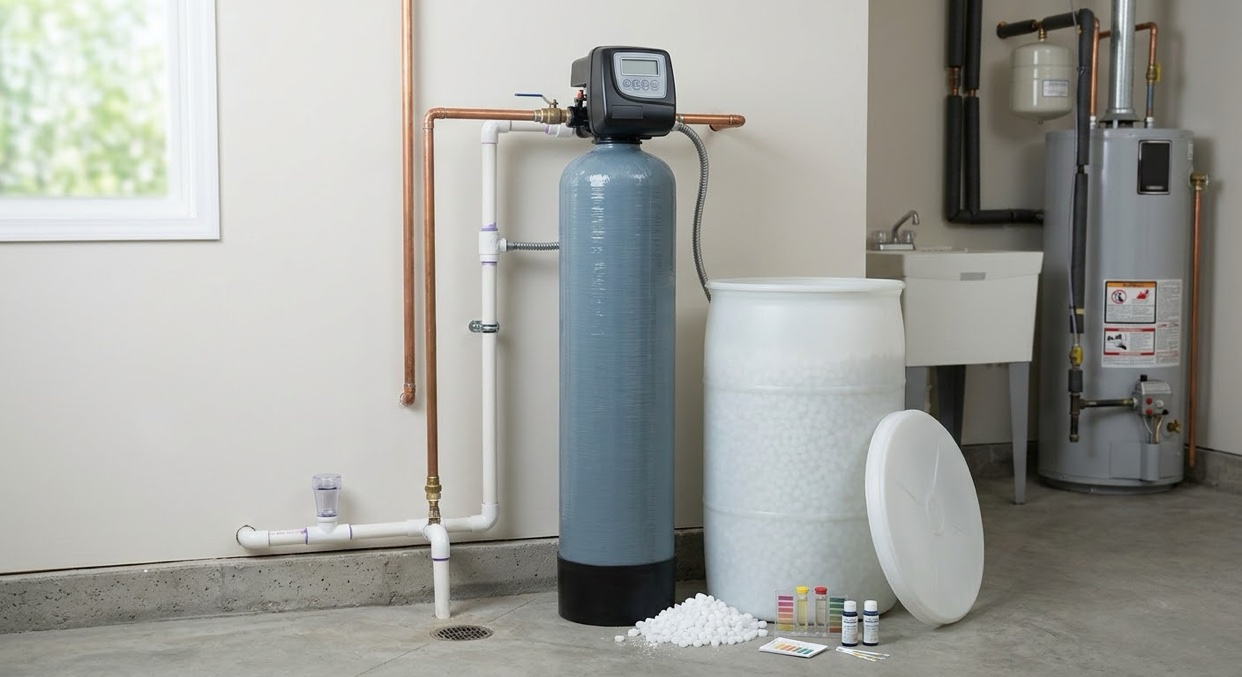
If you and I were standing in your kitchen talking about hard water, you’ve probably noticed the signs: white crusty scale around your faucets, spots on your glass shower doors, soap that just doesn’t lather right.
When homeowners ask me how to fix that, the conversation almost always turns to water softeners. But there is a huge misconception about what a traditional softener actually does. People think it’s a filter straining out minerals.
It isn’t. Here is my plain-English, honest breakdown of how ion exchange and water softening really work — and what you need to know before putting one in your home.
What Ion Exchange Actually Is: A Swap, Not a Filter
In plain words, a traditional water softener is a chemical exchanger, not a filter. Nothing is physically “filtered out” the way a screen or a carbon block stops dirt. It is a straight trade, ion for ion.
Inside the softener’s tall mineral tank are millions of tiny resin beads. The beads carry a negative electrical charge, and when the system is ready to work, they’re holding positively charged sodium ions (Na+) — or potassium ions, if you run potassium chloride instead of salt.
As hard water flows over the beads:
- Calcium (Ca2+) and magnesium (Mg2+) — the hardness — carry a double positive charge, stronger than sodium’s single charge.
- The resin prefers the stronger charge, so it grabs the calcium and magnesium out of the water and holds them.
- To balance the charge, the resin releases a matching amount of sodium into the water.
That’s ion exchange. Hard water with calcium and magnesium goes in one side; soft water with sodium comes out the other.
How Water Hardness Is Measured
We measure hardness in grains per gallon (gpg) — the weight of hardness minerals in a gallon of water. You’ll also see it as parts per million (ppm) or milligrams per liter (mg/L) on municipal reports. The conversion is simple: 1 gpg = 17.1 ppm.
The standard industry scale (the USGS publishes the same classification in mg/L):
- Soft: 0 to 1 gpg
- Slightly hard: 1 to 3.5 gpg
- Moderately hard: 3.5 to 7 gpg
- Hard: 7 to 10.5 gpg
- Very hard: above 10.5 gpg
If your test comes back at 7 gpg or higher, you will definitely notice scale on fixtures, poor soap performance, and shorter lives for your water heater and appliances.
Regeneration: How the System Recharges
Eventually every resin bead is loaded with calcium and magnesium and has no sodium left to trade. The system is “exhausted,” and hard water would slip straight through. So the softener recharges itself — regeneration:
- Backwash: water flushes backward through the resin bed, lifting it and rinsing away trapped dirt.
- Brine draw: concentrated salt water (brine) is drawn from the salt tank into the resin tank. Facing that flood of sodium, sheer numbers win — the sodium knocks the calcium and magnesium off the beads and reloads the resin. That is the actual recharge.
- Rinse: the displaced calcium, magnesium, and excess brine flush down the drain.
- Brine refill: fresh water goes back into the salt tank to dissolve more salt, so brine is ready for the next regeneration.
Timer vs. metered (demand-initiated) regeneration matters more than most sales pitches admit. Old timer systems regenerate on a fixed clock — every three days at 2 AM, say — whether your house used 100 gallons or 1,000: wasteful on vacation, and out of soft water when you have guests. Modern metered systems count every gallon you actually use and regenerate only when the resin’s capacity is genuinely spent, saving hundreds of pounds of salt and thousands of gallons of water over the system’s life. (NSF/ANSI 44 is the standard that covers these residential softeners and their efficiency ratings.)
Regeneration isn’t free: a modern metered system uses roughly 25 to 50 gallons of water per regeneration — older timer units can use far more — typically every few days to about a week for a household, depending on hardness and use.
The Sodium Question: How Much Salt Goes into Your Water?
The most common fear: “Steve, if it swaps calcium for sodium, am I drinking salt water?”
Let’s do the actual math. The sodium added is directly proportional to the hardness removed — roughly 7.5 milligrams of sodium per quart of water for every grain per gallon removed (the Water Quality Association’s figure, and it checks out chemically).
Real-world example: your water tests at 10 gpg. Softening it adds about 75 mg of sodium per quart — roughly 18–20 mg in an 8-ounce glass.
Perspective: one slice of white bread carries about 130–170 mg of sodium. An 8-ounce glass of milk, about 120 mg. Your softened water is not where your sodium lives — your food is.
Two honest exceptions: if you’re on a strict, medically mandated sodium-restricted diet, that 20 mg a glass is still yours to count — and you have options. Potassium chloride pellets work exactly the same way, swapping potassium instead of sodium (they cost noticeably more per bag). Or keep the kitchen cold tap unsoftened, or put a small reverse osmosis system at the sink, which strips the sodium right back out of your drinking water.
The Slippery Feel, Honestly
Everyone notices it the first shower: soft water feels slick, almost like the soap won’t rinse off. Here’s what’s actually happening. In hard water, soap reacts with calcium to form a film — soap scum — and that film coats your skin and hair. What you’re used to calling “squeaky clean” is that residue. In soft water there’s no calcium to make the film, your skin keeps its natural oils, and that slippery feel is clean skin. Bonus: soap and detergent work the way they’re supposed to, so you use noticeably less of both.
What Ion Exchange Does and Does NOT Do
It does:
- Calcium and magnesium: hardness reduced to virtually zero. That’s the job.
- Low levels of clear-water (dissolved) iron and manganese: a softener can pick up a few ppm of ferrous iron alongside the hardness — but treat that as a bonus, not a design feature. High iron fouls resin and shortens its life.
It does NOT:
- Filter anything. No sediment, no bacteria, no cysts — it’s not a strainer and it’s not a disinfectant.
- Remove chemicals. Chlorine and VOCs pass through (and chlorine slowly degrades the resin itself over the years).
- Purify the water. Softening swaps ions; it doesn’t remove them. Your TDS stays about the same — the hardness ions leave, sodium ions take their place. Softened water is not purified water, and a softener should never be sold as a health device. It’s plumbing-and-appliance protection: no scale in the pipes, the water heater, and the dishwasher — and scale, not old age, is what kills most water heaters early.
A word about iron — it counts five times. Here’s a piece of sizing math every well owner should know: when a dealer sizes a softener for water that also carries dissolved iron, each 1 ppm of iron is counted as 5 extra grains per gallon of hardness load — the industry calls the total compensated hardness. The resin grabs iron eagerly and gives it back reluctantly during regeneration, so iron occupies capacity out of all proportion to its concentration. That compensated number drives both decisions that matter: how big the unit needs to be, and how much salt each regeneration needs — because the brine has to be strong enough to strip everything the resin collected, iron included. And a reserve has to be set off that same number: a properly programmed softener holds back roughly a day’s worth of capacity — calculated on the compensated load — so it calls for regeneration the night before it would run dry, instead of feeding hard, iron-bearing water through the house while it waits for its 2 AM slot. Size, salt, and reserve all off the plain hardness number instead, and the regeneration comes up short every time: the bed never fully recharges, iron builds up, and the resin fouls. That’s why a softener sized on hardness alone will run out early on iron-bearing well water. High iron belongs in a dedicated iron filter ahead of the softener — let the softener do the job it was built for.
Two more honest tradeoffs: softened water isn’t ideal for houseplants or long-term lawn watering — the sodium builds up in soil. And some municipalities restrict or even ban salt-based softeners, because the chloride in the regeneration discharge is hard on wastewater treatment and local waterways. Check your local rules before you buy.
Salt-Free “Conditioners,” Honestly
Go online and you’ll see dozens of ads for “salt-free water softeners.”
There is no such thing. By definition, softening means the hardness is removed or exchanged down to near zero. Salt-free systems — template assisted crystallization (TAC) units, and the magnetic or electronic boxes — do not remove a single grain of hardness. Test the water behind one and it reads exactly as hard as the water in front of it.
What TAC honestly does: it converts dissolved hardness into microscopic crystals that float through your plumbing without sticking to surfaces as readily. That’s conditioning — it can reduce scale buildup — but you won’t get soft water’s feel, your soap won’t lather like soft water, and your hardness test won’t budge. Conditioners have their place. Calling them “salt-free softeners” is using the wrong word on purpose.
Bottom Line
If hard water is scaling your faucets, shortening your water heater’s life, and making your laundry stiff, a traditional salt-based ion-exchange softener is the gold standard: it trades hardness for a small, honest amount of sodium and protects your plumbing investment. Buy a modern metered unit, keep the salt tank fed, and if you want sodium-free drinking water, pair it with a small RO at the kitchen sink. Just buy it for what it is — an appliance-protection system that swaps ions — not as a filter, and not as a health product.
Technical claims checked against Water Quality Association and Penn State Extension references and NSF/ANSI 44, October 2026.
Leave a Reply