
Hey there, Steve here.
If you own a reverse osmosis (RO) system or a countertop distiller, you’ve probably seen the internet debates. One site tells you pure water is the ultimate way to cleanse your body. The next site warns you that drinking pure water will leech every mineral out of your bones by Tuesday unless you buy their proprietary $300 mineral cartridge.
As a water treatment guy who’s spent years installing, testing, and servicing these systems, let me give you the plain-spoken truth. No scare tactics, no sales pitches — just how the science and the hardware actually work, so you can decide what’s best for your kitchen.
1. What Is Remineralization, in Plain English?
Remineralization is simply the process of putting tiny amounts of healthy minerals — mainly calcium and magnesium — back into water that has had almost everything removed.
Think of it like baking bread with plain white flour, then adding a handful of seeds back in for texture and flavor. The water process starts by stripping everything out to get rid of contaminants, and remineralization puts back just a pinch of the harmless, good stuff at the very end.
2. Why RO and Distilled Water Come Out “Hungry”
To understand why people talk about adding minerals back, you have to understand how pure water behaves in nature.
Water is known as the “universal solvent.” It wants to dissolve things. When water falls as rain, it rolls over rocks and soil, dissolving tiny amounts of calcium, magnesium, iron, and other minerals along the way.
When you run water through an RO membrane or boil it down in a distiller, you strip away about 95% to 99% of all dissolved solids. What you get is extremely pure H₂O — and pure water is essentially “hungry.”
Because it has almost nothing dissolved in it, it eagerly absorbs whatever it touches. As soon as pure water comes into contact with the air, it absorbs carbon dioxide (CO₂). That dissolved CO₂ forms a tiny bit of carbonic acid, which drops the pH of the water down to around 5.5 to 6.5 (slightly acidic).
It isn’t dangerous acid, but it makes the water slightly aggressive, meaning it constantly looks for minerals to grab onto to achieve balance.
3. The Honest Health Picture: Do You Need Minerals in Your Water?
Let’s look at both sides of the coin without the hype.
The standard medical view. Most nutritionists and doctors will tell you flat out: you get the vast majority of your minerals from food, not water. A bite of cheese or a handful of nuts carries roughly as much calcium as a liter of typical mineralized tap water — and a full day of normal meals brings far more than your water glass ever will. If you eat a balanced diet with leafy greens, nuts, dairy, or meat, your body isn’t relying on your drinking glass to meet its daily calcium and magnesium quotas.
The other side of the argument. Proponents of remineralization raise a few points worth listening to:
- Hydration feel: Some people find that ultra-pure water passes right through them or feels less satisfying to drink, claiming mineralized water hydrates them better.
- Long-term demineralized water studies: Organizations like the World Health Organization (WHO) have published papers raising questions about long-term consumption of low-mineral water, particularly regarding subtle electrolyte balances in populations with already poor diets.
- Cooking: Cooking vegetables in low-mineral water can actually draw out a bit more of the natural minerals from the food into the cooking liquid, compared to cooking in mineralized water.
The bottom line on health: if you eat a healthy diet, drinking RO or distilled water isn’t going to harm you. But adding minerals back doesn’t hurt either, and it offers distinct benefits elsewhere.
4. The Taste Factor (and Why Coffee Folks Care)
This is where remineralization makes the biggest real-world difference: flavor.
Pure RO water can taste “flat,” “empty,” or slightly biting/bitter due to that low pH we talked about. Dissolved minerals give water its “mouthfeel” — that subtle, smooth texture that makes water taste crisp and refreshing.
If you are a coffee or tea enthusiast, this is huge:
- Over-extraction / bitterness: Ultra-pure water dissolves compounds too aggressively, pulling harsh, bitter tannins out of coffee grounds and tea leaves.
- Flavor extraction: Coffee roasters and baristas use specific mineral targets (usually around 150 ppm total dissolved solids) because calcium and magnesium act as little hooks that grab the pleasant aromatic oils and sugars from coffee beans.
If your morning brew tastes overly sharp or flat, your water’s mineral content is usually the culprit.
5. How Remineralization Actually Works in Home Systems
If you decide you want to add minerals back, you don’t need a degree in chemistry. Here is how it’s done in home setups.
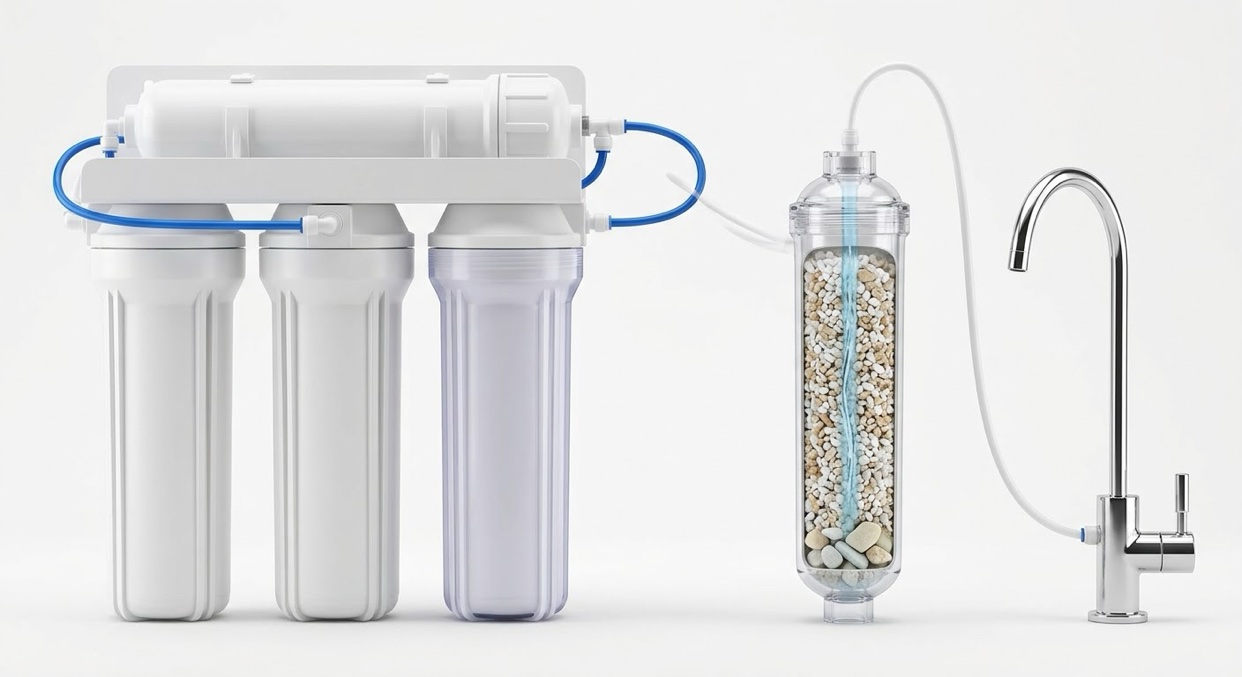
In-line calcite / Corosex cartridges (most common). On an under-sink RO system, this is a small filter tube installed as the very last stage before the faucet. Calcite is natural crushed calcium carbonate. As the slightly acidic RO water flows over it, it dissolves just enough calcium to neutralize the acidity, bump the pH up to around 7.0–7.5, and add a light mineral presence. Corosex is a magnesium oxide media, often mixed with calcite when you need to raise the pH higher or add magnesium alongside the calcium.
Integrated remineralizing RO stages. Many modern RO systems come out of the box with a built-in remineralization stage. These use a blend of mineral media to mimic natural spring water.
Manual additions. If you use a countertop distiller or don’t want to modify your RO plumbing, you have manual options:
- Liquid mineral drops: A few drops of concentrated trace mineral liquid into your pitcher.
- A pinch of unrefined salt: A tiny pinch of Celtic or Himalayan pink salt in a gallon of water. It won’t taste salty if done right — just smoother. (Be honest with yourself about the amounts, though: a pinch adds a whisper of minerals, not a serving.)
- Alkaline / mineral pitchers: Pouring your distilled or RO water through a specialty gravity pitcher filled with mineral beads.
6. How to Choose: Do You Need It?
Run down this quick checklist:
- You hate the “flat” taste of pure water — Yes. A mineral post-filter will immediately round out the taste.
- You brew specialty coffee or tea — Yes. Balanced minerals are essential for proper extraction and flavor.
- Your RO water feeds metal pipes or copper lines downstream — Yes. Low-pH “hungry” water can corrode metal plumbing over time.
- You eat a balanced diet and like the crisp, clean taste of RO — Optional. You’re getting your minerals from food, so don’t stress.
- You use your water mainly for steam irons, aquariums, or humidifiers — No. Keep it pure — minerals cause scale buildup in appliances.
7. What Remineralization Does NOT Do
Adding minerals back is a taste-and-balance tool. It is not magic, so let’s clear out the claims that come attached to it:
- It does not detox you. Your liver and kidneys do that job, for free, all day long. No cartridge upgrades them.
- It does not “structure,” “energize,” or “activate” your water. Those words sell products; they don’t describe anything the water is actually doing.
- It is not a mineral supplement. A cartridge adds small amounts of calcium and magnesium — enough to change taste and pH, not enough to replace a meal or a multivitamin.
- It does not restore everything the membrane removed. The full trace spread of a natural spring isn’t coming back out of one cartridge — and that’s fine, because that was never the point.
8. Practical Notes: Lifespan, Cost, and Checking Your Result
- Cartridges wear out by dissolving — that’s the job. An in-line calcite cartridge typically lasts about 6 to 12 months in a household before its pH lift fades, because the media is slowly used up. When your water starts tasting flat again, the cartridge is telling you it’s done.
- Cost stays modest. In-line remineralization cartridges generally run about $20 to $50, and a bottle of mineral drops lasts for months. Be suspicious of any “proprietary” mineral stage priced like a car payment.
- Check it yourself. A basic TDS meter and a set of pH test strips (or a simple pH meter) will show you the change in your own glass: TDS climbs modestly, and pH moves from the high 5s toward neutral. Don’t take my word for it — measure it. That’s the iPhilter way.
9. Steve’s Straight-Talk Takeaway
Here’s the deal: you don’t need to fear pure water, but you might enjoy mineralized water a whole lot more.
If you already have an RO system or distiller and love the taste, keep drinking it. Your body gets what it needs from your dinner plate. But if your water tastes a little sharp, your coffee tastes bitter, or you just want water that tastes like a fresh mountain spring, adding an in-line remineralization filter is an inexpensive, hassle-free upgrade.
Got questions about your specific filter setup? Drop a comment below or send me a message — I’m always happy to talk shop.
Leave a Reply