Author: iPhilter

  • TFA in Drinking Water: The PFAS That Falls From the Sky

    TFA in Drinking Water: The PFAS That Falls From the Sky

    Hi, I’m Steve. If you’ve spent any time reading around iPhilter, you know my goal as an independent New Jersey water guide is pretty simple: I’m here to give you straightforward, plain-English facts about what’s in your water, without any sales pitches or fearmongering. Water quality can feel like a complicated topic, but when you break down the science into clear terms, it becomes much easier to understand what’s happening at your tap and what options you have as a homeowner.

    Today, I want to talk about a specific compound that has been making news in environmental science circles: trifluoroacetic acid, or TFA.

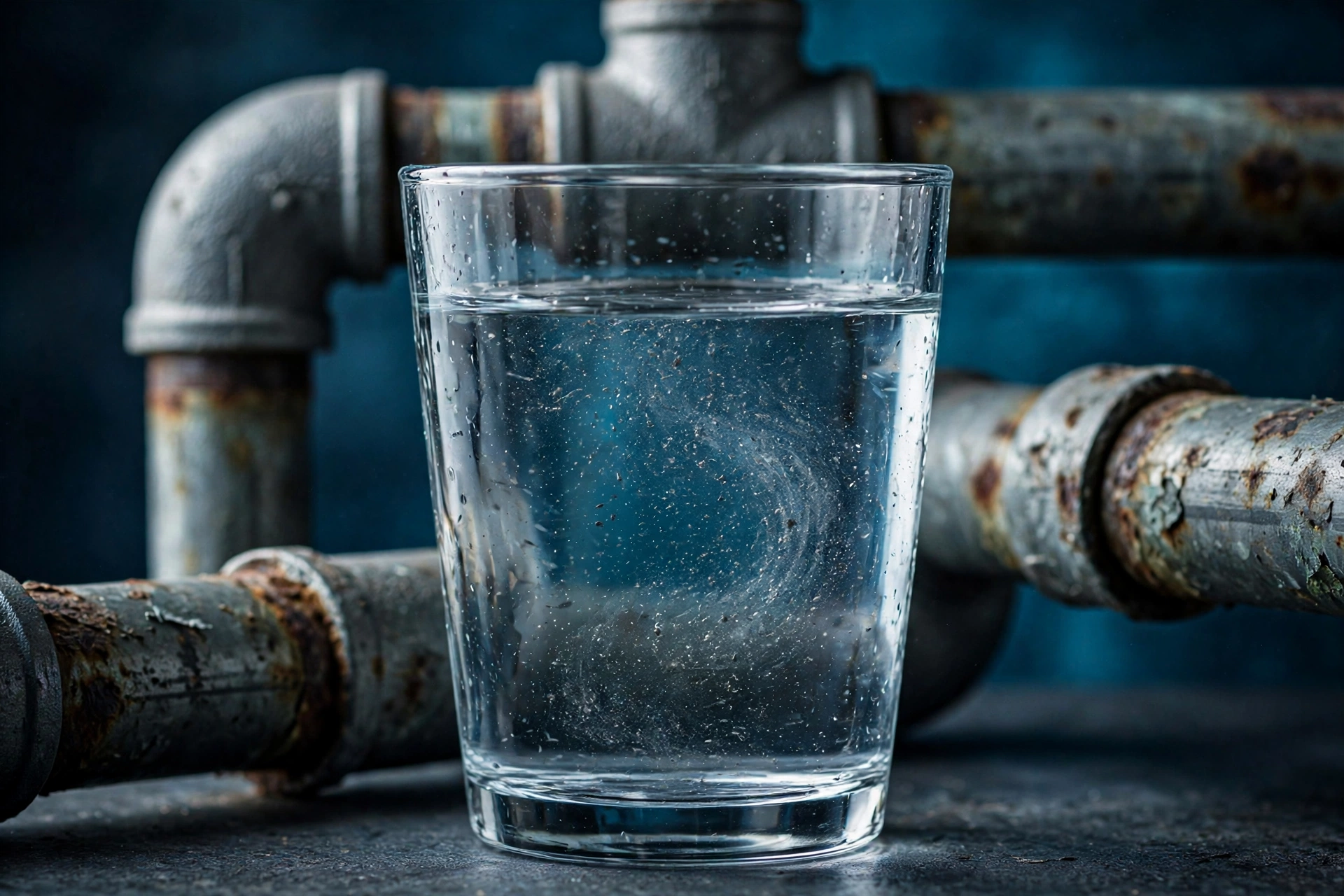
    You may already be familiar with the broader family of compounds known as PFAS, often called “forever chemicals.” While most discussions about PFAS focus on larger molecules used in manufacturing or firefighting foams, TFA represents a very different side of the same family. It is a chemical that forms high up in the air, falls with the rain, and presents unique challenges when it comes to testing and filtration.

    Let’s take a look at what TFA is, how it gets into our water supply, what scientists are finding right here in New Jersey, and what it means for your home.

    What Is TFA?

    TFA stands for trifluoroacetic acid. In the chemistry world, it is classified as an ultra-short-chain PFAS. In fact, it is the smallest of the “forever chemicals.”

    To understand why its size matters, it helps to think of the PFAS family as a group of chains. Longer-chain PFAS—like PFOA or PFOS, which you might have heard about in national news—have longer backbones of carbon atoms bonded to fluorine. TFA, on the other hand, has a very short carbon chain.

    Because of this ultra-short structure, TFA behaves quite differently from its larger chemical cousins:

    • It is extremely water-soluble: TFA dissolves easily in water and mixes thoroughly, making it mobile in the environment.
    • It is remarkably stable: Like other PFAS, the bond between carbon and fluorine in TFA is incredibly strong. As a result, TFA is extremely persistent—it does not break down meaningfully in the environment. Over time, as more of it is introduced into the water cycle, levels can gradually build up in surface waters and groundwater.
    • It travels lightly: Because it is small and soluble, it moves readily through soils and waterways rather than clinging to sediment.

    Understanding these physical traits helps explain how TFA gets into our water in the first place—and why standard filtration tools view it differently than longer-chain PFAS.

    How TFA Gets Into Our Water: The Skyward Cycle

    Unlike many industrial chemicals that enter local water supplies through direct spills, manufacturing discharge, or landfill leachate, TFA often takes a scenic route through the atmosphere.

    Here is how it forms and spreads:

    • Atmospheric Breakdown of Fluorinated Gases: Modern industrial societies use various fluorinated gases in everyday applications, most notably as refrigerants in air conditioning systems, heat pumps, and commercial cooling. When these gases escape into the atmosphere, solar radiation and chemical reactions break them down. One of the primary breakdown products of these gases is TFA.
    • Precipitation: Once TFA forms in the atmosphere, it binds with moisture in the air. When it rains or snows, that TFA comes back down to earth, landing on lakes, rivers, reservoirs, and open soil.
    • Pesticides and Pharmaceuticals: Beyond atmospheric gases, TFA also forms from the environmental degradation and breakdown of certain fluorinated agricultural pesticides and pharmaceutical compounds.
    • Accumulation in Water Supplies: Because TFA does not break down in the environment once it hits the ground, it washes into streams or seeps into underground aquifers, accumulating slowly over time.

    Because atmospheric rain is a primary vector, TFA is widespread and not limited solely to areas near heavy manufacturing plants or industrial sites.

    What Testing Shows in New Jersey

    To understand how widespread TFA might be in our local supply, researchers at the New Jersey Institute of Technology (NJIT) screened tap water from across the state — 70 samples, covering all 21 New Jersey counties — in the first statewide U.S. monitoring study of ultra-short-chain PFAS (published in Environmental Science & Technology Letters, September 2026).

    The findings were revealing: researchers found TFA in 64 of the 70 tap water samples — more than 91% — with at least one detection in every county. Among the samples where TFA turned up, the typical (median) level was 352 nanograms per liter, and the highest was 1,360 ng/L. Levels ran higher in several northern counties — Essex, Hudson, and Bergen. The same team also found TFA in nearly 80% of the bottled beverages they tested — and the 12 formulated drinks in the sample (sports drinks and electrolyte waters) averaged about 52 times the TFA of the plain bottled waters, with the top result at 94,100 ng/L — a reminder that this compound moves through the whole water cycle, not just the tap.

    These results highlight a key reason why TFA is receiving more attention from water quality experts:

    • It skips standard testing panels: Because TFA is much smaller and more water-soluble than the longer-chain PFAS that regulators and utilities routinely monitor, standard PFAS testing panels generally do not catch it. Finding TFA requires specialized laboratory testing methods specifically tuned for ultra-short-chain compounds.
    • It is widely present: The high detection rate in the NJIT screening demonstrates that TFA is a common feature of tap water across our region, reflective of its atmospheric origin and environmental persistence.

    Regulations and Health Research: Where Things Stand

    When learning about any newly highlighted compound in drinking water, it is natural to ask: What are the legal limits, and what does the health science say?

    It is important to look at both of these questions clearly and calmly.

    Regulatory Status

    Currently, there is no federal drinking-water limit—known as a Maximum Contaminant Level (MCL)—for TFA in the United States. While federal regulators have set limits for certain long-chain PFAS (such as PFOA and PFOS), ultra-short-chain compounds like TFA are not currently regulated under federal primary drinking water standards.

    Health Research

    Scientific research on the health effects of TFA, particularly at the low concentration levels typical of drinking water, is active and ongoing.

    Because science takes time to build a complete picture, it is best to view the research honestly:

    • Harm at typical tap-water exposure levels has not been definitively proven in human epidemiological studies.
    • Absolute safety at lifetime low-level exposure has also not been conclusively established, which is why scientists continue to study how short-chain PFAS interact with biological systems over long periods.

    As independent educators, our role at iPhilter is not to make health claims or predict future science, but to share where the current research and regulatory standards stand today so you can make informed choices for your home.

    Water Filtration: What Works and What Doesn’t

    If you are looking into water treatment options for your home, it is crucial to match the right filtration technology to the specific chemical you want to address. Because TFA has unique physical properties, standard filtration methods do not react to it the same way they do to longer-chain PFAS.

    Activated Carbon and Ion Exchange

    Media filters like activated carbon (found in standard pitcher filters, refrigerator filters, and many whole-house systems) and ion-exchange resins are very effective at capturing longer-chain PFAS chemicals. Those larger molecules stick readily to the surface of carbon or bind to resin beads.

    However, because TFA is so small, highly water-soluble, and polar, it binds poorly to activated carbon and ion-exchange resin media. As a result, these traditional filters are generally not designed to reliably capture TFA.

    Reverse Osmosis (RO)

    The effective home treatment option for removing TFA is reverse osmosis.

    Reverse osmosis systems work by forcing water under pressure through a semi-permeable membrane with extremely microscopic pores. Rather than relying on chemical binding (like carbon), RO relies primarily on size exclusion and membrane separation. Because the membrane barrier is tight enough to separate dissolved ions and tiny molecules from water, RO systems can successfully reduce ultra-short-chain compounds like TFA from drinking water.

    What To Do at Home

    • If you want to know your own number, test with a specialized lab — and ask specifically for ultra-short-chain PFAS analysis. A standard PFAS panel will not report TFA.
    • For drinking and cooking water, an under-sink reverse osmosis system is the treatment that works on TFA. Don’t count on a pitcher or refrigerator filter for this one — carbon doesn’t hold it.
    • Keep perspective: TFA showed up in most New Jersey taps at very low levels, there is no federal limit yet, and the health research is still developing. Test, treat the water you drink, and stay informed as the science firms up.

    Summary & Next Steps

    Understanding what goes into our drinking water is all about clarity. Here is a quick recap of the facts regarding TFA:

    • What it is: TFA (trifluoroacetic acid) is the smallest ultra-short-chain member of the PFAS chemical family.
    • Where it comes from: It forms mainly in the atmosphere from the breakdown of fluorinated gases (like refrigerants) and falls in rain, as well as from the breakdown of certain pesticides and pharmaceuticals.
    • Persistence: It does not break down naturally in the environment, leading to gradual buildup in water sources over time.
    • Local presence: An NJIT screening found TFA in more than 91% of tested tap water samples in New Jersey — every county.
    • Testing & Regulation: It requires specialized testing to detect, is omitted from standard PFAS panels, and currently has no federal MCL.
    • Treatment: Due to its small size and high solubility, TFA binds poorly to carbon and ion-exchange filters; reverse osmosis is the effective home treatment method for it.

    If you ever have questions about reading a water quality report, understanding testing options, or choosing home filtration equipment that fits your needs, feel free to explore our guides here on iPhilter. We are always here to help you navigate your water quality with plain facts and neighborly advice.

    check the pH, then filter.
  • Perchloroethylene (PCE) in Drinking Water

    Perchloroethylene (PCE) in Drinking Water

    If there’s a dry cleaner anywhere near your well — especially an older one — this article is for you. Perchloroethylene, PCE for short, is the dry-cleaning solvent, and it has a long history of finding its way into groundwater.

    What it is. Perchloroethylene (also called tetrachloroethylene, PCE, or “perc”) is a manufactured chlorinated solvent — a clear, colorless liquid that evaporates easily and carries a mild, sweet, chloroform-like odor. It is used mostly in dry cleaning and textile processing, with smaller uses in metal degreasing and chemical manufacturing. Like its cousins TCE and vinyl chloride, it’s a volatile organic compound — and like them, it’s denser than water, so spilled PCE sinks deep into aquifers and lingers for decades.

    Where it comes from. Dry cleaners, first and foremost — decades of small spills, leaky machines, and improper disposal add up. Metal degreasing shops, chemical plants, and old industrial sites round out the list. And here’s the family connection: PCE breaks down very slowly underground into TCE, then into dichloroethylene (DCE), and then into vinyl chloride — so a PCE plume can generate its more dangerous relatives over time.

    The health picture, honestly. The EPA’s health goal (MCLG) for PCE is zero, because the EPA classifies PCE as likely to be carcinogenic to humans. The legally enforceable limit (MCL) is 0.005 mg/L — 5 parts per billion. Drinking water with PCE above that limit over many years could lead to liver problems and an increased risk of cancer. Short-term exposure to high concentrations can affect the nervous system. And because PCE is volatile, showering and bathing add inhalation to the exposure — which is why this one is a whole-house conversation, not just a kitchen-sink one.

    How to test. A lab VOC test (EPA Method 524.2) from a state-certified drinking water laboratory — basic home test strips will not work. The lab will give you specialized glass vials designed for volatile organic compounds, so the chemical doesn’t evaporate before analysis. City water folks: check your annual water quality report. Well owners within sight of a dry cleaner — current or long-closed — should test. Old cleaners are the gift that keeps on giving.

    What removes it. Granular activated carbon and aeration are the EPA’s best available technologies for PCE. Solid carbon block filters certified for VOC reduction take it out at the tap, and reverse osmosis systems with carbon pre- and post-filters also remove it. At the city scale, treatment plants use air stripping (packed tower aeration) or granular activated carbon.

    What does NOT remove it. Standard pitcher filters, basic refrigerator cartridges, and simple sediment filters will not reliably capture PCE. Water softeners, UV, and chlorine don’t remove it either. And boiling is not a fix: PCE evaporates easily, so boiling can drive it out of the water and into the air you breathe. A point-of-use filter at the kitchen sink also leaves the shower untouched — and with a volatile solvent, the shower matters.

    What I’d buy: Treatment type: whole-house granular activated carbon filtration at the point of entry, NSF or WQA listed — with aeration ahead of it if your test numbers are high — plus an under-sink carbon block or reverse osmosis system certified for VOC reduction for drinking water. Retest after install and on a schedule; carbon exhausts, and you need to know when.

    PCE is the quiet legacy of every strip-mall dry cleaner that ever spilled a bucket. But carbon and aeration take it out reliably. Test if there’s any history near your well, treat the whole house, verify.

    Curious what’s in your tap? Start with What’s In Your Water?

  • Cyanotoxins (Blue-Green Algae) in Drinking Water

    Cyanotoxins (Blue-Green Algae) in Drinking Water

    Every summer, lakes and reservoirs across the country turn green with algal blooms — and some of those blooms produce cyanotoxins, potent natural poisons that can end up in tap water. Toledo learned this the hard way in 2014, when half a million people were told not to drink their water.

    What they are. Cyanotoxins are toxins produced by cyanobacteria — “blue-green algae,” though they’re actually bacteria. The main ones in drinking water: microcystins (liver toxins, the most common), cylindrospermopsin (liver and kidney), anatoxin-a (a fast-acting neurotoxin), and saxitoxins. They’re dissolved chemicals, not living organisms — killing the algae doesn’t remove the toxins.

    Where they come from. Nutrient-polluted surface water — farm fertilizer runoff and sewage feed the blooms, warm still water grows them. Any utility drawing from a lake or reservoir in farm country can face a bloom season. This is a surface-water story, and it’s getting worse as waters warm.

    The health picture, honestly. Microcystins attack the liver; acute exposure causes vomiting, diarrhea, and liver damage. There’s no federal MCL — the EPA has health advisories instead: 0.3 parts per billion of microcystins for young children, 1.6 ppb for everyone else, for short-term exposure. When a bloom hits, utilities issue do-not-drink advisories. Take them seriously.

    How to test. Specialized lab testing for microcystins — not a home test-kit item. Practically: watch your utility’s bloom-season notices. If your water comes from a reservoir and the lake looks like pea soup, pay attention to advisories before you pay for a lab.

    What removes them. Activated carbon — powdered or granular — adsorbs dissolved microcystins effectively, though the carbon must be fresh and properly sized; exhausted carbon stops working. Reverse osmosis removes them. Ozone destroys them. NSF P477 is the certification for microcystin reduction — look for it specifically. For homeowners during a bloom event, an RO unit plus fresh carbon is the practical defense.

    What does NOT remove them. Boiling — and this is critical, because boiling does NOT destroy cyanotoxins and prolonged boiling concentrates them as water evaporates. Most camping filters and standard home filters are not effective. Chlorine alone is unreliable. Killing the algae with algaecide can actually make things worse by bursting the cells and releasing more dissolved toxin.

    What I’d buy: Treatment type: an under-sink reverse osmosis unit, NSF listed, plus fresh activated carbon — the practical home defense during bloom season. But the honest primary advice: obey do-not-drink advisories. No home filter replaces that.

    Cyanotoxins are the reminder that “natural” doesn’t mean safe — these are among the most potent natural poisons known. Watch the bloom reports, heed the advisories, and keep RO plus fresh carbon as your backup.

    Curious what’s in your tap? Start with What’s In Your Water?

  • Haloacetic Acids (HAA5) in Drinking Water

    Haloacetic Acids (HAA5) in Drinking Water

    Trihalomethanes get most of the attention, but they’re only half the disinfection-byproduct story. The other half is haloacetic acids — HAA5, the group of five — formed the same way, by the same chlorine, carrying their own cancer risk.

    What they are. Haloacetic acids are a group of five related compounds formed when chlorine (or chloramine) reacts with natural organic matter in the water. Unlike trihalomethanes, they’re not volatile — they don’t evaporate, they don’t off-gas in the shower. They stay in the water, which makes them an ingestion concern: drinking and cooking.

    Where they come from. Same origin as TTHMs — disinfection doing its job. Chlorine meets organic matter, byproducts form, and they ride the distribution system to your tap. Levels run highest in warm months and in surface-water systems. Another city-water story.

    The health picture, honestly. Long-term exposure above the legal limit carries an increased risk of cancer — that’s the EPA’s stated concern. The legal limit is 60 parts per billion (0.060 mg/L). Note the difference from TTHMs: because HAA5 isn’t volatile, the shower isn’t the exposure route — the glass is.

    How to test. Your utility’s annual water quality report lists HAA5 right alongside TTHMs. Independent labs run it too. And like TTHMs, if your utility has sent violation notices, they’re telling you the numbers already.

    What removes them. Activated carbon — point-of-use carbon adsorbs haloacetic acids, though it loads up and breaks through as the bed fills, so filter changes matter more here than usual. A quality under-sink carbon block system handles the drinking and cooking water. Whole-house carbon helps too.

    What does NOT remove them. Boiling won’t touch them (they’re not volatile). Water softeners, UV, and standard pitcher filters aren’t the answer. And don’t assume your TTHM treatment automatically covers HAA5 — check what the system is actually rated for.

    What I’d buy: Treatment type: an under-sink carbon block system, NSF listed, for drinking and cooking water — with disciplined filter changes, because carbon loads up on HAA5 and loses effectiveness as it fills. If TTHMs are also on your report, a whole-house carbon system covers both at once.

    HAA5 is the quiet half of the disinfection-byproduct pair — no smell, no shower vapor, just in the glass. Carbon filtration handles it. Read your utility’s report, treat the drinking water, change the filters on time.

    Curious what’s in your tap? Start with What’s In Your Water?

  • Vinyl Chloride in Drinking Water

    Vinyl Chloride in Drinking Water

    This one has the lowest legal limit of any volatile organic chemical on the EPA’s list — 2 parts per billion — and there’s a reason. Vinyl chloride is a known human carcinogen, and the cancer it causes is liver cancer.

    What it is. Vinyl chloride is a colorless gas used to make PVC — polyvinyl chloride, the plastic in pipes, siding, and countless products. It’s also what TCE and PCE turn into when they break down underground, which means old solvent plumes can generate vinyl chloride years after the original spill.

    Where it comes from. Three routes: industrial discharge from plastics and chemical plants, leaching from PVC pipes (especially older ones), and the breakdown of other chlorinated solvents already sitting in the groundwater. That last one catches people off guard — you investigate a TCE spill and find vinyl chloride where the TCE used to be.

    The health picture, honestly. Liver cancer is the headline — the evidence from workers and animal studies is solid. At high exposures it’s also tied to liver damage and nerve effects. The EPA set the legal limit at 2 ppb with a health goal of zero — and even that 2 ppb reflects what labs can reliably measure, not a level where risk disappears. Keep it as low as you can get it.

    How to test. Same playbook as the other VOCs: a lab test (EPA Method 524.2 or 502.2) from a state-certified lab. City water folks, check the annual water quality report. Well owners near industrial areas, old dry cleaners, or anywhere with a solvent history — test.

    What removes it. Granular activated carbon and aeration — the EPA’s best available technologies for vinyl chloride. A whole-house GAC system at the point of entry, with aeration ahead of it when test numbers run high.

    What does NOT remove it. Pitcher filters. Boiling — it just drives a volatile chemical into the air. Water softeners, UV, chlorine. Same story as its solvent cousins: this is a whole-house problem.

    What I’d buy: Treatment type: whole-house granular activated carbon filtration, NSF or WQA listed, at the point of entry — with aeration ahead of it if your numbers are high. Retest after install and on a schedule. Carbon has a lifespan, and you need to know when it’s spent.

    Vinyl chloride doesn’t give you a second warning — by the time you know it’s there, it’s been there a while. Test if the history around your well gives you any reason at all. Then treat the whole house and verify.

    Curious what’s in your tap? Start with What’s In Your Water?

  • Atrazine & Pesticides in Drinking Water

    Atrazine & Pesticides in Drinking Water

    Atrazine is the most widely used herbicide in America — tens of millions of pounds a year, mostly on corn — and the pesticide most frequently detected in tap water. If you live in farm country, this one’s for you.

    What it is. Atrazine is a herbicide in the triazine family, used since 1959 to kill weeds in corn, sorghum, and sugarcane. It’s an endocrine disruptor — it interferes with hormones — which is what makes it controversial well beyond the usual pesticide concerns. Animal studies link it to reproductive and developmental effects, including feminization of males; some epidemiological studies associate it with certain cancers.

    Where it comes from. Runoff from treated fields into lakes, streams, and rivers, plus leaching through soil into groundwater. Levels spike in spring and early summer after application — and here’s the regulatory gap: utilities aren’t required to test during those spikes, so the official averages can hide the worst weeks. The Corn Belt states — Illinois, Iowa, Indiana, Kansas, Missouri, Nebraska, Ohio — carry the heaviest load.

    The health picture, honestly. The EPA’s legal limit is 3 parts per billion, and several independent studies report hormonal effects below that line — California’s public health goal is 0.15 ppb, twenty times lower. I’m not going to tell you the legal limit is a safety guarantee here. It’s a regulatory compromise. If atrazine concerns you, treat below the MCL, not to it.

    How to test. A lab pesticide panel (EPA Method 525.2 or similar) from a state-certified lab — test in late spring or early summer when levels peak, not in winter when they’re lowest. Your utility’s annual report lists atrazine if they found it. The EWG Tap Water Database shows what’s been detected in your zip code.

    What removes it. Granular activated carbon — the EPA’s best available technology for atrazine, and genuinely effective. A whole-house GAC system or a quality under-sink carbon block both work. Reverse osmosis and distillation remove it too. Note that conventional municipal treatment (coagulation, settling, sand filtration) does NOT remove atrazine — that’s why it shows up in tap water in the first place.

    What does NOT remove it. Boiling, UV, chlorine, water softeners, standard pitcher filters. Your utility’s standard treatment train, as noted above.

    What I’d buy: Treatment type: an under-sink carbon block system, NSF listed for pesticide/chemical reduction, for drinking and cooking water — or whole-house granular activated carbon if your test numbers run high. Change carbon on schedule; pesticides load it up like everything else.

    Atrazine is the poster child for “legal isn’t the same as safe.” Know your area, test in the right season, and filter with carbon that you actually maintain.

    Curious what’s in your tap? Start with What’s In Your Water?

  • 1,4-Dioxane in Drinking Water

    1,4-Dioxane in Drinking Water

    This is the contaminant that slips through almost everything. 1,4-Dioxane is a likely human carcinogen with no federal drinking-water limit yet — and it’s one of the hardest chemicals in water to remove. If your area has industrial history, read on.

    What it is. 1,4-Dioxane is a clear liquid solvent used in manufacturing — historically as a stabilizer in chlorinated solvents, and as a byproduct impurity in consumer products made with ethoxylated ingredients (anything with “-eth” or “-oxynol” on the label: detergents, shampoos, cosmetics). It’s highly soluble in water, doesn’t break down easily, and moves fast through groundwater.

    Where it comes from. Industrial sites — degreasing operations, chemical plants, landfills, and anywhere chlorinated solvents were used or dumped. Because it was a stabilizer in solvents like TCA, it rides along with old solvent plumes. It was detected in nearly 1 in 5 public water supplies tested in one national survey.

    The health picture, honestly. The EPA classifies 1,4-dioxane as “likely to be carcinogenic to humans” by all routes of exposure, based on liver and nasal cancers in animal studies. There’s no federal MCL — it’s officially a “contaminant of emerging concern” and a likely candidate for future regulation. The EPA’s screening level is 0.35 ppb, the concentration tied to a one-in-a-million lifetime cancer risk. The states are moving first: New York set the nation’s first MCL at 1 ppb in 2020, and California’s notification level is 1 ppb too. The honest position: minimize exposure.

    How to test. Specialized lab testing (EPA Method 522) — not every local lab runs it, so ask before you ship a sample. City water folks, check whether your utility participated in federal monitoring and what they found.

    What removes it. This is where it gets difficult. Advanced oxidation — UV light combined with hydrogen peroxide (or ozone) — is the most effective treatment, destroying 1,4-dioxane outright with removal above 99% at the municipal scale. Specialty synthetic sorbent resins work at the remediation scale. Home options are honestly limited: reverse osmosis is inconsistent for this small, highly soluble molecule — some systems cut levels, some barely touch it, and no RO rating guarantees dioxane removal.

    What does NOT remove it. Standard activated carbon — 1,4-dioxane’s small size and neutral charge mean it barely adsorbs; GAC managed under 20% removal in pilot testing. Pitcher filters, boiling, water softeners, UV alone (without the oxidation chemistry), chlorine. This is the rare contaminant where “just get a carbon filter” is genuinely wrong advice.

    What I’d buy: Treatment type: start with the test, not a purchase. If your levels come back low, an under-sink reverse osmosis unit may reduce them further — but it isn’t a guarantee. If your levels are high, advanced oxidation is the proven technology, and that’s a conversation with a water treatment professional, not a filter-and-hope buy.

    1,4-Dioxane is the frontier of drinking-water contamination — unregulated, hard to remove, and more common than anyone thought. The science and the standards are still catching up. Until they do: test first, know your number, and match the treatment to it.

    Curious what’s in your tap? Start with What’s In Your Water?

  • Friday Fact: The Dam That Had to Be Refrigerated

    Friday Fact: The Dam That Had to Be Refrigerated

    When people think of Hoover Dam, they usually picture an engineering marvel holding back massive amounts of water. But during its construction in the 1930s, the biggest enemy wasn’t water at all. It was heat.

    As concrete hardens, it generates heat. Because Hoover Dam contained such a huge volume of concrete, that internal heat had nowhere to escape. Left to itself, the structure would have taken about 125 years to cool down completely, leading to massive cracking.

    To solve this, engineers got creative. They poured the dam in separate blocks and ran over 580 miles of steel pipes directly through the concrete. First, they pumped cold river water through the network. Then, they switched to refrigerated water to pull the remaining heat out quickly.

    That exact same chemical process happens right at home. Whenever fresh concrete goes down for a patio or driveway, it gets hot as it cures. Keeping the surface wet controls that heat and keeps your new slab strong and crack-free.

    Inspired by the Water Quality Association’s Friday Fact

  • WQA’s Own Numbers Prove It: Consumers Want Education First

    WQA’s Own Numbers Prove It: Consumers Want Education First

    I watched the Water Quality Association’s podcast this week, and I want to talk about what their own numbers say — because they say a lot.

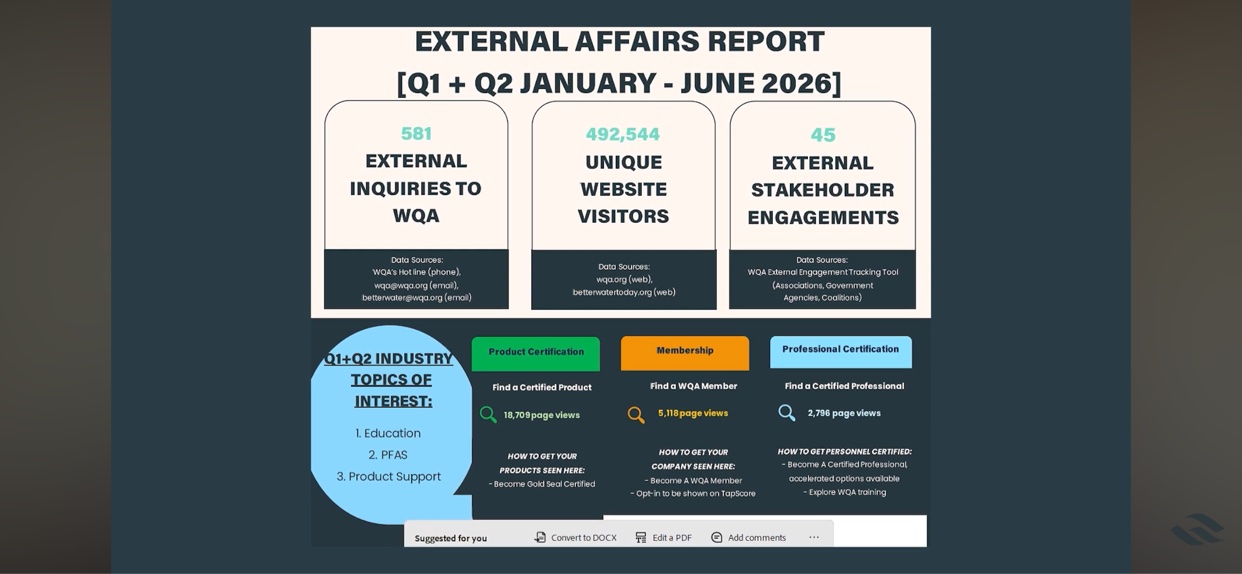
    For the first half of 2026, the WQA reported 492,544 unique visitors to their websites and 581 direct inquiries from the public. And when they listed what people came asking about, the number one topic wasn’t a product. It was education. Number two was PFAS. Number three was product support.

    Education first. That’s the whole idea behind this site.

    I’ve spent my career on the other side of the counter, and I’ll tell you what I told customers for years: learn what’s in your water before anybody sells you anything to fix it. The WQA’s own report says that’s exactly what the public is doing. People aren’t starting with a salesman anymore. They’re starting with questions.

    She also talked about how consumers find their way to the WQA — a lot of them start with a logo on a box, or another company, and go looking to see if the claim is real. That’s the habit I try to teach here: if a box says certified, don’t take the box’s word for it. Look the product up in the certifier’s own directory. 18,709 people viewed the WQA’s certified product search in that same period. I can’t prove my little corner of the internet sent any of them there — but teaching people to check is what I do, and the checking is clearly happening.

    One more thing they said plain, and it matters: the WQA does not recommend specific products. They test, they certify, they list — and then they stop. The picking is left to you. That’s the step I take here: every product in my buyer’s guide got looked up in the certifiers’ own directories before it earned its place. They built the library. Somebody still has to walk you to the right shelf.

    There’s something new in there too. The WQA is putting three doors in front of consumers now: find a certified product, find a member company, and find a certified professional — and member dealers can opt in to be shown on TapScore, a consumer water-testing platform. The trade association is learning what I’ve been saying: consumers want a way in that starts with information, not a sales pitch.

    And learn the difference between their two logos, because some dealers count on you not knowing it: the member logo means a company paid its dues. The Gold Seal means a product was actually tested and certified. Only one of those tells you anything about what’s in the box — and the member logo isn’t even allowed on product packaging.

    They also talked about their code of ethics, which matters to me — my article on spotting an honest water treatment company is built on holding this industry to its own stated standards. And their new slogan is “Creditability in every drop.” Creditability — credibility, being worthy of belief. If it means the industry plans to stand behind what it sells, I’ll take it.

    I was never a WQA member, and they don’t endorse this site — that independence is the point. But understand me: I support them. I support their code of ethics, their certification programs, and what they’re trying to do for this industry. You don’t have to carry a membership card to stand behind doing water right.

    Check the pH, then filter. And before that: learn.

    — Steve

    Video: https://youtu.be/In-UJhpauXM

  • Cadmium in Drinking Water

    Cadmium in Drinking Water

    Cadmium is the heavy metal nobody talks about — no headlines, no Erin Brockovich movie. But it has a legal limit three times lower than lead’s old action level, and it goes straight for your kidneys.

    What it is. Cadmium is a soft, bluish-white metal used in batteries, pigments, metal coatings, and plastics. Your body has no use for it at all — unlike copper or iron, there’s no “essential trace amount.” Any cadmium in your water is unwelcome.

    Where it comes from. The number-one household source: corrosion of galvanized steel pipes — the zinc coating on old galvanized plumbing contains cadmium, and acidic water leaches it out. Beyond the house: erosion of natural deposits, discharge from metal refineries, and runoff from waste batteries and paints. If your home has galvanized plumbing and low-pH water, you’re in the highest-risk category.

    The health picture, honestly. Kidneys first — cadmium accumulates there and damages them with chronic exposure. Long-term exposure is also linked to fragile bones and lung damage. Short-term high doses cause nausea, vomiting, and cramps. The EPA’s legal limit is 5 parts per billion (0.005 mg/L), and the health goal is set at the same level — no margin built in.

    How to test. A lab metals panel from a state-certified lab — cadmium rides along on the standard heavy-metals screen. Homes with galvanized pipes should test a first-draw sample (water that’s sat overnight). City water folks, check the annual report.

    What removes it. Reverse osmosis, ion exchange, and distillation all take cadmium below the legal limit — the EPA lists coagulation/filtration, ion exchange, lime softening, and RO as proven methods. NSF-53 listed filters cover cadmium. If galvanized pipes are the source, replacing the plumbing is the permanent fix; filtration handles the water in the meantime.

    What does NOT remove it. Boiling (concentrates it). Standard pitcher filters, water softeners alone, UV, chlorine.

    What I’d buy: Treatment type: an under-sink reverse osmosis unit, NSF listed, for drinking and cooking water. If your pipes are galvanized, plan the repipe as the real fix — but don’t drink the water unfiltered while you plan.

    Cadmium is a quiet contaminant — no taste, no stain, no smell. But old galvanized plumbing plus acidic water is a combination worth checking. A metals panel is cheap. Knowing is cheaper than not knowing.

    Curious what’s in your tap? Start with What’s In Your Water?