
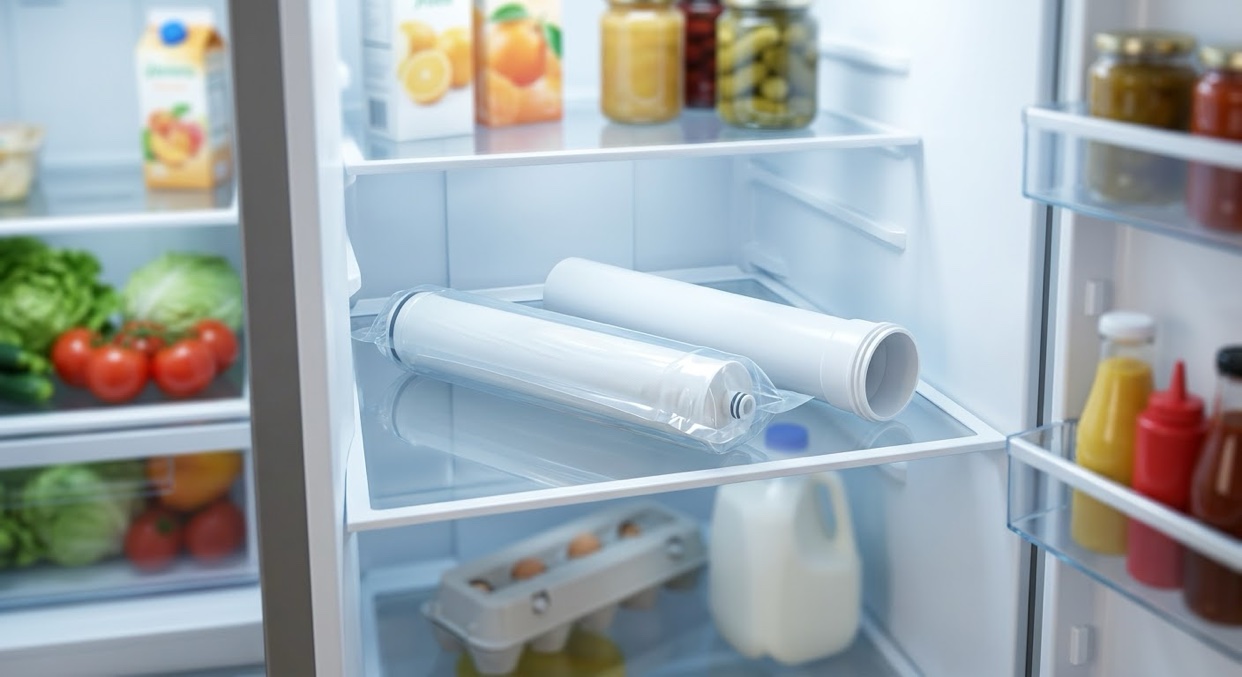
If you own a reverse osmosis (RO) system, keeping a spare membrane on hand is cheap insurance. When your current membrane eventually degrades or clogs, having a fresh replacement ready means you don’t have to wait days for shipping or drink unfiltered tap water in the interim.
But buying a spare is only half the battle. Store an RO membrane incorrectly and it can be ruined before it ever touches a drop of water in your system. Heat is its biggest enemy.
I keep my own spare membrane sealed up right inside my refrigerator, and readers ask me if that’s actually necessary or just an old wives’ tale. Here’s the straightforward explanation of how membrane storage works, why temperature matters, and how to make sure your spare actually works when you need it.
The Storage Rules: Cool, Dark, and Sealed
The gold standard for storing any reverse osmosis membrane comes down to three rules: keep it sealed in its original packaging, keep it dark, and keep it cool.
The ideal storage temperature for most residential RO membranes is roughly 40°F to 50°F (5°C to 10°C). DuPont FilmTec, the biggest membrane maker in the business, puts the overall storage envelope at about 22°F to 113°F (−4°C to 45°C) — but the cool end of that range is where a membrane lives longest.
That ideal band is precisely why a home refrigerator is the best place to keep a spare. Your kitchen fridge typically sits around 35°F to 40°F — cool enough to slow microbial growth to a crawl, and nowhere near freezing.
Two temperature warnings to remember:
- Don’t let a wet membrane freeze. Freezing is the hard limit for a membrane stored in liquid: ice forming in that liquid can physically damage the delicate membrane layers. (A dry membrane tolerates cold far better — but there’s no reason to test either one. A refrigerator never gets close.)
- Keep it out of the heat. Tossing a spare membrane on a shelf in a hot garage, attic, or sunny laundry room is the fastest way to ruin it. Heat breaks down the preservative in a wet membrane and accelerates biological growth — the two things that kill spares. More on that below.
Dry vs. Wet (Preserved) Membranes: The Big Distinction
How long your spare lasts in storage depends entirely on whether the manufacturer shipped it dry or wet.
Dry membranes
Many modern residential membranes — standard DuPont FilmTec elements among them — are dried during manufacturing and sealed in airtight bags.
- Shelf life: Because there’s no moisture to support bacterial growth, a factory-sealed dry membrane keeps almost indefinitely. FilmTec’s own storage guidance puts it plainly: the storage time of dry elements is unlimited, as long as the bag stays sealed.
- Storage needs: Keep the seal intact and the heat off it, and a dry membrane is very forgiving.
Wet (preserved) membranes
Some membranes are shipped wet — pre-tested and soaked in a preservative solution, typically a 1% sodium bisulfite solution.
- Shelf life: Finite. Plan on 12 to 18 months in the original packaging as the practical ceiling, and only if it’s stored cool.
- Storage needs: The preservative is what stops bacteria, algae, and mold from colonizing the damp membrane surface — and it doesn’t last forever. Inspect a wet-stored membrane every three months for biological growth, and refresh the preservative after about six months, or sooner if the liquid turns cloudy. If the preservative’s pH ever drops below 3, it’s done its job and then some — time to re-preserve or replace. This is where the refrigerator earns its keep: cold storage keeps that preservative stable and effective far longer than a warm shelf does.
Why Heat Kills Spare Membranes
Heat attacks a stored membrane from two sides:
First, warm temperatures make the sodium bisulfite preservative in a wet membrane break down and dissipate much faster. Manufacturer storage tables are blunt about it: above about 95°F (35°C), a preserved membrane’s rated storage life collapses to roughly a month.
Second, once the preservative is gone — or if a dry membrane’s seal is breached in a humid environment — heat acts as an accelerator for biological growth. Mold, fungi, and bacteria thrive in warm, dark spaces. Once biofouling takes root on a membrane surface, it clogs the microscopic pores — about 0.0001 micron on an RO membrane — and permanently ruins the element.
My Own Spare, Honestly
My spare is a standard residential membrane, and it has lived in my refrigerator for years, unused — emergency insurance, same as the rest of my gear. Here’s the honest math on a spare that old: if it shipped dry, as most modern residential membranes do, it’s very likely still good, because a sealed dry element doesn’t run on a calendar. If it shipped wet, the preservative’s rated life is long past, and no calendar can tell me whether it’s still fine. The verdict doesn’t come from the date — it comes from the install-day test below. That’s true of my spare, and it’s true of yours.
The Day You Install an Old Spare: Step-by-Step
When the day finally comes to unpack your stored membrane and put it to work, follow these steps to make sure it’s safe and performing correctly:
- Inspect the packaging. Before cutting open the bag, look closely at the liquid inside (if it’s a wet membrane). If the liquid looks cloudy, discolored, or smells foul or moldy, the preservative has failed. Do not install it.
- Install and flush thoroughly. Once the membrane is in its housing, turn on the water supply and let the system run. Throw away all the water produced during the first hour of operation. That flushes out any remaining preservative or manufacturing wetting agents.
- Test with a TDS meter. After flushing, check your water with a handheld TDS (total dissolved solids) meter. Measure your raw tap water first, then your RO water. A healthy TFC membrane should reject roughly 96% to 98% of dissolved solids — so if your tap reads 300 and your RO water reads 6 to 12, your stored spare survived just fine.
Summary
Tossing a spare RO membrane in an unconditioned garage is a recipe for a ruined filter. Keep your spare sealed in its original bag, store it away from direct sunlight, and if you want it to last as long as possible, give it a little corner on a shelf in your refrigerator. Keep it cool, keep it sealed, keep it from freezing — and it will be ready to perform when your system needs it.
Storage guidance checked against DuPont FilmTec membrane storage documentation and manufacturer storage references, October 2026.
Leave a Reply