
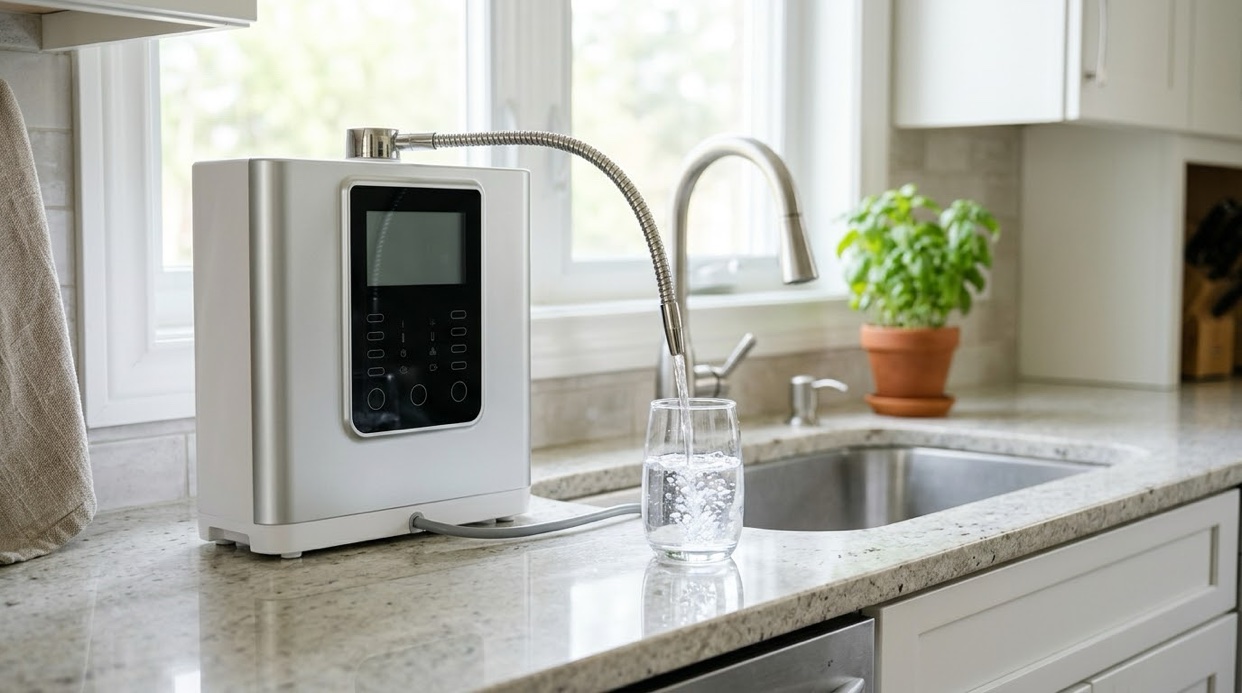
Spend any time looking into home water treatment and you will run into the machines: water ionizers. Kangen is the big household name, but plenty of brands sell similar countertop devices, all promising water that is “alkaline,” “ionized,” “electrolyzed reduced,” “hydrogen-rich,” and even “micro-clustered” — water that will change your health, your energy, and your life.
In the water treatment trade since 1994, I have watched equipment, trends, and marketing buzzwords come and go. This article is not here to scare you, and it is not here to sell you an alternative system. It is here to explain, in plain English, what these machines actually do, what they don’t do, and what you should know before spending your money.
What the Machine Actually Does
Look past the touchscreen and an ionizer is one core process: electrolysis. Inside is a chamber of platinum-coated titanium plates. As tap water flows over the charged plates, the electric current separates the water into two streams:
- An alkaline stream — water with a higher pH, which flows from the main drinking spout.
- An acidic stream — low-pH water that drains from a secondary hose.
That process is 100% real. The machine genuinely alters the pH of your water at the tap. But changing pH is one chemical trick — and it leads straight to the biggest misconception about these devices.
What the Machine Does NOT Do
Here is the most critical distinction every homeowner needs to hear: a water ionizer is not a water filter.
Changing the pH of your tap water does not remove anything from it. An ionizer does not remove:
- Heavy metals like lead, copper, or cadmium
- “Forever chemicals” such as PFAS and PFOS
- Agricultural runoff like nitrates, nitrites, and pesticides
- Disinfection byproducts like trihalomethanes and haloacetic acids
- Bacteria, viruses, or cysts
Most ionizers ship with a small built-in carbon cartridge. It knocks out basic chlorine taste and odor — which is why owners often say their water “tastes better,” and they’re not imagining that part — but it is nowhere near a certified filtration system. If your water contains a genuine health hazard, an ionizer hands it right back to you, at a higher pH.
If you have a water quality problem, an ionizer does not solve it.
The Claims, One at a Time
- “Micro-clustered water hydrates you better.” Sales reps claim ordinary water forms “large clusters” of 13 to 15 molecules that your body struggles to absorb, while ionized water breaks into “micro-clusters” of 5 to 6 that slip straight into your cells. The reality: in liquid water, hydrogen bonds between molecules form, break, and reform on a scale of picoseconds — trillionths of a second. No stable clusters exist to break. There is no accepted scientific evidence that “micro-clustered” water exists, or that it changes hydration. Your body absorbs water through tiny protein channels called aquaporins, one molecule at a time, and it manages fine without any clustering.
- “Alkaline water balances your body and improves your health.” The core pitch is that high-pH water counteracts an “acidic diet” and detoxifies you. The reality: the moment alkaline water reaches your stomach, it meets gastric acid at a pH of 1.5 to 3.5, which neutralizes it on contact. Your blood holds a strict pH of 7.35 to 7.45, maintained by your lungs and kidneys — what you drink does not move it. There are no recognized medical health claims for ionized water.
- “Hydrogen-rich, antioxidant water (negative ORP).” Dissolved molecular hydrogen is a legitimate subject of laboratory research. But the hydrogen a household ionizer produces is variable, unstable, and largely gone once the water sits in a glass — and the sweeping claims (prevents chronic disease, reverses aging) are unproven in human clinical trials.
- The one honest benefit: taste. Some people genuinely like the smooth taste of the water — mostly thanks to that little carbon cartridge taking out chlorine. If a machine on your counter gets your family drinking more water instead of soda, that’s a real benefit. Just don’t confuse good taste with medical treatment.
- The two “extreme” waters need an additive — and they’re chemistry, not magic. The drinking settings don’t use additives. But the strongest settings on the sales sheet — the pH 2.5 “sanitizing” water and the pH 11.5 “cleansing” water — cannot be made without adding an “electrolysis enhancer” fluid. By the manufacturer’s own ingredient list, that fluid is water, sodium chloride (table salt), and a small amount of sodium hypochlorite. Electrolyzing it produces, on the acid side, hypochlorous acid at 20 to 60 parts per million of available chlorine — a genuine chlorine sanitizer, which is the actual reason that water disinfects cutting boards and gets used on vegetables. On the alkaline side it produces a weak sodium hydroxide solution — which is why it degreases: it behaves like soap, because chemically that’s its family. Neither strong water is for drinking, and the manufacturer says so. One more thing, stated plainly because you’ll hear it claimed both ways: those additives are not classified carcinogens. The honest objection isn’t poison — it’s that ordinary sanitizer-and-soap chemistry is being sold as a health miracle.
What About the Certifications?
Fair is fair: the best-known ionizer brand, Enagic (the Kangen maker), holds real certifications — four WQA Gold Seals, verified in the Water Quality Association’s official listing for its K8 and SD501 models. But a seal only means what its standard says, so let’s say the seal, then say what the seal means:
- NSF/ANSI 42 — Aesthetic Effects. This certifies the built-in cartridge reduces chlorine taste and odor. It is a taste claim — the only performance claim on the list.
- NSF/ANSI 372 — Lead Content of Components. This certifies the machine’s own parts are made with low-lead materials. It certifies that the machine doesn’t add lead. It removes none. (At least one distributor’s page describes this seal as able to “effectively remove lead” — that is false, and it’s exactly why the scope matters.)
- NSF/ANSI 18 — Food & Beverage Dispensing Equipment. The machine is safe for serving drinks, including commercially.
- CSA B483.1 — Drinking Water Treatment Systems. A Canadian construction and safety standard.
Now compare a reverse osmosis system, which carries NSF/ANSI 58 — certification for the RO process itself, including reduction of total dissolved solids and specific contaminants — often alongside NSF/ANSI 53, the health-effects standard covering things like lead, PFAS, and cysts. The ionizer holds none of those: no 53, no 58, no 401. Same three letters — NSF — on the brochure, completely different universe. Its certifications say it is a well-built appliance whose small filter freshens the taste of your water. Nothing certifies it to make water safer, and nothing certifies the water to make you healthier.
Enagic is also licensed in Japan as a medical device manufacturer — electrolyzed-water generators are a regulated medical-device category there — and its factory runs an ISO 13485 quality system. That licenses the making of the machines. It is not proof the water treats anything, and it does not transfer to the United States, where no health claim for ionized water is FDA-approved.
The Practical Downsides
- Cost. Quality ionizers routinely run $2,000 to $5,000 or more; the flagship Kangen K8 sells for roughly $5,000 to $5,900.
- Multi-level marketing. The biggest brands are sold through multi-level marketing, so a substantial share of the price pays commissions up a chain of distributors rather than hardware. One industry analysis of the K8 put roughly $2,850 of its price into distributor commissions.
- Scale and maintenance. Hard water is an ionizer’s enemy: calcium and magnesium scale up the electrolysis plates, efficiency drops, and the machine needs routine cleaning cycles and cartridge replacements.
- The pH doesn’t last. Alkaline water sitting in a pitcher absorbs carbon dioxide from the air, forms carbonic acid, and drifts back toward neutral. The shift you paid for fades in storage.
The Honest Bottom Line
pH is a measurement — of hydrogen ion concentration. It is not a measure of purity, safety, or health. High-pH water is not clean water, and low-pH water is not dirty water.
If you’re concerned about your tap, don’t start with buzzwords. Start with your utility’s annual Consumer Confidence Report, or an independent certified lab test of your own tap or well. Find out what is actually in your glass. Then choose a certified technology — activated carbon, reverse osmosis, specialized media — built to remove those things.
Facts first, then filter. — Steve
“check the pH, then filter.”
Leave a Reply