
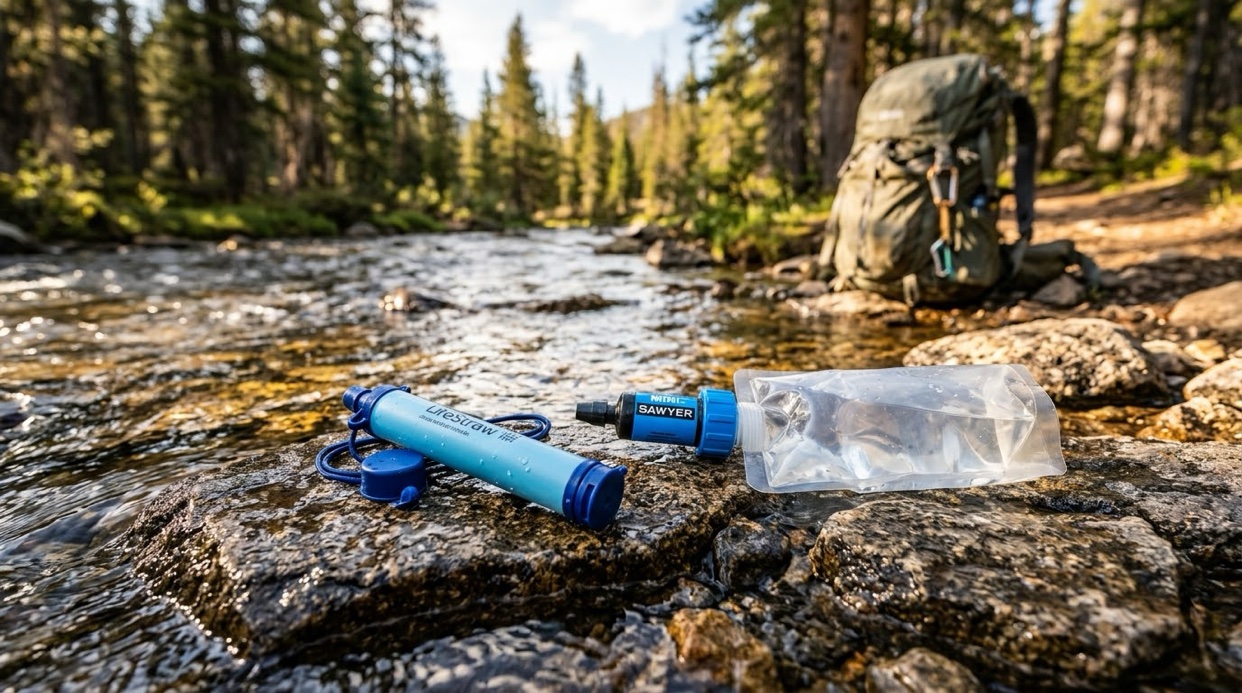
If you have ever shopped for ultralight water filtration — whether for backpacking, international travel, or an emergency kit — you have run into the LifeStraw Personal and the Sawyer MINI. They are the two most recognizable personal water filters on the market.
Both use hollow-fiber membrane technology, cost under $30, weigh practically nothing in a pack, and protect against dangerous waterborne pathogens out in the wilderness. Because they look so similar on paper, gear lists constantly pit them against each other. In real-world field use, though, these two filters work quite differently.
Side-by-Side Specifications
LifeStraw Personal
- Filter type: Hollow-fiber membrane microfilter
- Pore size: 0.2 micron
- Rated lifespan: 1,000 gallons (4,000 liters)
- Weight: 1.6 oz (46 g)
- How you drink: Direct straw — straight from the source or a container
- Backflushable: No syringe backflush — you blow air back through it after use
- List price: $17.95
Sawyer MINI
- Filter type: Hollow-fiber membrane microfilter, absolute-rated
- Pore size: 0.1 micron absolute (no pore larger than 0.1 micron)
- Rated lifespan: Up to 100,000 gallons
- Weight: 2 oz (the filter unit alone is 1.4 oz)
- How you drink: Included squeeze pouch, standard 28mm bottles, inline on a hydration pack, or the included straw
- Backflushable: Yes — cleaning plunger (syringe) included
- List price: $28.99 (often sold for less)
What Both Filters Remove
Both filters work the same basic way: hollow-fiber membranes act like microscopic sieves. Water passes through; anything larger than the pore openings gets trapped.
- Bacteria: LifeStraw removes 99.999999% of waterborne bacteria; the Sawyer MINI removes 99.99999%. Both cover the dangerous ones — E. coli, Salmonella, and Vibrio cholerae (cholera).
- Protozoa and parasites: LifeStraw removes 99.999% of parasites; the Sawyer MINI removes 99.9999% of protozoa — including Giardia and Cryptosporidium.
- Microplastics, sediment, and cloudiness: Both physically block them. LifeStraw rates microplastic reduction at 99.999%; Sawyer claims 100% of microplastics. Either way, cloudy water comes out clear.
LifeStraw also notes the Personal meets US EPA and NSF P231 drinking water standards for the removal of bacteria and parasites.
What NEITHER Filter Removes
Let’s be completely blunt: neither of these is a full-spectrum purifier or a home treatment system. They are physical microfilters built for backcountry and emergency water, where microbes are the primary risk. Neither one will remove:
- Viruses. Norovirus, Hepatitis A, and Rotavirus run roughly 0.02 to 0.08 microns across — smaller than either filter’s pores. They pass straight through.
- Chemicals and pesticides. Agricultural runoff, industrial chemicals, and chlorine pass through a hollow-fiber membrane untouched. There is no activated carbon stage in either base model.
- Heavy metals. Dissolved lead, arsenic, and mercury need chemical reduction, ion exchange, or reverse osmosis. A microfilter will not reduce them.
- PFAS. The “forever chemicals” cannot be screened out by physical microfiltration alone.
- Bad taste and odor. No carbon core means stagnant, marshy water still tastes like stagnant, marshy water.
The step up is reverse osmosis — and it doesn’t have to mean a plumbed-in system. Manual hand-pump RO units exist for off-grid and emergency use (I keep one in my own kit). One honest caveat: unlike home RO systems, none of the hand-pump models is NSF/ANSI 58 certified — you are trusting the membrane, not a certification.
If you need to treat tap water at home, or water near agricultural or industrial runoff, you need a dedicated home system or a true purifier. These little filters are for pathogens on the trail.
Real-World Differences That Actually Matter
Versatility and threading
This is the biggest practical difference. The LifeStraw Personal is a pure drinking straw: you kneel at the stream, or stick it in a cup or wide-mouth bottle, and suck. The classic model has no threads, so you can’t screw it onto a bottle or squeeze filtered water into a cook pot for a group. (Worth knowing: LifeStraw’s newer Peak Series straw fixes exactly this — its removable bottom cap threads onto standard bottles and gravity hoses. Same membrane and ratings, a little more money, 2.3 oz.) The Sawyer MINI has standard 28mm threads — it screws onto disposable water bottles, attaches to its included squeeze pouch, runs inline on a hydration bladder, or works with its included straw.
Flow rate and clogging
LifeStraw’s slightly larger 0.2-micron pores make for an easier pull when drinking straight from a source, though flow fades as silt builds up. The MINI’s tight 0.1-micron absolute pores are the safer barrier, but its small surface area makes it slow — filter silty water and it clogs fast and needs cleaning in the field. Even dealers will tell you the MINI filters slower and needs more frequent backflushing than its bigger brother, the Sawyer Squeeze.
Cleaning and maintenance
LifeStraw maintenance is blowing air back through the straw after use to clear water and sediment — LifeStraw itself calls this backwashing, but there’s no syringe and no deep flush. Once silt permanently clogs the membrane, the filter is done. The Sawyer MINI ships with a cleaning plunger: push clean water backward through it and you flush out the trapped sediment. Sawyer says a proper backwash restores up to 98.5% of the filter’s flow rate — which is how the MINI can carry that huge lifespan rating.
Realistic lifespan
LifeStraw is rated for 1,000 gallons (4,000 liters) — for one person, that’s years of emergency and weekend use, and it has an unlimited shelf life sitting in a kit. The MINI is rated up to 100,000 gallons. You’ll never filter 100,000 gallons in a lifetime, but because it can be backflushed and restored, it will outlast the LifeStraw under heavy field use.
Who Should Buy Which One?
Buy the LifeStraw Personal if:
- You’re building emergency kits — it’s grab-and-go, foolproof, and has no loose accessories or syringe to keep track of.
- You want absolute simplicity: no threads to match, no pouches to roll. Stick it in water and drink.
- Budget comes first: at $17.95, it’s one of the most accessible emergency filters on earth.
Buy the Sawyer MINI if:
- You’re a backpacker or hiker — fill a bottle or the pouch, screw the MINI on, drink on the go or squeeze clean water into a cook pot.
- You want one filter that works four ways: straw, squeeze, inline on a bladder, or gravity-fed.
- You want long-term durability: backflushing gives it a far longer working life.
What I’d Buy: The Honest Verdict
Full disclosure first: I own LifeStraws myself — two different models, and they live in my go bag. For an emergency kit I’d buy them again — nothing to assemble, nothing to lose, ready in ten years if they have to be.
But if I had to pick just one for a hiking pack, I’d pick the Sawyer MINI. Being forced to put your face down at a dirty water source every time you drink is a real limitation on the trail. The MINI screws onto a standard bottle or its own pouch, so you fill up and walk. Add the syringe backflushing and the 100,000-gallon rating, and it wins on versatility and maintainability every time.
One step-up worth knowing: if your trails run silty or muddy, look at the standard Sawyer Squeeze — same idea, larger surface area, faster flow. Between the two little ones, though, the MINI is the trail pick and the LifeStraw is the emergency-kit pick. Honestly, at these prices, owning both — one in the pack, one in the kit — is a perfectly reasonable answer. It’s the direction my own kit is heading: the LifeStraws aren’t leaving my go bag, and I’d add the Sawyer alongside them.
Specs and removal rates are from the manufacturers’ own product pages (LifeStraw.com and Sawyer), checked October 2026. Prices are US list prices at the time of checking and change often — confirm before you buy.
Leave a Reply