
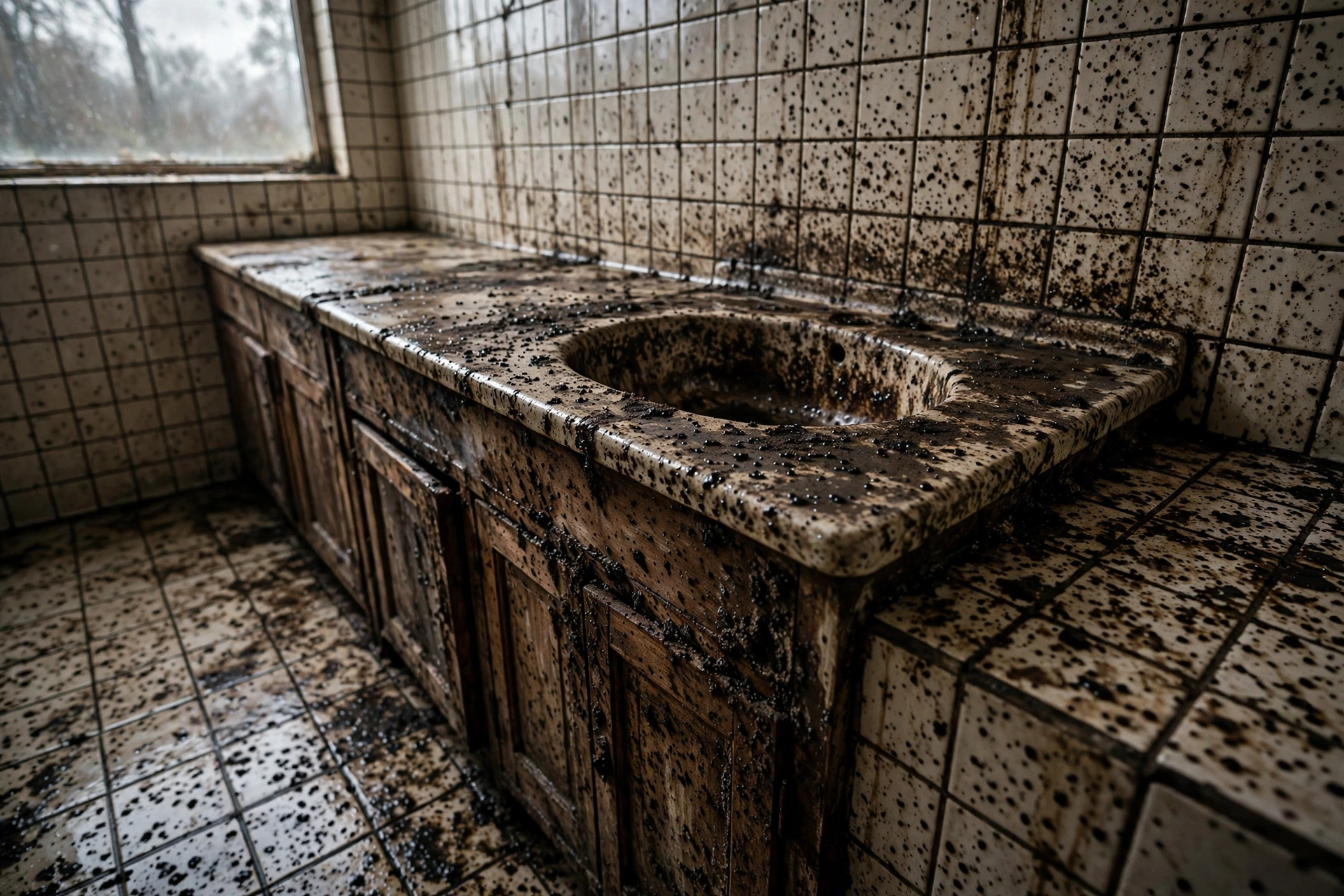
If iron stains orange, manganese stains black — and it’s iron’s constant companion in well water. Most people meet manganese through their laundry: dark brown or black stains that no detergent fixes.
What it is. Manganese is a naturally occurring mineral, an essential nutrient in trace amounts — your body needs a little. Like iron, it dissolves into groundwater invisibly and reveals itself through staining, metallic taste, and black particles.
Where it comes from. Geology — manganese-bearing rock and soil — the same aquifers that produce iron problems usually produce manganese alongside it. It’s the classic private-well nuisance, often riding in with iron.
The health picture, honestly. At typical levels, manganese is an aesthetic problem: black staining, bitter metallic taste. But unlike iron, it has a health dimension at higher levels — the EPA’s lifetime health advisory is 0.3 mg/L, with infants under 6 months the most vulnerable (developing brains, and formula made with high-manganese water is the exposure route). Long-term high exposure is linked to neurological effects: memory, attention, and motor issues. The secondary standard is 0.05 mg/L — that’s about staining, not health.
How to test. A lab test for manganese plus iron and pH — you almost always treat them together. If you see black staining, test. If you’re mixing infant formula with well water, test before the first bottle.
What removes it. Same playbook as iron: for low levels, a water softener (cation exchange). For higher levels, oxidation plus filtration — manganese greensand or equivalent oxidizing media converts dissolved manganese to filterable particles. Aeration plus filtration for moderate levels. NSF/ANSI 42 covers manganese reduction claims.
What does NOT remove it. Boiling — it concentrates manganese as water evaporates. Standard carbon pitchers, UV, chlorine alone.
What I’d buy: Treatment type: match it to the numbers like iron — a water softener for low levels, an oxidizing filter (manganese greensand or equivalent) at the point of entry for higher levels. If iron is present too (it usually is), one properly sized system handles both. Test first: manganese level, iron level, pH.
Manganese is iron’s shadow — same sources, same treatment, darker stains. And unlike iron, it deserves respect at high levels, especially around infants. Test, treat, verify.
Curious what’s in your tap? Start with What’s In Your Water?
Leave a Reply