
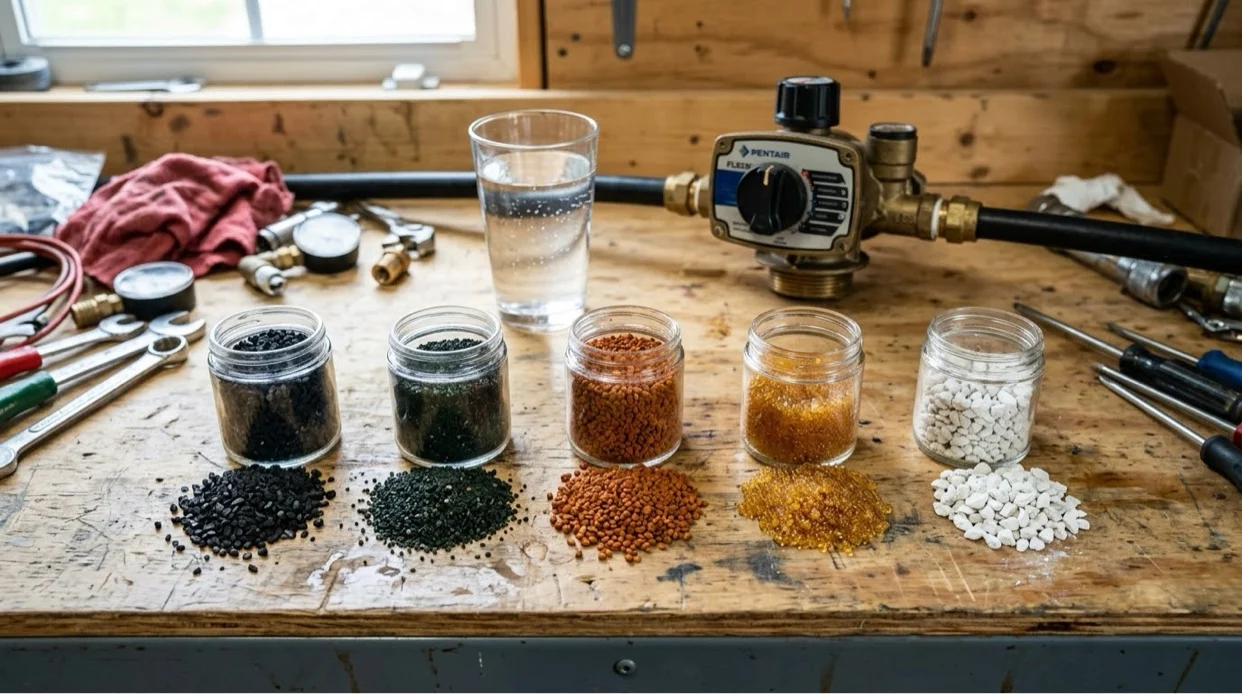
Every water filter ever sold is the same product wearing different clothes: a box, water flowing through it, and a material inside doing the actual work. That material is called the media, and the media — not the brand name on the tank — decides what comes out of your water and what stays in. Here’s the honest tour of what’s inside the box.
Granular activated carbon (GAC). The workhorse. Water passes over a bed of tiny carbon granules and contaminants stick to their enormous surface area — that’s adsorption. GAC is excellent on chlorine, bad taste and odor, and many VOCs (the chemical family from solvents and fuels). Its weaknesses: it’s slow against chloramine, it doesn’t do metals, and water can carve channels through a settled bed and slip past untreated. You’ll also see silver-impregnated carbon, sold as “bacteriostatic” — the silver keeps bacteria from colonizing the carbon bed itself. Honest note: that’s all it does. It does not disinfect your water, and it carries no purifier claim.
Catalytic carbon. GAC’s upgraded cousin — carbon treated so its surface doesn’t just grab contaminants, it chemically converts them. This is the media for chloramine (the disinfectant GAC struggles with), hydrogen sulfide (rotten-egg gas), and some iron. It costs more, and it wants sediment filtered out ahead of it so the surface stays clean.
Carbon block. Carbon ground up and pressed into a solid block, so water has to push through it instead of around granules. That structure adds fine sediment filtration and, in a tight enough block, cyst removal. This is where microns matter: a block rated 0.5 micron absolute is fine enough to stop cysts like Giardia — “absolute” means essentially everything that size is caught, while a “nominal” rating at the same number only catches most of it. The trade-off is flow: tighter block, more pressure drop, and it clogs fast if dirty water hits it first.
KDF media. Granules of copper and zinc alloy that work by redox — a tiny electrochemical reaction. KDF-55 is aimed at chlorine and soluble heavy metals; KDF-85 is the version for ferrous iron and hydrogen sulfide. It’s dense, heavy stuff, and it needs a strong backwash to stay clean, which is why you mostly see it in whole-house systems and shower filters rather than pitchers.
Birm, greensand, and the oxidizing bench. A family of dark, heavy media built to do one trick: grab dissolved iron and manganese out of the water and turn them into particles the bed can strain out — the oxidation-plus-filtration the iron and manganese articles keep pointing at. Birm is a lightweight media coated in manganese dioxide, which acts as a catalyst: with enough dissolved oxygen in the water (and pH up around 6.8 or better), it oxidizes iron on contact and needs no chemicals to regenerate — just a backwash. Manganese greensand (today usually GreensandPlus) is the old-school original: it oxidizes and filters in one bed, but it needs to be regenerated with potassium permanganate, or fed chlorine continuously, to keep its coating alive. Filox is the heavyweight cousin — solid manganese dioxide ore, higher capacity, hungrier for backwash flow. Pick wrong for your water chemistry and these beds fail quietly, which is why the test numbers come before the tank.
Calcite — the pH fixer. Not every media removes something; calcite’s job is to give something back. It’s crushed calcium carbonate — marble, basically — and acidic water slowly dissolves it as it passes through, raising the pH toward neutral. That’s the fix for the low-pH water that leaches copper and lead out of plumbing (the hydrogen article’s villain). It’s sacrificial: the bed literally gets eaten, so it needs topping up every year or so, and it adds a little hardness back as it works. For very low pH, calcite gets blended with Corosex (magnesium oxide), which corrects harder but can overshoot if it’s used alone.
Filter-Ag and the sediment bench. Somebody has to stand at the door and catch the grit before it fouls the expensive media downstream. Filter-Ag is a lightweight aluminosilicate granule used in backwashing sediment tanks — lighter than sand, so it backwashes clean at lower flow, with a big capacity for holding suspended dirt. Anthracite plays the same role layered into multi-media beds. No chemistry here, just a bouncer — but every media in this article lasts longer with one working ahead of it.
Cation resin — the softener resin everyone knows. Millions of tiny beads pre-loaded with sodium. Hard water flows through, and calcium and magnesium (both positively charged — cations) swap places with the sodium. When the beads are spent, salt brine flushes the hardness off and reloads them. One job, done well: killing hardness. It also grabs low levels of iron and manganese, which is why softeners sometimes double as light iron filters — and why chlorine in the water slowly chews the beads up over the years.
Anion resin — the lesser-known sibling. Same bead idea, opposite charge: anion resin trades negative ions. That’s not hardness — that’s nitrate, sulfate, tannins (the tea color in well water), and arsenate. It’s the specialist you bring in when the problem isn’t scale but a specific contaminant on the negative list. It regenerates differently from softener resin — caustic soda or salt depending on the type — and it has one famous quirk, which brings us to the fish. (Honorable mention while we’re on specialists: activated alumina, an adsorptive media that earns its living on fluoride and arsenic — you met it in the fluoride article.)
Why your water smells like fish. Here’s a call every honest water tech has taken: “My water smells like a fish market.” Nine times out of ten, there’s anion resin in the system. The most common strong-base anion resin (Type 1) is built with a chemical group based on trimethylamine — literally the compound that makes old fish smell like old fish. When chlorine or chloramine in the water attacks those groups, or the resin runs exhausted, trace amines break loose and the water picks up the smell. Two honest facts: your nose can detect trimethylamine at astonishingly low levels, so a whisper of it smells like a dock — and at the levels involved, it’s an aesthetic problem, not a poisoning. It’s still worth fixing, because nobody should have to hold their nose to drink.
The fixes. Carbon before the anion resin, to strip the chlorine out first — chlorinated water should never run straight through anion resin; that’s the whole ballgame. New resin gets a thorough rinse (a good flush of many bed volumes) before it goes into service. Exhausted resin gets regenerated; resin that’s been oxidatively chewed up gets replaced. And if you’re specifying a new system, Type 2 anion resin is built on a different amine chemistry and is far less prone to the fishy release. Buy potable-grade resin certified to NSF/ANSI 61 — the standard for materials that touch drinking water.
Where they meet. Run water through both resins — cation in one form, anion in another — and you get deionized water: virtually everything dissolved stripped out. That’s lab water, aquarium water, spot-free-rinse water. For drinking, it’s overkill, and water that pure is aggressive — it wants to dissolve something, which is a whole other article.
What I’d buy: Match the media to your test results, not to a sales pitch. Chlorine taste: GAC. Chloramine: catalytic carbon. Cysts: a 0.5-micron absolute carbon block. Hardness: cation resin (a softener). Iron and manganese with oxygen in the water: a Birm or greensand bed. Acidic water eating your pipes: calcite. Nitrate or tannins: anion resin — with carbon ahead of it, always. And if your water smells like fish, don’t replace the whole system before you check what’s happening at the anion bed.
The box is just plumbing. The media is the filter. Know which one your water needs, and you’ll never buy the wrong box again.
Curious what’s in your tap? Start with What’s In Your Water?
Leave a Reply