
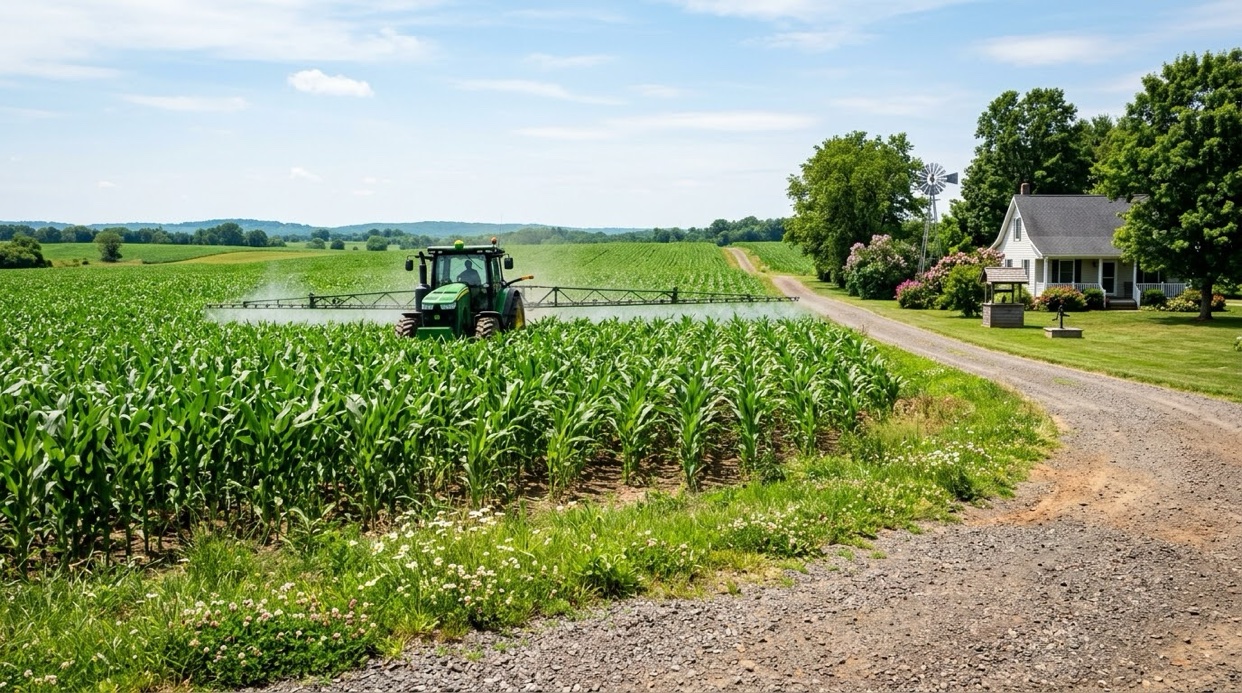
2,4-D (short for 2,4-dichlorophenoxyacetic acid) is one of the most widely used herbicides in the world. It belongs to the phenoxy class of synthetic weedkillers, designed to target broadleaf weeds without killing grasses. While agriculture relies heavily on it for row crops like corn, wheat, and pastureland, it is just as common on residential home lawns, golf courses, and commercial turf across the country.
Because of its massive annual usage in both commercial farming and suburban lawn care, understanding how 2,4-D moves into local water sources is essential for anyone relying on a private well or municipal supply.
Where It Comes From and Why It Is Still Used Today
The Environmental Protection Agency (EPA) lists the primary source of 2,4-D in drinking water as runoff from herbicide used on row crops.
To understand this chemical, you have to look at the contrast that defines it. Its close chemical cousin Silvex (2,4,5-TP) was banned in 1985 due to contamination issues and environmental persistence, but 2,4-D was NOT banned and is still in widespread use today. That makes 2,4-D a current-use contaminant, not a legacy chemical washing out from decades past. Millions of pounds are legally purchased, mixed, and sprayed across fields and neighborhood lawns every single year.
How It Enters Drinking Water Supplies
Because 2,4-D is actively sprayed throughout the growing season, its migration into drinking water is driven by seasonal weather patterns and local application schedules.
When farmers apply 2,4-D to crops or land management crews spray suburban turf, the chemical sits on plant foliage and topsoil. Heavy rainfall following a spring or summer application washes the herbicide off land surfaces as agricultural and storm runoff, carrying it directly into rivers, lakes, and reservoirs used for municipal tap water.
In rural and semi-rural areas, rainwater also dissolves the compound, allowing it to seep down through light or sandy soils. Over time, these percolating rainwater currents reach underground aquifers that feed private drinking water wells. Shallow wells located down-gradient from active agricultural acreage or heavily treated turf grass face the highest risk of seasonal spikes.
2,4-D Drinking Water Standards (EPA Facts)
- EPA Health Goal (MCLG): 0.07 mg/L
- EPA Enforceable Limit (MCL): 0.07 mg/L (70 parts per billion)
- Comparison: The health goal and the limit are the same number.
- Stated Long-Term Health Effect: Kidney, liver, or adrenal gland problems (at levels above the limit).
- Regulatory Status: Active, current-use herbicide (NOT banned).
Health Effects of 2,4-D
Federal safety standards monitor 2,4-D levels in drinking water supplies to safeguard residential health over long-term consumption.
The EPA establishes maximum contaminant thresholds based on toxicology evaluations and health impact studies:
- Organ System Impacts: The EPA's stated health effect of drinking water containing 2,4-D at levels above the limit over long periods is kidney, liver, or adrenal gland problems.
- Goal vs. Limit: The EPA set both the health goal (MCLG) and the enforceable limit (MCL) at 0.07 mg/L (70 parts per billion). The health goal and the limit are the same number — saying plainly that public water suppliers must maintain concentrations at or below this safety threshold to remain in legal compliance.
If testing indicates that a public water provider exceeds the 70 parts per billion limit, the utility is legally required to implement public notifications and take treatment measures to bring concentrations back down.
How to Remove 2,4-D from Drinking Water
If a certified laboratory water test reveals 2,4-D in your private well or tap water, basic mechanical filtration will not solve the issue. Ordinary sediment filtration — such as spun polypropylene cartridge filters or pleated paper units — does not remove dissolved herbicides. Sediment filters only trap physical particles like dirt, silt, sand, and scale rust. Chemical compounds like 2,4-D dissolve completely into liquid water at the molecular level, floating straight through particle filter pores.
Granular activated carbon (GAC) is the standard treatment method for this kind of herbicide.
How Granular Activated Carbon Works
Granular activated carbon filters remove chemical herbicides using a physical-chemical mechanism known as adsorption.
- Massive Surface Area: Carbon media (often processed from high-grade coconut shells or coal) undergoes high-temperature thermal activation. This creates millions of microscopic pores and internal channels, giving a single pound of carbon the surface area of several football fields.
- Molecular Attraction: As water containing dissolved 2,4-D passes slowly through the packed carbon bed, non-polar organic molecules like herbicides are attracted to the carbon's surface walls.
- Trapping Contaminants: The 2,4-D molecules bind tightly inside the microscopic pore matrix. The herbicide remains locked onto the carbon while purified water passes freely out of the filter housing.
Granular activated carbon can be installed as a whole-house point-of-entry (POE) tank to treat every faucet in the home, or as an under-sink point-of-use (POU) system dedicated solely to cooking and drinking water.
Always confirm contaminant levels through a state-certified laboratory test before choosing or installing any home treatment system.
Facts first, then filter. — Steve
Leave a Reply