
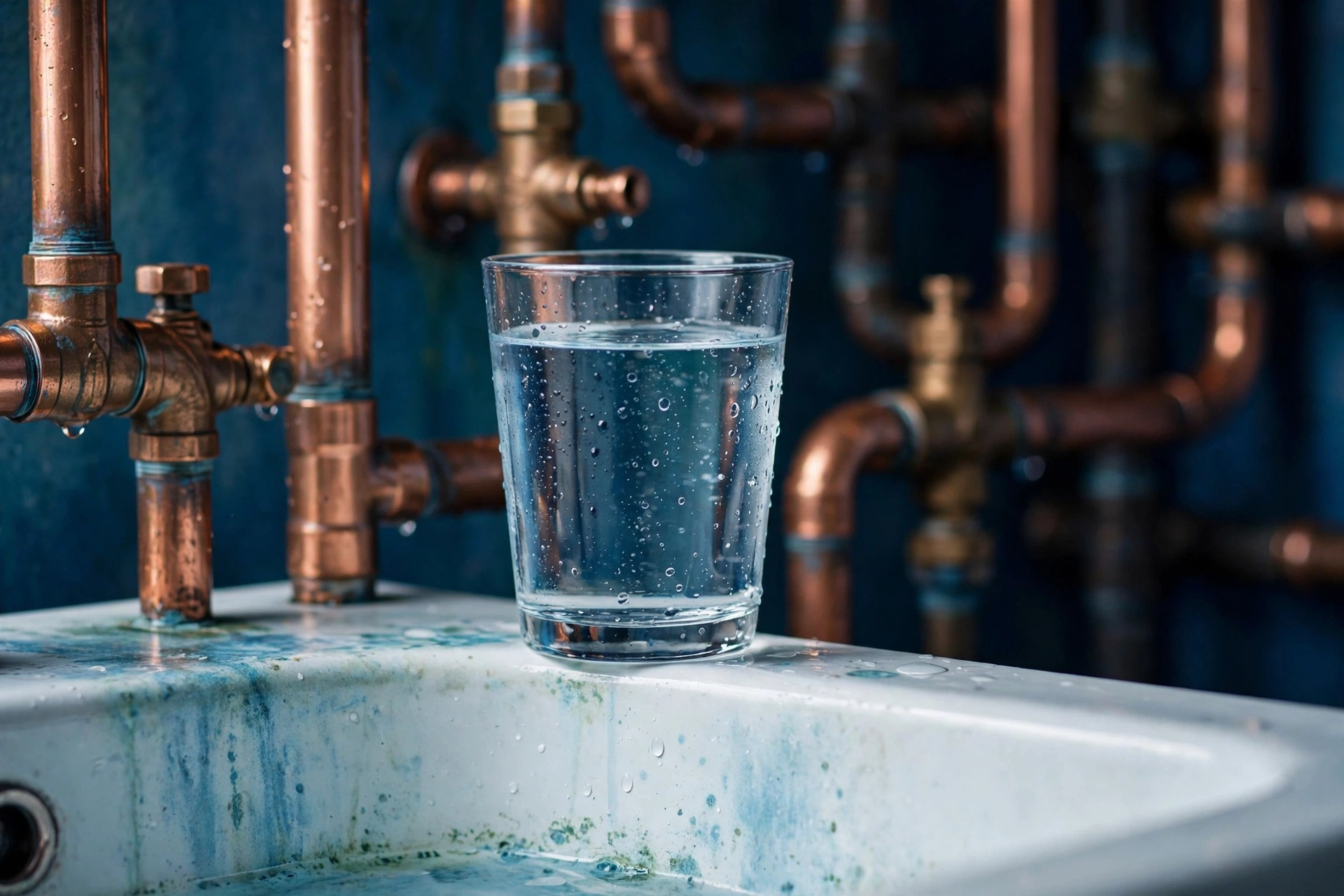
Copper is the contaminant that comes from inside the house — literally. Your water can leave the treatment plant perfectly clean and pick up copper on the way to your glass, straight out of your own plumbing.
What it is. Copper is an essential mineral in trace amounts — your body needs a little. The problem is dose, as usual. In drinking water, copper comes almost entirely from corrosion of copper pipes, fittings, and fixtures in household plumbing, especially when the water is acidic or low in mineral content.
Where it comes from. Your pipes. New copper plumbing leaches the most in its first few years, and corrosive water (low pH, soft water) keeps leaching indefinitely. The tell is unmistakable: blue-green stains in sinks, tubs, and toilets. If you see that staining, you’ve got copper in the water — the only question is how much.
The health picture, honestly. Short-term, excess copper causes nausea, vomiting, and stomach cramps — the classic “bad water at the new house” story. Long-term exposure above the action level can damage the liver and kidneys, and it’s dangerous for people with Wilson’s disease, a genetic condition that prevents the body from clearing copper. The EPA’s action level is 1.3 mg/L — not a hard MCL but a trigger: if more than 10% of sampled taps exceed it, the utility must act.
How to test. A first-draw sample (water that’s sat in the pipes overnight) from a lab, or your utility’s report. If you see blue-green staining, don’t wait for a report — test. Also check your water’s pH; acidic water plus copper pipes is the combination that causes this.
What removes it. Two approaches: fix the cause or filter the symptom. Fixing the cause means addressing corrosive water — a calcite neutralizer or soda ash injection raises pH and stops the leaching. Filtering the symptom means reverse osmosis or ion exchange at the drinking-water tap, both effective against dissolved copper. NSF-53 listed filters cover copper.
What does NOT remove it. Standard pitcher filters aren’t rated for meaningful copper reduction at high levels. Boiling concentrates it. Water softeners don’t remove dissolved copper — and soft water can actually be more corrosive to copper pipes.
What I’d buy: Treatment type: start with a water test plus a pH check. If the water is acidic, a calcite acid neutralizer treats the cause for the whole house. For the drinking water specifically, an under-sink reverse osmosis unit takes out the copper that’s already dissolved. Cause first, filter second.
Copper is one of the few contaminants where your house is the source — which means it’s also one of the few you can fix at the root. Test, check the pH, and treat accordingly.
Curious what’s in your tap? Start with What’s In Your Water?
Leave a Reply