
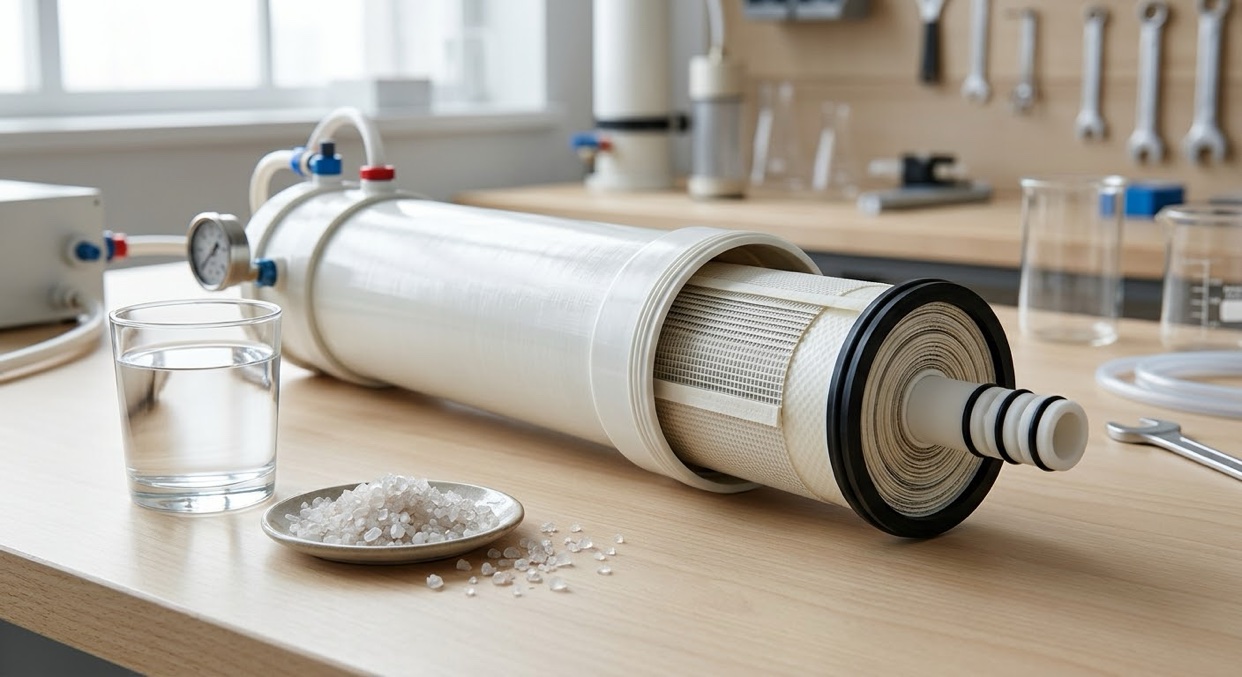
If you have spent any time looking into home water filtration, you have probably heard of reverse osmosis, and maybe ultrafiltration. But every now and then, a homeowner asks me about a middle-ground technology called nanofiltration (NF).
When folks bring it up in the kitchen, they are usually trying to solve a specific problem: they want the deep, molecular-level filtration of a membrane, but they don’t necessarily want to strip every single mineral out of their water — or they want a way to deal with hardness without hauling salt bags.
Here is my plain-English, no-hype breakdown of what nanofiltration actually is, how it works, where it shines, and where it falls short.
What Nanofiltration Actually Is
In the water treatment world, membrane filtration sits on a spectrum defined by pore size. On the coarser end, you have microfiltration and ultrafiltration. On the tightest end, you have reverse osmosis (RO).
Nanofiltration sits right in the middle — it’s frequently nicknamed “loose RO,” and that nickname tells you most of the story.
It uses a semipermeable membrane and pressure to separate contaminants from water, but it is engineered with a very specific selectivity in mind. Rather than acting as a total barrier to everything dissolved in the water, it is designed to let certain small, simple substances pass through while blocking larger, more complex molecules and specific minerals.
The Pore Size and How It Works
To understand nanofiltration, we have to talk about micron ratings. A micron (short for micrometer) is one-thousandth of a millimeter. For context, a single human hair is about 70 microns wide, and a typical bacterial cell is around 1 micron.
An NF membrane works at a pore scale of about 0.001 microns — 1 nanometer, which is where the “nano” in its name comes from.
But nanofiltration does not work by size alone. If it relied only on microscopic holes, you wouldn’t get the selective performance NF is famous for. NF membranes are also made with a slight negative electrical charge on their surface, so they separate using two mechanisms at once:
- Physical sieving: blocking particles and molecules larger than the membrane’s pores.
- Charge repulsion: electrically pushing back dissolved ions, depending on how strong a charge those ions carry.
One more thing worth knowing: because the openings are too small to rate the way we rate ordinary filters, NF membranes are usually specified by molecular weight cut-off — roughly 200 to 1,000 daltons. In plain terms, that’s the size of molecule the membrane is built to stop. Most pesticides, drug residues, and natural organic matter are bigger than that line.
The Key Concept: Selective Ion Removal
The most critical thing to understand about nanofiltration is that it is selective. It cares about the electrical charge of the minerals dissolved in your water.
- Divalent ions (two charges): calcium (Ca2+), magnesium (Mg2+), and sulfate (SO4) carry a double charge. The charge on an NF membrane strongly rejects these ions.
- Monovalent ions (one charge): sodium (Na+) and chloride (Cl-) carry a single charge. Most of them pass through — exactly how much gets through depends on the specific membrane, but the majority of your table salt slips by.
In plain kitchen English: if a mineral in your water carries a heavy double charge — like the calcium that scales up your kettle — the membrane turns it away. If it carries a light single charge — like simple table salt — it slips through the door.
One honest exception to keep in mind: nitrate is single-charged too, but NF holds back only part of it, and that varies a lot by membrane. Don’t buy an NF system counting on it for nitrate.
What Nanofiltration Removes Well
Because of its pore size and charge repulsion, nanofiltration excels at stripping out specific troublesome contaminants:
- Water hardness: it typically rejects 85% to 95% of dissolved calcium and magnesium.
- Sulfates: it removes 90% to 99% of sulfates, thanks to their strong double charge.
- Color, tannins, and organics: it removes natural organic matter, the tea-colored tannins in well water, and humic acids exceptionally well.
- Pesticides and pharmaceuticals: most of these molecules are large compared to NF’s cut-off, and many carry charges the membrane repels — so most are blocked.
- Pathogens: it blocks virtually all bacteria and nearly all viruses, which are far larger than 0.001 microns.
What Nanofiltration Does NOT Remove Well
Here is where honesty matters most: nanofiltration is not desalination.
Because single-charged ions pass through, NF does not remove high levels of sodium or chloride. If you feed brackish water or salty well water into an NF system, the water coming out will still taste salty.
And because it leaves those monovalent salts behind, nanofiltration barely lowers total dissolved solids (TDS) when the TDS is mostly sodium and chloride. If your goal is to reduce mineral content across the board, or turn brackish water sweet, NF is the wrong tool — that’s reverse osmosis work.
NF vs. a Salt-Based Water Softener
Because NF removes calcium and magnesium, people often ask if it can replace a standard ion-exchange water softener.
The short answer is yes — but with tradeoffs.
- The advantage: a traditional softener uses salt brine to swap calcium for sodium, which means you’re adding sodium to the water and hauling salt bags. NF removes the hardness physically — no salt, no bags, no sodium added.
- Where NF falls short: a softener makes no wastewater while it’s in service (it only sends water to drain during its periodic regeneration), and it handles high flow rates easily. An NF system generates a continuous stream of reject water to keep the membrane flushed, usually needs electricity for a booster pump, and can foul quickly if your raw water has unmanaged iron or manganese.
Operating Pressure and Wastewater
One of the major engineering benefits of NF compared to RO is efficiency.
- Operating pressure: because NF lets single-charged salts pass, it doesn’t have to fight the full osmotic pressure that salt creates. NF membranes typically run at significantly lower pressure than a comparable RO system — often 20% to 50% less — which is a big part of why NF earned the “loose RO” name.
- Wastewater (recovery rate): like RO, NF is a cross-flow process — some water carries the rejected contaminants down the drain. But because it runs at lower pressure and handles minerals differently, NF systems can often run at higher recovery rates, meaning less wastewater per gallon of clean water, than a standard tight RO unit under similar conditions.
Where Nanofiltration Is Actually Used
You don’t see NF under every kitchen sink, but it plays massive roles across water treatment:
- Whole-house hardness and color removal: private wells with heavy tannin staining and moderate hardness, where the homeowner refuses to use salt.
- Municipal water treatment: cities use large-scale NF to soften water supplies and remove the organic matter that can turn into disinfection byproducts, without completely demineralizing the water.
- Food, beverage, and dairy processing: concentrating whey protein and juice, and removing lactose, while letting salts pass through.
- Pretreatment before reverse osmosis: industrial plants use NF to strip out calcium, sulfate, and hardness minerals ahead of an RO unit, preventing the scale that would destroy the tighter RO membranes downstream.
How NF Compares to RO in One Paragraph
If you line them up side by side, reverse osmosis is the total-demineralization sledgehammer, while nanofiltration is the targeted scalpel. Reverse osmosis strips out virtually everything — including single-charged sodium, chloride, and the minerals you might actually want to keep — leaving you with near-pure H2O. Nanofiltration selectively strips out heavy hardness, organic color, and large synthetic molecules while letting simple salts pass through, making it the lighter, lower-pressure touch when total salt removal isn’t the job.
Bottom Line
Nanofiltration is a brilliant piece of membrane engineering. If you are dealing with organic color, complex contaminants, or hardness — and you want membrane-level filtration without stripping out the single-charged minerals or paying reverse osmosis’s higher pressure demands — NF is worth a serious look. Just remember: if your main issue is sodium, brackish salt, or simple taste, stick with carbon filtration or full reverse osmosis.
Technical claims checked against membrane manufacturer and industry references, October 2026.
Leave a Reply