
If you have spent any time researching home water treatment, you have almost certainly run into reverse osmosis (RO). It gets recommended for almost everything — lead worries, well water issues, PFAS headlines, or just making coffee taste better.
Because it gets pitched so aggressively, it is easy to assume RO is either a miracle solution or an expensive scam. The reality is neither. Reverse osmosis is simply a very effective, highly specific filtration technology. It is great at certain jobs, completely unnecessary for others, and comes with a few real-world tradeoffs you ought to know before spending your money. Here is the honest breakdown of how it works, what it does, and what it doesn’t do.
What Reverse Osmosis Actually Is, in Plain English
To understand reverse osmosis, it helps to understand regular osmosis first. In nature, if you separate freshwater and saltwater with a semipermeable membrane (a barrier with microscopic holes), freshwater naturally flows toward the saltwater side to dilute it until both sides reach balance.
Reverse osmosis simply flips that natural process. By applying household water pressure to the concentrated side, we force water backward through the membrane. Pure water molecules get pushed through the tiny pores to the clean side, while dissolved minerals, heavy metals, and contaminants are left behind and flushed down the drain. It is pure mechanical separation using water pressure.
How a Typical Home RO System Works, Stage by Stage
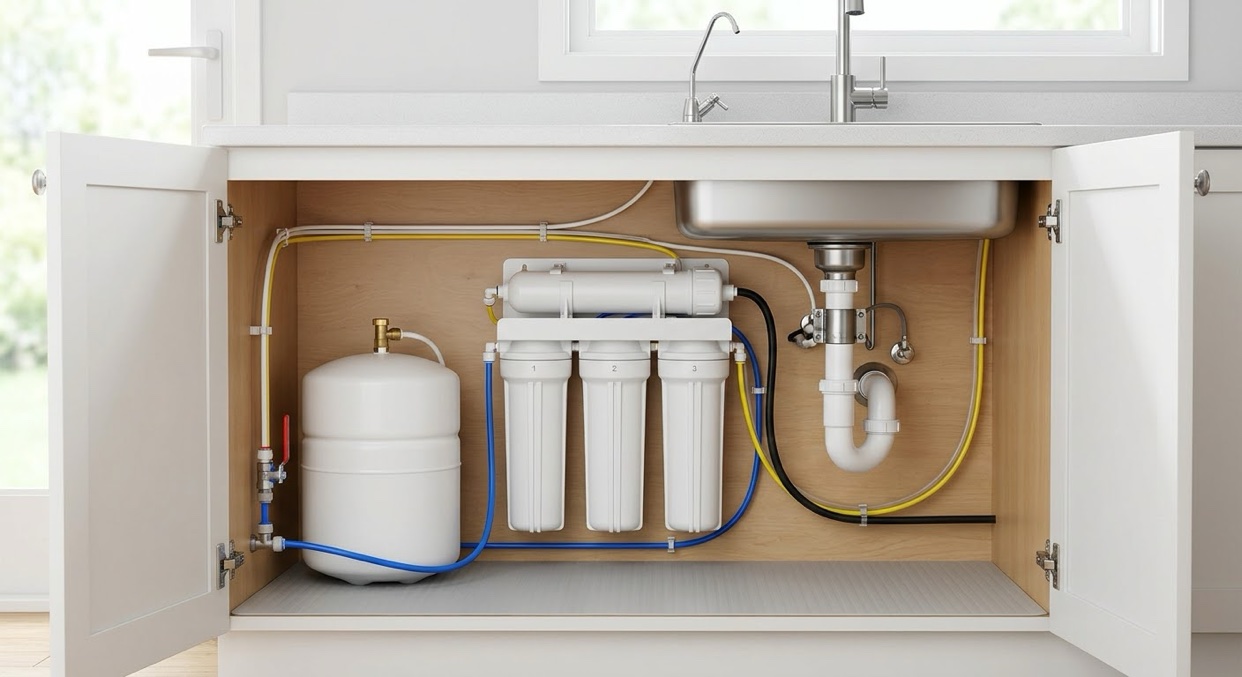
A standalone RO membrane cannot do the job by itself. If you fed raw tap water straight into a membrane, dissolved chlorine would destroy it in short order, and floating dirt would clog its microscopic pores within weeks. That is why home RO units are multi-stage systems. Here is what each stage actually does:
- Sediment Prefilter: Captures dirt, rust, silt, and pipe scale. Its job is to keep coarse particles from physically scratching or clogging the downstream filters.
- Carbon Prefilter: Usually an activated carbon block. Its primary job is to remove chlorine before the water reaches the membrane — critical, because chlorine degrades thin-film composite (TFC) RO membranes. (Chloramine is harder: it needs catalytic carbon or longer contact time.)
- The Reverse Osmosis Membrane: The heart of the system. Water is squeezed through the tight membrane, separating clean water from dissolved contaminants.
- Storage Tank (Standard Systems): Because an RO membrane creates water slowly — drip by drip — the clean water goes into a pressurized bladder tank so you have instant flow when you open the dedicated faucet.
- Post-Carbon Filter (Polishing Stage): As water leaves the storage tank on its way to your glass, it passes through a final inline carbon filter to scrub out any residual taste or odor picked up from sitting in the rubber bladder.
The Two Membrane Chemistries: TFC vs. CTA
If you look under the hood of different RO systems, you will find membranes built from one of two primary chemical compositions. Understanding the difference explains why your system is designed the way it is:
- TFC (Thin-Film Composite Polyamide): The modern industry standard. TFC membranes deliver exceptional performance — 95% to 99% rejection of dissolved solids. Their weakness is chlorine: free chlorine permanently damages the polyamide layer (tolerance is under 0.1 ppm, and the damage accumulates with exposure). That oxidation damage is why home RO systems strictly require an activated carbon prefilter upstream of the membrane.
- CTA (Cellulose Triacetate): The older, legacy membrane type, made from a cellulose derivative. Unlike TFC, CTA naturally tolerates continuous free chlorine (roughly 0.5 to 1.0 ppm). But it comes with clear drawbacks: lower salt rejection (roughly 85% to 95%), a narrower operating pH range, a shorter lifespan, and because it is cellulose-based, it is biodegradable — bacteria can attack the membrane itself.
An honest note: CTA membranes are now a specialized niche choice. Nearly every standard residential reverse osmosis system sold today uses a TFC membrane, relying on the carbon prefilter to protect the delicate polyamide layer from chlorine.
What RO Removes (and the Pore Scale)
The RO membrane is one of the tightest liquid filtration barriers known. A typical TFC membrane has a pore rating around 0.0001 microns. To put that in perspective, a standard human hair is about 70 microns wide, and a common bacteria cell is around 1 micron.
Because the pores are so tiny, RO excels at removing dissolved inorganic solids and heavy metals. Typical rejection rates for a properly operating system under standard household conditions:
- Lead: 95% to 98%
- Arsenic: 92% to 96% for arsenic V — but arsenic III is rejected poorly and inconsistently until it is oxidized to arsenic V first, which is why the EPA recommends pre-oxidation for arsenic water
- Fluoride: 85% to 95%
- Nitrates / Nitrites: 60% to 95% — the most variable number on this list; it depends heavily on the membrane, your water pressure, and your water’s chemistry
- Sodium & Chloride: 85% to 98%
- PFAS / PFOA / PFOS: 90% and up in testing — for a guaranteed claim, look for a system specifically certified to NSF/ANSI 58 for PFAS reduction
- Total Dissolved Solids (TDS): 90% to 97% overall reduction
Rejection is not pure size-sieving — the membrane also discriminates by chemical character and charge — but as a rule, most dissolved substances larger than a water molecule are physically rejected.
What RO Does NOT Do Well
Despite what sales flyers imply, RO is not a magic wand. Here is where it falls short:
- It Needs Carbon for Chemicals: The membrane alone is weak against chlorine and many light synthetic organic chemicals and Volatile Organic Compounds (VOCs) — several are only poorly rejected and pass through. That is why the carbon pre- and post-filters are non-negotiable.
- It Does Not Guarantee Sterilization: While an RO membrane’s pores are smaller than bacteria and viruses, standard under-sink RO units are not certified as biological sterilizers. Microscopic leaks in seals or O-rings mean you should never rely on a standard RO alone for microbiologically unsafe well water without disinfection (like UV light).
- Dissolved Gases Pass Right Through: Gases like hydrogen sulfide (the rotten-egg smell) and dissolved carbon dioxide pass straight through the membrane.
- It Strips “Good” Minerals: RO does not discriminate. It removes beneficial minerals like calcium and magnesium right along with lead and arsenic. This leaves the water slightly acidic (often around pH 6.0–6.5) and flat to the taste. Many owners add an inline remineralization cartridge to add calcium back and raise the pH.
The Wastewater Question, Answered Straight
Unlike a standard pitcher filter that processes 100% of the water poured into it, an RO membrane continuously flushes itself so contaminants do not cake onto the surface. That cross-flow process creates wastewater (called brine) that goes straight down the drain.
- Traditional Tank Systems: Standard residential under-sink RO units historically ran at a 3:1 to 4:1 waste ratio — roughly 3 to 4 gallons down the drain for every 1 gallon of purified water produced.
- Modern Efficient Systems: Permeate pumps and efficient modern designs have brought that down to 2:1 or even 1:1 under good water pressure and temperature. A useful shopping benchmark: EPA WaterSense-labeled point-of-use RO systems must run at 2.3:1 or better.
While wasting water sounds alarming, perspective helps: an average family using 2 gallons of RO drinking water a day on a 2:1 system sends 4 gallons down the drain — about 120 gallons a month, roughly equivalent to two extra toilet flushes a day.
Tank vs. Tankless RO Systems
When shopping, you will choose between traditional tank systems and newer tankless (direct-flow) systems.
Footprint — Tank: Larger (requires space for a 3–4 gallon tank) | Tankless: Compact (fits neatly under the sink)
Flow Rate at Faucet — Tank: Strong flow at first from the pressurized tank, fading as the tank drains | Tankless: Steady, continuous flow powered by an internal pump — no tank, no fade
Stagnation Risk — Tank: Water can sit in the rubber bladder | Tankless: Always fresh, direct-flow water
Electricity Needed — Tank: No (uses incoming street pressure) | Tankless: Yes (requires an electrical outlet for the internal booster pump)
Upfront Cost — Tank: $150 – $350 | Tankless: $350 – $700
Who Needs RO, Who Doesn’t, and Annual Running Costs
You Probably Need RO If:
- Your local water quality report shows elevated levels of heavy metals (lead, arsenic), nitrates, or fluoride.
- You are on private well water tested high in total dissolved solids (TDS) or dissolved salts.
- You want verified removal of “forever chemicals” (PFAS) at your drinking tap.
You Probably DON’T Need RO If:
- You just want to remove chlorine taste and odor — a simple, inexpensive carbon block filter does this fine, without wastewater.
- Your municipal water report is clean and you already enjoy the taste of your tap water.
Maintenance & Real-World Running Costs
An RO system is not a set-it-and-forget-it appliance. Filters must be changed on schedule:
- Sediment & Carbon Prefilters: Replace every 6 to 12 months (~$30–$60/year).
- Post-Carbon Polish Filter: Replace every 12 months (~$15–$25/year).
- RO Membrane: Replace every 2 to 3 years (~$40–$90 per replacement).
Total ongoing annual cost typically averages between $60 and $120 per year in replacement media, plus a minor bump in your water bill.
Summary
Reverse osmosis is one of the most reliable ways to get near-distilled quality drinking water right from your kitchen sink. It strips out heavy metals, nitrates, fluoride, and dissolved solids better than almost any other consumer technology.
However, it produces wastewater, requires routine filter changes, strips healthy minerals, and relies heavily on its carbon stages to handle chemicals and chlorine. If you match the tool to the actual problem in your water, an RO system is hard to beat.
Rejection figures are typical ranges drawn from membrane manufacturers’ published rejection charts and EPA treatment guidance, checked October 2026; your results vary with your membrane, pressure, temperature, and water chemistry. Prices are typical US retail ranges at the time of checking.
Leave a Reply