Category: Water Contaminants

  • Phosphorus in Drinking Water: What You Should Know

    Phosphorus in Drinking Water: What You Should Know

    Phosphorus and Phosphate in Drinking Water: What You Should Know

    If you take a look at the periodic table, you will spot phosphorus sitting right at element number 15, directly underneath nitrogen. In its pure, elemental state, phosphorus is a highly reactive, volatile non-metal that glows in the dark and can even catch fire spontaneously in air.

    However, when homeowners see “phosphorus” or “phosphate” pop up on a water lab report or in local water discussions, they are often unsure what to make of it. As someone who spends every day helping people make sense of what comes out of their taps, I can tell you that phosphorus is a fascinating element with a unique role in drinking water safety.

    Here is a clear, honest breakdown of what phosphorus is, why it is in your water, why treatment plants sometimes add it on purpose, and how to manage it without any sales pitch or scare tactics.

    1. The Honest Naming Point: Phosphorus vs. Phosphate

    Just as nobody deals with pure silicon metal in drinking water (it exists dissolved as silica), the same honest naming rule applies here:

    In water chemistry, nobody is dealing with elemental phosphorus. Instead, it travels dissolved as phosphate (PO_4^{3-}).

    When elemental phosphorus interacts with oxygen and hydrogen in nature or industrial processes, it forms phosphate compounds. On drinking water test panels and water utility reports, you will almost always see it listed as Phosphate, Orthophosphate, or Total Phosphorus. Whenever you see those terms, you are looking at dissolved phosphorus compounds in your water.

    2. How It Gets Into Drinking Water

    Phosphate makes its way into source waters through several distinct natural and human-made avenues:

    • Agricultural Runoff: Commercial crop fertilizers are rich in phosphorus because plants rely on it as a primary nutrient. Rainwater washing over farm fields carries excess fertilizer into nearby rivers, lakes, and shallow groundwater basins.
    • Wastewater & Septic Systems: Human waste and animal manure contain significant amounts of natural phosphorus. Discharge from municipal sewage treatment plants or leaking private septic systems can elevate phosphate levels in regional waterways.
    • Natural Erosion: As water flows through rock formations and mineral deposits containing apatite (phosphate rock), tiny amounts of natural phosphate slowly dissolve into groundwater.
    • Legacy Detergents: Historically, household laundry and dishwasher detergents contained high levels of phosphates to soften water and boost cleaning power. Because excess phosphates harmed local waterways, many states and countries restricted or banned phosphate additives in residential detergents decades ago.

    3. The Route That Surprises People: Added on Purpose

    Here is the twist that surprises most homeowners when reviewing their local city water report: many municipal water utilities intentionally add phosphate to drinking water.

    Utilities add food-grade orthophosphate or polyphosphates during the treatment process as a critical tool for corrosion control.

    How Orthophosphate Protects Your Home

    When orthophosphate flows through utility water mains and home plumbing, it reacts with the metal surfaces inside the pipes to form a microscopic, insoluble protective barrier along the pipe walls.

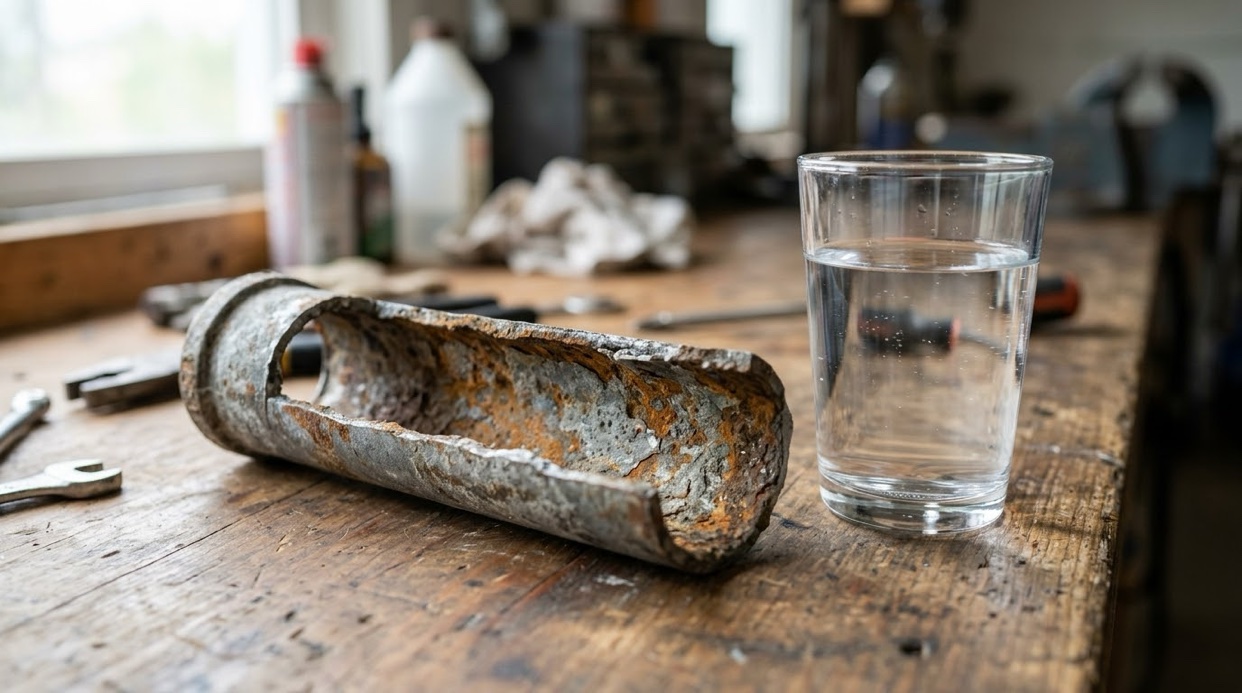
    This protective mineral coating seals off old metal pipes, preventing aggressive, oxygenated water from making direct contact with raw metal. By doing so, it stops lead, copper, and iron from dissolving and leaching out of aging utility service lines and household solder into your drinking glass. If you live in a city with older infrastructure, the phosphate added to your water is actively working to protect your health.

    4. What It Can Do to Health and the Environment

    When evaluating phosphorus in drinking water, it is vital to separate personal health from environmental impact.

    Personal Health: An Essential Nutrient

    To put it plainly: there is no drinking-water poisoning story for phosphorus at typical tap water levels.

    Phosphorus is an essential nutrient that human bodies require to build strong bones and teeth, synthesize DNA, and generate cellular energy. We consume hundreds of milligrams of phosphorus every single day through common foods like dairy, meat, fish, nuts, and whole grains. The trace amounts of phosphate found in drinking water—even water treated with orthophosphate—are tiny compared to what is on your dinner plate.

    The Real Problem: Environmental Algae Blooms

    The true phosphorus issue is environmental, not personal.

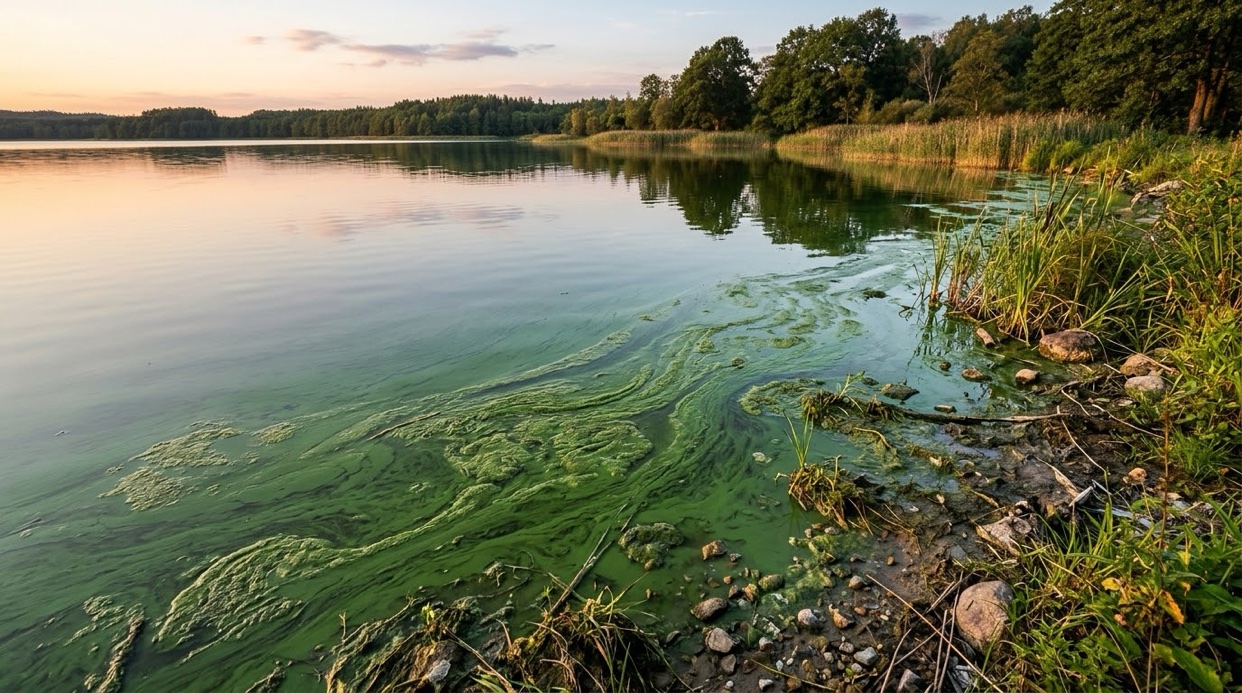
    When excessive amounts of phosphate from agricultural runoff or sewage discharge flow into lakes, rivers, and reservoirs, it acts as a massive plant fertilizer in the water. This leads to eutrophication—rapid, overgrown blooms of algae and cyanobacteria (toxic blue-green algae). These algae blooms block sunlight, deplete oxygen levels in the water, kill fish, and create taste and odor problems for drinking water supplies.

    5. The Federal Picture: Unregulated in Drinking Water

    When reviewing a home water test, homeowners often look for a mandatory federal standard.

    Phosphorus has NO EPA Maximum Contaminant Level (MCL) for drinking water.

    Because trace phosphate presents no primary health risk when consumed, the U.S. Environmental Protection Agency does not enforce a mandatory health limit for phosphorus or phosphate in drinking water supplies. (The EPA and state environmental agencies do set environmental discharge limits for wastewater entering lakes and rivers to prevent algae blooms, but not as a drinking water health threshold).

    6. How a Homeowner Can Test Their Water

    You cannot see, taste, or smell typical concentrations of phosphate in tap water.

    • Certified Laboratory Testing: A state-certified drinking water laboratory can accurately measure total phosphorus or orthophosphate levels using colorimetric or spectrophotometric testing methods.
    • Do You Need to Test? Truthfully, testing for phosphate is rarely a priority for a homeowner. Unless you are an aquarium enthusiast managing delicate fish tanks or a water treatment professional calculating pipe corrosion indexes, chasing a phosphate number on a home test is usually unnecessary.

    7. How to Manage Phosphate in the Home

    For most homeowners on city water, you do not need to remove phosphate. If your local utility adds orthophosphate to prevent lead and copper leaching, that phosphate is performing a valuable safety service for your plumbing.

    However, if you truly want to remove dissolved phosphate at your kitchen tap for specific cooking, brewing, or aquarium needs:

    • Reverse Osmosis (RO): An under-sink point-of-use Reverse Osmosis system is the most dependable home method. The semi-permeable RO membrane blocks multivalent ions like dissolved phosphate (PO₄³⁻) especially well — typically removing about 95–98% or more of it.
    • Standard Carbon & Softeners: Standard activated carbon filters and traditional water softeners do not reliably remove dissolved phosphate ions.

    The Role of Physical Sediment Pre-Filters & Micron Ratings

    While physical sediment pre-filters cannot catch dissolved phosphate ions, they play an essential role in protecting under-sink RO membranes from clogging with silt, rust, and dirt.

    When evaluating pre-filters, pay attention to micron ratings:

    • Micron Rating: A micron measures pore size. A 5-micron or 1-micron sediment pre-filter is standard industry practice ahead of an RO membrane.
    • Nominal vs. Absolute Rating:
    • Nominal Rating: Traps approximately 60% to 85% of particles at that rated micron size under standard flow.
    • Absolute Rating: Traps 99.9% or more of particles at the specified micron size under strict lab testing conditions.

    Using an absolute-rated pre-filter ensures consistent physical protection for your primary treatment equipment over time.

    The Bottom Line

    Phosphorus in drinking water travels as phosphate. It is an essential nutrient for human life, carries no health-based EPA drinking water limit, and presents no personal health hazard at tap water concentrations.

    While excess phosphate in rivers and lakes is a real environmental concern for algae blooms, the trace phosphate in your city tap water is often added deliberately by treatment professionals to protect your home from lead and copper pipe corrosion. Unless you have a specialized reason to remove it, you can let it do its job.

  • Magnesium in Drinking Water: What You Should Know

    Magnesium in Drinking Water: What You Should Know

    If you take a look at the periodic table, you will spot magnesium sitting right at element number 12. It is a light, silvery-white metal and one of the most abundant elements in the Earth’s crust, found deep within rocks, soil, and sea salt.

    In daily life, magnesium is famous for many things—from lightweight racing wheels and fireworks to dietary supplements and Epsom salts. But in the world of home water treatment, magnesium is best known as one-half of the dynamic duo responsible for “hard water.”

    As someone who spends every day helping homeowners understand what comes out of their taps, I can tell you that magnesium is a classic example of an essential nutrient that can simultaneously be a headache for your home’s plumbing. Here is a clear, honest breakdown of what magnesium is, how it gets into your water, what it does in your body and your home, and how to manage it.

    1. What Magnesium Is and Where It Comes From

    Magnesium is a naturally occurring mineral and an essential nutrient that human bodies need to run hundreds of biochemical reactions—everything from muscle and nerve function to blood sugar control and bone building.

    In nature, magnesium is locked inside rock deposits throughout the Earth’s geology, most notably in dolomite (magnesium calcium carbonate) and magnesium-rich limestone. Because magnesium minerals dissolve readily in natural water, groundwater flowing through subterranean rock formations picks up dissolved magnesium ions (Mg^{2+}) along its journey to local wells and reservoirs.

    2. How It Gets Into Drinking Water (The Hard Water Partnership)

    Magnesium enters drinking water almost exclusively through natural geological leaching as rainwater and groundwater flow over underground mineral deposits.

    When you look at a water test report, you will rarely see magnesium discussed in isolation. Instead, it is paired with its chemical cousin, calcium.

    The Hard Water Partnership: In water chemistry, “total hardness” is primarily the sum of dissolved calcium plus magnesium.

    Together, these two minerals make up virtually the entire hard-water story. If your groundwater flows through dolomite or limestone geology, you have hard water. Calcium usually accounts for most hardness and magnesium for a smaller share, but the split varies widely with local geology — from a minor fraction to roughly half in magnesium-rich (dolomite) waters. There is no standard fixed proportion.

    3. What It Does in the Home: The Hard Water Story

    While magnesium in drinking water won’t hurt your body, it can certainly wage a quiet war on your home’s plumbing and appliances:

    • Limescale Buildup: When hard water containing magnesium and calcium is heated inside your hot water heater, boiler, or coffee maker, the minerals precipitate out of solution, forming hard, crusty limescale. This scale coats heating elements, reducing energy efficiency and shortening appliance lifespan.
    • Soap Resistance: Magnesium reacts directly with soaps and detergents to form an insoluble curd (the classic bathtub ring). Because of this reaction, hard water fights soap, requiring you to use significantly more laundry detergent, shampoo, and dish soap to get a good lather.
    • Spotting and Film: As water droplets evaporate off glass shower doors, chrome faucets, and dishes in the dishwasher, magnesium leaves behind stubborn white mineral spots and cloudy films.

    4. What It Can Do to a Person’s Health: The Honest Picture

    When evaluating magnesium from a health perspective, the news is overwhelmingly positive, with just one practical caveat.

    • The Beneficial Nutrient Side: Magnesium is a crucial mineral that many people do not get enough of in their daily diets. Drinking hard water rich in magnesium quietly contributes to your daily magnesium intake, supporting cardiovascular health, bone density, and muscle function. There is zero poisoning or toxicity story here at drinking water levels.
    • The Laxative Effect: To be completely frank and plain: consuming water with extremely high concentrations of magnesium—especially when paired with high sulfate levels (forming magnesium sulfate, which is chemically identical to Epsom salt)—can have a mild to moderate laxative effect. People unaccustomed to high-magnesium well water may experience temporary digestive upset or loose stools when visiting an area with exceptionally hard water.

    5. The Federal Picture: Unregulated and Beneficial

    When looking at a water quality report, homeowners often search for a federal safety limit.

    Magnesium currently has NO EPA Maximum Contaminant Level (MCL) and NO Secondary Maximum Contaminant Level (SMCL).

    It is completely unregulated at the federal level by the U.S. Environmental Protection Agency. Because magnesium is an essential nutrient with no toxic health risks at tap water levels, the EPA does not enforce health limits or aesthetic secondary guidelines for it in public water supplies.

    6. How a Homeowner Can Test Their Water

    Testing for magnesium in your water is straightforward, depending on how detailed you want to be:

    • At-Home Hardness Test Kits: Because magnesium travels hand-in-hand with calcium, a standard total hardness test kit or test strip (measured in Grains Per Gallon, or GPG) gives you 90% of the information you need for practical home decisions.
    • Certified Laboratory Testing: If you want to know the exact breakdown—specifically how many milligrams per liter are calcium versus how many are magnesium—send a water sample to a state-certified drinking water laboratory for an inorganic minerals panel.

    7. How to Manage Magnesium in Drinking Water

    Managing magnesium comes down to balancing your home’s plumbing needs with your personal taste preferences.

    Effective Management Options

    • Traditional Water Softeners (Ion Exchange): A whole-house water softener is the classic solution for removing magnesium and calcium. The softener passes hard water through a bed of cation exchange resin that trades dissolved magnesium (Mg^{2+}) and calcium (Ca^{2+}) ions for sodium or potassium ions, protecting your whole home from scale and soap curd.
    • Under-Sink Reverse Osmosis (RO): For drinking and cooking water at the kitchen tap, a point-of-use Reverse Osmosis system typically removes 95% to 98% of dissolved minerals, including magnesium, leaving you with pure, low-mineral water.
    • Remineralization (Taste Preference): Some homeowners love the crisp, clean taste of low-mineral RO water, while others prefer the natural body of mineralized water. Many under-sink RO systems can be paired with a post-filter remineralization cartridge that adds a small, balanced amount of magnesium and calcium back into the water for flavor. Retaining or re-adding minerals is purely a matter of personal taste preference, not a health requirement.

    Pre-Filtration and Micron Ratings

    While physical sediment pre-filters do not remove dissolved mineral ions like magnesium, they protect water softeners and RO systems from getting clogged with sand, rust, and dirt particles.

    When selecting pre-filters, pay attention to micron ratings:

    • Micron Rating: A micron measures pore size. A 5-micron or 1-micron sediment pre-filter is standard practice ahead of a water treatment system.
    • Nominal vs. Absolute Rating:
    • Nominal Rating: Traps approximately 60% to 85% of particles at that rated micron size under standard flow.
    • Absolute Rating: Traps 99.9% or more of particles at the specified micron size under strict lab testing conditions.

    Using an absolute-rated pre-filter gives your primary water treatment equipment consistent physical protection over time.

    The Bottom Line

    Magnesium in drinking water isn’t a pollutant—it is an essential dietary nutrient that partners with calcium to create hard water.

    Because there is no federal limit, you only need to manage magnesium if hard water scale, soap curd, or spotty glassware is causing problems in your home. If hard water is giving your plumbing a hard time, a whole-house water softener will eliminate the scale, while an under-sink Reverse Osmosis system will give you complete control over your drinking water’s mineral content.

  • Sodium in Drinking Water: What You Should Know

    Sodium in Drinking Water: What You Should Know

    If you take a look at the periodic table, you will spot sodium sitting right at element number 11. It is a soft, silvery alkali metal that is so reactive in its pure form that it reacts vigorously when brought into contact with plain air or water.

    Because of that intense reactivity, you will never find pure sodium metal floating in your tap water. Instead, in nature and in water chemistry, sodium always travels dissolved as a positively charged sodium ion (Na^+)—the exact same sodium that combines with chloride to give us common table salt.

    As someone who spends every day helping homeowners navigate what is coming out of their taps, sodium is one of the topics I get asked about most. Here is a clear, honest breakdown of what sodium is, how it gets into your water, what it means for your health, and how to manage it in your home without any sales pitch or scare tactics.

    1. What Sodium Is and Where It Comes From

    Sodium is one of the most abundant elements on Earth, making up roughly 2.6% of the Earth’s crust. It is naturally present in soil, rocks, mineral deposits, and oceans across the planet.

    In everyday life, sodium is an essential mineral that human bodies need to maintain fluid balance, conduct nerve impulses, and contract muscles. Beyond dietary salt, sodium compounds are widely used in food preservation, commercial manufacturing, agriculture, and chemical processing.

    2. How Sodium Gets Into Drinking Water

    Sodium enters drinking water through several distinct routes—some natural, some environmental, and one right inside your own home:

    • Natural Geological Leaching: As groundwater flows over subterranean rock, clay, and mineral salt deposits, sodium naturally dissolves into aquifers and deep private wells.
    • Road Salt Runoff (Snow Country): In colder northern climates, winter road salting is a real and growing water quality issue. Tons of rock salt (sodium chloride) applied to icy roads wash into roadside ditches during spring thaws, slowly seeping into shallow groundwater wells and surface water reservoirs.
    • Seawater Intrusion: Coastal groundwater wells can experience elevated sodium levels due to coastal ocean water seeping into freshwater aquifers, especially when heavy pumping pulls the water table down.
    • The Route Inside Your Home (Water Softeners): This is the pathway that constantly surprises homeowners: an ion-exchange water softener actively adds sodium to your water. A traditional water softener works by swapping hardness minerals (calcium and magnesium) for sodium ions. For every grain of hardness removed, a small, proportional amount of sodium is added directly to your household water supply.

    3. What It Can Do to a Person’s Health: Keeping Proportions in Mind

    When discussing sodium in drinking water, an honest perspective on dietary proportions is essential.

    • Food vs. Water: The overwhelming majority of sodium in most people’s diets comes from processed foods, restaurant meals, and cooking—not from tap water. Drinking two liters of typical tap water usually contributes only a tiny fraction of your total daily sodium intake.
    • High-Sodium Taste Threshold: At elevated concentrations—typically above 200 mg/L—water begins to take on a noticeably salty, flat, or brackish taste.
    • When Water Sodium Counts (Low-Sodium Diets): For individuals on doctor-ordered, strictly restricted low-sodium diets (such as those managing severe hypertension, congestive heart failure, or kidney disease), every milligram matters. If your doctor has put you on a 1,500 mg or 2,000 mg daily sodium limit, drinking a gallon of water that contains elevated sodium—especially water softened with sodium chloride—can contribute a meaningful portion of your daily allowance. In those cases, knowing your exact water sodium number is critical.

    4. The Federal Picture: Advisory Levels vs. Standards

    When reviewing a home water test, homeowners often expect a federal health limit.

    Sodium currently has NO EPA Maximum Contaminant Level (MCL).

    Because sodium is a necessary dietary nutrient and dietary food intake completely dwarfs water intake for the general public, the U.S. Environmental Protection Agency does not enforce a mandatory health standard for sodium in public water supplies.

    However, the EPA has established a guidance benchmark:

    EPA’s Drinking Water Advisory sets a guidance level for sodium of 20 mg/L, developed for individuals on a very low-sodium diet of 500 mg/day. It is guidance for that specific group — not an enforceable standard, and not a limit meant for the general population.

    5. How a Homeowner Can Test Their Water

    You cannot see or smell sodium in drinking water, and unless levels are quite high, you usually cannot taste it either.

    • Skip DIY Home Test Strips: Over-the-counter test strips sold at hardware stores are fine for basic pH or total hardness, but they cannot measure sodium concentrations accurately.
    • Use a Certified Laboratory: Send a water sample to a state-certified drinking water laboratory. Labs analyze sodium using precise instruments, such as ICP-OES (EPA Method 200.7), to deliver an exact measurement in milligrams per liter (mg/L).

    6. How to Manage Sodium in Drinking Water

    If your water test shows elevated sodium—or if you have a whole-house water softener and want sodium-free drinking water at your kitchen sink—effective management options exist.

    Practical Management Solutions

    • Under-Sink Reverse Osmosis (RO): Installing a point-of-use under-sink Reverse Osmosis system at the kitchen tap is the classic, dependable answer. RO forces water under pressure through a semi-permeable membrane that typically rejects tiny sodium ions (Na^+) by 90% to 98%, giving you sodium-free drinking and cooking water right at the sink, even if you soften your whole house.
    • Potassium Chloride Softener Salt: If you have a traditional ion-exchange water softener, you can swap out standard sodium chloride salt pellets for potassium chloride pellets in your salt tank. The softener will then trade calcium and magnesium for potassium instead of sodium. (Potassium chloride is typically more expensive, but it prevents sodium addition at the whole-house level).

    What Does NOT Remove Sodium

    Standard activated carbon block filters (like pitcher filters or refrigerator filters) excel at removing chlorine, bad tastes, and odors, but they have zero effect on dissolved sodium ions.

    Pre-Filtration and Micron Ratings

    While physical sediment pre-filters do not catch dissolved sodium ions, they play a vital protective role in keeping rust, silt, and sand from clogging your under-sink RO membrane.

    When evaluating pre-filters, pay attention to micron ratings:

    • Micron Rating: A micron measures pore size. A 5-micron or 1-micron sediment pre-filter is standard ahead of an under-sink RO membrane.
    • Nominal vs. Absolute Rating:
    • Nominal Rating: Traps approximately 60% to 85% of particles at that rated micron size under standard flow.
    • Absolute Rating: Traps 99.9% or more of particles at the rated micron size under strict lab testing conditions.

    Using an absolute-rated pre-filter ensures consistent physical protection for your under-sink RO membrane over time.

    The Bottom Line

    For most people, sodium in tap water is a minor contributor compared to what is on our dinner plates. But if you have a whole-house water softener or follow a strict, doctor-ordered low-sodium diet, sodium in your drinking water is something to pay attention to.

    Because there is no federal limit, compare your test results against the EPA advisory level of 20 mg/L if you are on a restricted diet. If your numbers are high, installing an under-sink Reverse Osmosis system at your kitchen tap is the simplest, most dependable solution for pure, low-sodium drinking water.

  • Oxygen in Drinking Water: What You Should Know

    Oxygen in Drinking Water: What You Should Know

    If you take a look at the periodic table, you will spot oxygen sitting at element number 8. It is the most abundant element in the Earth’s crust and the third most abundant element in the universe.

    When homeowners ask me about oxygen in drinking water, I always start with an honest, fundamental fact: oxygen is the “O” in H_2O. Just like hydrogen, oxygen is part of the water molecule itself. You cannot filter oxygen out of water—without it, you wouldn’t have water at all!

    Because oxygen forms the chemical backbone of water itself, no water quality report lists “oxygen” as a pollutant or contaminant. Instead, oxygen’s real role in water quality comes down to dissolved oxygen—oxygen gas (O_2) from the atmosphere that gets trapped and dissolved in liquid water.

    As someone who spends every day helping people understand what comes out of their taps, here is a clear, plain-English breakdown of what dissolved oxygen does in your water, how it behaves as both a troublemaker and a vital water treatment tool, and what you need to know about it.

    1. Dissolved Oxygen: Surface Water vs. Deep Wells

    Dissolved oxygen refers to free, unbonded oxygen gas (O_2) molecules dissolved right into the water stream, usually measured in milligrams per liter (mg/L).

    Where your water comes from dictates how much dissolved oxygen it contains:

    • Surface Water (Rivers & Lakes): Water exposed to open air and flowing over rocks naturally absorbs oxygen from the atmosphere. Splashing waves, wind, and aquatic plants constantly aerate surface water, keeping dissolved oxygen levels high.
    • Deep Well Water (Groundwater): Water trapped deep underground in subterranean aquifers has no contact with the atmosphere and limited exposure to air. As a result, deep well water often has very low dissolved oxygen—sometimes near zero.

    How Dissolved Oxygen Affects Taste

    Dissolved oxygen plays a major role in how your water tastes at the tap:

    • Fresh and Crisp: Water rich in dissolved oxygen tastes fresh, light, and crisp.
    • Flat or Stale: Water with very low or zero dissolved oxygen—like fresh draw from a deep private well—often tastes “flat,” heavy, or stale. (If you’ve ever poured well water back and forth between two clean glasses to mix in air, you’ve tasted how adding oxygen instantly perks up the flavor!)

    2. Oxygen the Troublemaker: Corrosion and Rust Stains

    While dissolved oxygen makes water taste great, it comes with a mischievous side inside your plumbing: oxygen drives corrosion and rust.

    When dissolved oxygen interacts with metal pipes and plumbing fixtures, it acts as an oxidizing agent:

    • Corrosion of Iron and Steel Pipes: Dissolved oxygen reacts with galvanized steel, cast iron, and copper pipes, slowly eating away at metal surfaces and causing pinhole leaks or flaking pipe debris.
    • Creating Rust Stains: If your groundwater contains dissolved, invisible clear-water iron (Fe^{2+}), exposure to dissolved oxygen turns that iron into oxidized, insoluble red rust particles (Fe^{3+}). This chemical transformation is what leaves stubborn, reddish-orange rust stains on your sinks, toilets, and laundry.

    3. Oxygen the Tool: How Water Treatment Professionals Use It

    Here is where my trade gets interesting: water treatment professionals routinely use oxygen as one of our most effective filtration tools.

    Because oxygen reacts so reliably with dissolved minerals, air injection oxidation is one of the oldest and most dependable tricks in the book for solving well water problems.

    How Air Injection Oxidation Works

    If your well water contains dissolved clear-water iron, manganese, or that terrible “rotten egg” hydrogen sulfide gas, we can use oxygen to clean it up naturally without harsh chemicals:

    • Air Injection: We draw raw well water through a specialized valve that injects a pocket of air (rich in oxygen) directly into the water stream.
    • Rapid Oxidation: The dissolved oxygen instantly reacts with the dissolved iron and manganese, converting them into solid, physical rust and mineral particles. It also oxidizes hydrogen sulfide gas into harmless elemental sulfur particles, destroying the odor.
    • Physical Filtration: The water then flows through a media bed (like manganese dioxide or greensand) that physically traps those solid particles, allowing crystal-clear, odor-free water to flow to your home.

    4. The Federal Picture: No EPA Limits

    When reviewing a municipal water quality report or private well test, you will not find a federal safety standard for dissolved oxygen.

    There is NO EPA standard for dissolved oxygen in drinking water.

    Dissolved oxygen poses no primary health hazard to humans. Because it is a natural component of water with no toxic health effects, the U.S. Environmental Protection Agency does not regulate or set maximum limits for it in public drinking water supplies.

    5. Testing for Dissolved Oxygen

    Testing for dissolved oxygen requires specialized electronic meters or chemical titration kits, and it is usually done on-site right at the wellhead by water treatment professionals or environmental scientists.

    As a homeowner, you rarely need a dissolved oxygen number on a lab report. What you see instead is what oxygen does in your home:

    • Reddish rust stains in sinks (dissolved iron hitting air and oxidizing).
    • A rotten egg smell from the tap (indicating an absence of oxygen in raw well water, allowing anaerobic sulfur-reducing bacteria to thrive).
    • Flat-tasting water straight from a deep well.

    6. The Truth About “Oxygenated” Bottled Water

    In recent years, trendy bottled “oxygenated water” products and oxygen-injection gadgets have claimed that drinking oxygen-enriched water boosts athletic performance, increases energy, or detoxifies the body.

    Here is the honest, plain-English truth: those health claims are scientifically unproven.

    Your body is designed to absorb oxygen through your lungs, not your digestive tract. When you drink oxygenated water, the extra oxygen gas simply bubbles out in your stomach or gets burped out long before it ever reaches your bloodstream. Paying extra for bottled “oxygenated water” for health benefits is a marketing gimmick, plain and simple.

    The Bottom Line

    Oxygen isn’t a contaminant—it is the literal foundation of water itself (H_2O), and its dissolved gas form determines how fresh your water tastes and how dissolved minerals behave.

    You don’t need to fear oxygen or try to filter it out. While dissolved oxygen can drive pipe corrosion, it is also one of the cleanest, most effective natural tools we have to eliminate rust stains and rotten-egg smells from well water.

  • Hydrogen in Drinking Water: What You Should Know

    Hydrogen in Drinking Water: What You Should Know

    If you take a look at the periodic table, you will spot hydrogen sitting right at the top left corner—element number 1. It is the lightest, simplest, and most abundant element in the entire universe.

    When homeowners ask me about hydrogen in drinking water, I always smile, because hydrogen comes with a fundamental, honest truth: hydrogen is literally half of what water is. Every single drop of pure water (H_2O) consists of two hydrogen atoms chemically bonded to one oxygen atom. You couldn’t take hydrogen out of water if you tried—without it, you wouldn’t have water at all!

    Because hydrogen is part of the water molecule itself, no certified lab report will ever list “hydrogen” as a pollutant or contaminant, and you can’t filter it out. Instead, hydrogen’s real role in water quality comes down to a single, critical concept that every homeowner should understand: pH.

    As someone who spends every day helping people make sense of their tap water, here is a clear, plain-English breakdown of what hydrogen actually does in your water, why pH matters so much, and how it impacts your home.

    1. The Real Role of Hydrogen: Understanding pH

    When water treatment professionals talk about hydrogen in drinking water, we are really talking about hydrogen ions (H^+).

    In any body of water, a tiny fraction of H_2O molecules naturally split apart into positively charged hydrogen ions (H^+) and negatively charged hydroxyl ions (OH^-). The balance between these two ions determines your water’s pH—which literally stands for the “potential of hydrogen.”

    Put simply:

    • High concentration of hydrogen ions (H^+): Your water is acidic.
    • Low concentration of hydrogen ions (H^+): Your water is alkaline (or basic).

    pH isn’t just an abstract scientific term; it is a measure of how active hydrogen ions are in your water, and it dictates how your water interacts with everything it touches—from your copper pipes to your laundry detergent.

    2. Walking the pH Scale

    The pH scale runs from 0 to 14, with 7 representing neutral:

    • Below 7.0 (Acidic): The water has an excess of active hydrogen ions. Acidic water is aggressive and reactive.
    • 7.0 (Neutral): Hydrogen ions (H^+) and hydroxyl ions (OH^-) are in perfect balance. Pure, distilled water at room temperature sits right around 7.0.
    • Above 7.0 (Alkaline): The water has fewer hydrogen ions and an excess of hydroxyl ions (OH^-). Alkaline water is rich in dissolved mineral bases like calcium and magnesium.

    The Federal Picture: Secondary Guidelines

    When reviewing your municipal water report, you won’t find a health-based limit for pH.

    The U.S. Environmental Protection Agency (EPA) lists pH under its Secondary Maximum Contaminant Level (SMCL) guidelines, recommending a target range of 6.5 to 8.5.

    It is important to understand what a Secondary guideline means: 6.5 to 8.5 is a non-enforceable aesthetic guideline, NOT a mandatory health standard. Public utilities aim for this range to prevent pipe corrosion and aesthetic issues, but it is not enforced as a primary health limit.

    3. Why pH Matters More Than Almost Anything Else in Your Home

    While hydrogen ions themselves don’t pose a direct health hazard when you drink them, the pH of your water can cause major headaches throughout your home. In fact, low or high pH damages your plumbing first—and damaged plumbing is often where real drinking water contaminants actually originate.

    Acidic Water (pH Below 6.5)

    When water has an abundance of active hydrogen ions, it becomes aggressive and hungry to react with metals:

    • Pipe Corrosion: Acidic water dissolves copper, brass, and lead out of your home’s plumbing, hot water heater, and fixtures.
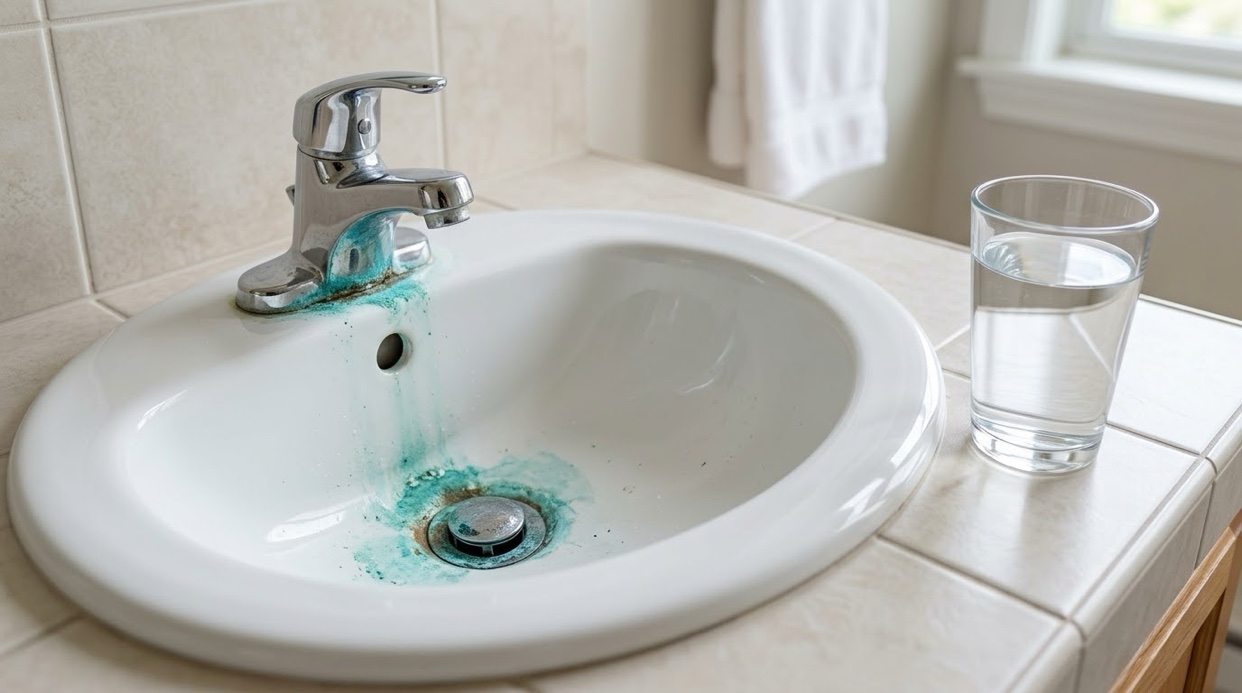
    • Blue-Green Staining: If you see bluish-green stains on your porcelain sinks, tubs, or toilets, acidic water is actively dissolving your home’s copper pipes.
    • Pinhole Leaks: Over time, low-pH water eats thin spots right through copper lines, leading to hidden pinhole leaks behind drywall and under floors.
    • Secondary Contaminants: As acidic water corrodes your plumbing, it carries dissolved lead and copper directly into your kitchen tap.

    High-pH / Alkaline Water (pH Above 8.5)

    When water has a low concentration of hydrogen ions and a high concentration of mineral bases:

    • Scale Buildup: High-pH water readily drops calcium and magnesium out of solution, coating heating elements, showerheads, and dishwasher interiors in crusty white scale.
    • Bitter Taste: Water with a very high pH can taste slippery, soda-like, or unpleasantly bitter.
    • Reduced Soap Efficiency: High-pH water interferes with soaps and detergents, leaving clothes looking dingy and dishes covered in a film.

    4. Testing Your Water’s pH

    Unlike trace heavy metals or synthetic chemicals that require expensive lab equipment, testing your water’s pH (hydrogen ion activity) is simple, fast, and inexpensive:

    • At-Home Dip Strips: Basic pH test strips give a quick, color-coded estimate of where your water sits on the 0 to 14 scale.
    • Digital pH Meters: Handheld digital pH meters provide precise, electronic readings down to a fraction of a decimal point for homeowners who want exact numbers.
    • Certified Lab Testing: If you are testing private well water for a broader panel, certified laboratories always measure pH alongside hardness and heavy metals to check for corrosive conditions.

    5. How to Balance pH in Your Home

    Because you cannot “filter out” hydrogen, managing hydrogen activity comes down to neutralizing acidic water or adjusting high-pH water.

    Treating Acidic Water (Low pH)

    If your water tests below 6.5, the solution is neutralization—adding natural minerals back into the water to bind with the excess hydrogen ions:

    • Calcite Neutralizing Tanks: Whole-house neutralizing tanks filled with crushed calcium carbonate (calcite) dissolve tiny amounts of natural calcium into acidic water as it passes through, safely raising the pH to a neutral, non-corrosive level (around 7.0 to 7.2).
    • Magnesium Oxide Blends: For extremely low pH (below 6.0), a blend of calcite and magnesium oxide (Corosex) is used to bring the pH back into a safe, non-corrosive range.

    Managing High-pH Water

    High pH is usually managed by addressing the underlying mineral hardness (using standard water softeners) or by installing Reverse Osmosis systems at the kitchen tap, which naturally lowers finished drinking water pH slightly by removing alkaline minerals.

    A note on ‘hydrogen water’ and molecular-hydrogen gadgets: these products are marketed with health claims that are not established by evidence, and no homeowner needs them — ordinary water already is hydrogen, in the only form that matters.

    The Bottom Line

    Hydrogen isn’t a contaminant—it is the literal foundation of water itself (H_2O), and its ion activity determines your water’s pH.

    You don’t need to fear hydrogen or try to filter it out. Instead, test your water’s pH to make sure it falls within the EPA’s secondary recommended range of 6.5 to 8.5. If your water is acidic (below 6.5), installing an acid neutralizer will protect your plumbing, prevent blue-green stains, and keep dissolved metals out of your family’s drinking glass.

  • Silicon in Drinking Water: What You Should Know

    Silicon in Drinking Water: What You Should Know

    If you take a look at the periodic table, you will spot silicon sitting right at element number 14. It sits directly beneath carbon, sharing a spot in the chemical family that makes up the bedrock of our physical world.

    Silicon is the second most abundant element in the Earth’s crust, trailing only oxygen. It is the fundamental building block of sand, quartz, granite, and glass, and it forms the physical foundation of modern microchips and computer electronics.

    When homeowners see “silicon” or “silica” turn up on a water test, they often wonder what it means for their family’s health and their home’s plumbing. As someone who spends every day helping people navigate what comes out of their taps, I can tell you that silicon in drinking water is almost entirely a nuisance and plumbing story, not a health story.

    Here is a clear, honest breakdown of what silicon is, how it behaves in water, why it is so stubborn to deal with, and how to manage it in your home without any sales pitch or scare tactics.

    1. The Honest Naming Point: Silicon vs. Silica

    Before diving into how it gets into your water, it is worth clarifying a common point of confusion around the terminology:

    In water chemistry, nobody is dealing with pure elemental silicon metal. Instead, it shows up dissolved as silica (silicon dioxide, SiO_2).

    When silicon interacts with oxygen and water underground, it forms silica and silicic acid compounds. Because of this, water testing laboratories and water treatment professionals almost always measure and list it on lab reports as Silica (SiO_2) rather than plain silicon. Whenever you see “silica” on a water quality panel, that is the dissolved silicon in your water.

    2. How It Gets Into Drinking Water

    Silica makes its way into drinking water supplies through natural geological weathering:

    • Natural Erosion of Rock and Sand: As rainwater and subterranean groundwater flow through soil, sand, granite, and quartz rock formations, small amounts of silica slowly dissolve into solution.
    • Volcanic and Mineral-Rich Geology: Certain geographic regions—especially areas with volcanic geology, basalt formations, or thermal mineral springs—have groundwater with naturally high silica concentrations. Deep private wells drawing from bedrock in these regions frequently show elevated silica levels.

    3. What It Does: A Nuisance Story, Not a Health Hazard

    When evaluating silica in drinking water, it helps to separate health effects from home maintenance impacts.

    No Known Health Hazards

    To put it plainly: there are no known health hazards associated with drinking water containing typical levels of dissolved silica. In fact, some dietary studies suggest trace silica may even support bone and connective tissue health. You can drink water containing silica without worrying about toxic health effects.

    The Maintenance Nuisance

    Where silica causes real trouble is inside your home’s pipes, appliances, and fixtures:

    • Hard, Glassy Scale: Unlike soft calcium scale that can often be dissolved with household vinegar, silica forms a rock-hard, glass-like scale (magnesium silicate or complex silica deposits) on heating elements, glass shower doors, and chrome fixtures. Once silica scale bakes onto a surface, it is notoriously difficult to scrub or etch off.
    • Etched Glassware and Spotting: High-silica water leaves persistent white spots and haze on glassware and dishes coming out of the dishwasher.
    • Membrane Fouling: For homeowners using water treatment equipment, high silica concentrations can coat and foul the semi-permeable membranes used in Reverse Osmosis systems, drastically shortening their lifespan if not managed properly.

    4. The Federal Picture: Unregulated by the EPA

    When reviewing a home water test, homeowners often look for a federal safety benchmark.

    Silica has NO EPA Maximum Contaminant Level (MCL) and NO Secondary Maximum Contaminant Level (SMCL).

    It is completely unregulated at the federal level by the U.S. Environmental Protection Agency. Because dissolved silica poses no health hazard to humans and varies widely across regional geology, the EPA has not established primary health limits or aesthetic secondary guidelines for public water supplies.

    5. How a Homeowner Can Test Their Water

    You cannot smell or taste silica in drinking water, though extremely high levels can occasionally give water a slightly slick feel.

    • Ask the Lab Specifically for Silica (SiO_2): Silica is not included on standard basic home drinking water test panels. When ordering a water test from a state-certified drinking water laboratory, explicitly request that Silica or Reactive Silica be added to your testing panel.
    • Skip DIY Home Test Strips: Over-the-counter dip strips sold at hardware stores are designed for basic pH, total hardness, or free chlorine. They cannot measure dissolved silica concentrations accurately.

    6. How to Remove Silica (And What Actually Works)

    Removing silica from water requires honest expectations: silica is one of the more difficult dissolved components to remove from residential water.

    What Works (With Caveats)

    • Reverse Osmosis (RO): An under-sink point-of-use Reverse Osmosis system is the most practical residential option for drinking water. RO membranes reject dissolved (reactive) silica very effectively — typically 95–99% for modern thin-film composite membranes, with commercial FilmTec elements listing 99.7–99.8% silica rejection in standard solute tests. Silica fouling is not triggered by 20–30 mg/L in the feed water by itself; it becomes a risk when recovery concentrates silica in the reject stream above its solubility — about 120–150 mg/L as SiO₂ at 25 °C and near-neutral pH, and higher with a suitable antiscalant — so high-silica water needs lower recovery, pretreatment, or antiscalant, not just a feed-water warning.
    • Specialized Anion Exchange: At commercial or industrial scales, strongly basic anion exchange resins in hydroxide form can remove reactive silica. However, this process requires complex chemical regeneration that is rarely practical for a standard residential whole-house setup.

    What Does NOT Work

    • Standard Water Softeners: Conventional cation exchange water softeners trade calcium and magnesium for sodium. They do not remove dissolved silica (SiO_2).
    • Standard Carbon Filters: Activated carbon filters excel at removing chlorine and organic tastes, but they have zero effect on dissolved silica.

    Pre-Filtration and Micron Ratings

    If silica exists in your water as fine, colloidal (suspended particle) silica rather than fully dissolved silica, physical sediment pre-filters can help protect downstream equipment.

    When evaluating pre-filters, pay attention to micron ratings:

    • Micron Rating: A micron measures pore size. A 5-micron or 1-micron sediment pre-filter is standard ahead of an under-sink RO system to catch fine particles.
    • Nominal vs. Absolute Rating:
      • Nominal Rating: Indicates the filter will trap approximately 60% to 85% of particles at that micron size under standard flow.
      • Absolute Rating: Traps 99.9% or more of particles at the specified micron size under strict lab testing conditions.

    Using an absolute-rated pre-filter ensures your treatment equipment gets consistent physical protection against fine particulate buildup.

    The Bottom Line

    Silicon in drinking water—measured on lab reports as dissolved silica (SiO_2)—is entirely a nuisance story, not a health concern. It forms hard, glassy scale on fixtures and dishwashers, but it won’t hurt you to drink it.

    Because there is no federal EPA limit, you only need to manage silica if it is causing scaling or spotting in your home. If you want pure drinking water free of silica at the kitchen sink, an under-sink Reverse Osmosis system is your most effective option.

  • Silver in Drinking Water: What You Should Know

    Silver in Drinking Water: What You Should Know

    If you take a look at the periodic table, you will spot silver sitting right at element number 47. It is a brilliant, precious metal that has been treasured for thousands of years—not just for jewelry, coins, and mirror coatings, but also for its remarkable natural antimicrobial properties. Long before modern water treatment existed, ancient civilizations knew that storing water in silver vessels helped keep it fresh and free of spoilage.

    Because silver is so famous for killing microbes, people are often surprised when they see it pop up on a water test or listed in discussions about drinking water safety. As someone who spends every day helping homeowners understand what is coming out of their taps, I can tell you that silver in drinking water is generally a very minor story, but it comes with a few unique angles worth knowing.

    Here is a clear, honest breakdown of what silver is, how it ends up in water, what it does in the body, and how to manage it in your home.

    1. What Silver Is and Where It Comes From

    Silver is a naturally occurring precious metal found in trace amounts throughout the Earth’s crust, soils, and rock formations. In pure form or bound in mineral ores, it is relatively rare compared to abundant metals like iron or aluminum.

    Beyond its traditional uses in jewelry, silverware, and coins, silver plays a vital role in modern industry and technology:

    • Electronics & Conductors: It is the single most electrically conductive element, making it indispensable in circuit boards, solar panels, and electrical contacts.
    • Antimicrobial Applications: Silver ions (Ag^+) disrupt essential functions in microscopic bacteria, fungi, and algae. Because of this, silver is widely used in medical wound dressings, medical equipment coatings, and anti-odor textiles.
    • Photography & Alloys: Historically essential in traditional film photography, silver remains widely used in brazing and soldering alloys.

    2. How It Gets Into Drinking Water

    Natural erosion of rock deposits releases only microscopic traces of silver into rivers, lakes, and underground aquifers. Industrial discharges from mining, electronics processing, or photographic waste can contribute, but these sources are tightly controlled today.

    However, silver has a unique, intentional route into tap water that homeowners often miss: the filtration equipment itself.

    • Silver-Impregnated Carbon Filters: Some home water filters—particularly certain carbon block or granular activated carbon (GAC) cartridges—use silver-impregnated media. The silver is added in tiny amounts to act as a bacteriostat, which stops bacteria from colonizing and growing inside the moist filter bed over time. In these systems, minute traces of silver can slowly leach into the filtered water.
    • Colloidal Silver & Dietary Supplements: Some individuals intentionally add liquid colloidal silver products to their home drinking water as an alternative health remedy.

    3. What It Can Do to a Person’s Health

    At typical drinking water concentrations, silver is a minor health concern. Unlike heavy metals like lead or mercury, silver does not accumulate in ways that damage internal organs like the brain, kidneys, or liver.

    However, chronic high intake of silver over long periods carries one distinct, well-documented effect:

    Argyria: Excessive, long-term consumption or exposure to silver can cause a condition called argyria. Silver particles deposit in skin tissue, mucous membranes, and internal organs, and when exposed to sunlight, they react to turn the skin a permanent blue-gray color.

    While health agencies categorize argyria primarily as a cosmetic issue rather than toxic organ damage, the blue-gray discoloration is permanent. It does not fade once exposure stops.

    At typical tap water levels—and when using standard home water filters according to manufacturer guidelines—the risk of developing argyria is extremely low.

    4. The Federal Picture: Secondary Standards vs. Health Limits

    When evaluating a home water test, understanding how the U.S. Environmental Protection Agency (EPA) handles silver is essential.

    Silver has NO health-based EPA Maximum Contaminant Level (MCL).

    Because typical environmental levels do not present an organ toxicity risk, the EPA does not enforce a mandatory primary health standard for public water utilities. Instead, the EPA lists a Secondary Maximum Contaminant Level (SMCL) of 0.1 mg/L (milligrams per liter, or 100 parts per billion).

    It is important to label this correctly:

    • Secondary SMCLs are non-enforceable guidelines established to address aesthetic concerns or cosmetic issues—specifically to prevent argyria (skin discoloration) and skin graying—rather than primary organ toxicity.
    • Public water suppliers are not legally mandated by federal law to remove silver to meet this target, but it serves as a guideline for water quality management.

    5. How a Homeowner Can Test Their Water

    You cannot see, taste, or smell trace silver in drinking water. Finding out if it is present—and in what quantity—requires accurate testing.

    • Skip DIY Home Test Strips: Over-the-counter test strips sold at home centers are designed for basic pH, hardness, or free chlorine. They cannot accurately measure trace metals like silver down to parts-per-billion levels.
    • Use a Certified Laboratory: Send a water sample to a state-certified drinking water laboratory. Labs use sensitive analytical equipment, such as ICP-MS (Inductively Coupled Plasma Mass Spectrometry), to deliver a precise measurement of silver in milligrams per liter (mg/L).

    6. How to Remove Silver from Drinking Water

    If a certified lab report shows silver levels approaching or exceeding the 0.1 mg/L secondary limit, several effective residential treatment options exist.

    Effective Removal Technologies

    • Reverse Osmosis (RO): A point-of-use under-sink Reverse Osmosis system is the most dependable home method for removing dissolved silver. RO forces water under pressure through a semi-permeable membrane that rejects positively charged silver ions (Ag^+) while letting pure water pass through.
    • Ion Exchange: Because dissolved silver exists as a positively charged ion in water, standard cation exchange resins (similar to those used in water softeners) can effectively swap silver ions for sodium or potassium.
    • Distillation: Countertop water distillers boil water into steam and condense it back into liquid, leaving silver and other mineral salts behind in the boiling chamber.

    Pre-Filtration and Micron Ratings

    While physical sediment pre-filters cannot trap dissolved silver ions, they protect RO membranes and ion exchange resins from getting clogged with rust, sand, and silt.

    When selecting pre-filters, pay attention to micron ratings:

    • Micron Rating: A micron measures pore size. A 5-micron or 1-micron sediment pre-filter is standard practice ahead of an under-sink RO membrane.
    • Nominal vs. Absolute Rating:
      • Nominal Rating: Traps approximately 60% to 85% of particles at that micron size under standard flow.
      • Absolute Rating: Traps 99.9% or more of particles at the rated micron size under strict lab test conditions.

    Using an absolute-rated pre-filter gives your primary treatment equipment reliable, consistent physical protection over time.

    The Bottom Line

    Silver in drinking water is a rare finding and generally a minor story. It is prized for its natural antimicrobial powers and is sometimes added to filter media to stop bacterial growth inside the cartridge itself.

    Because silver has no mandatory primary health limit, compare your test results against the EPA secondary cosmetic guideline of 0.1 mg/L. If your water tests high or if you want absolute peace of mind at your tap, a standard under-sink Reverse Osmosis system is your most effective, straightforward solution for pure drinking water.

  • Strontium in Drinking Water: What You Should Know

    Strontium in Drinking Water: What You Should Know

    If you take a look at the periodic table, you will spot strontium sitting right at element number 38. It belongs to the alkaline-earth metal family, which makes it a direct chemical cousin to calcium and magnesium—the two minerals responsible for hard water.

    Most people recognize strontium for its industrial uses, like giving red fireworks and signal flares their vibrant color, or for its role in glass manufacturing and ceramic magnets. But because it shares so much chemical DNA with calcium, strontium is also a naturally occurring element that regularly turns up in deep groundwater.

    As someone who spends every day helping homeowners understand what comes out of their taps, I know that seeing an unfamiliar metal on a water lab report can cause concern. Here is a clear, honest breakdown of what strontium is, how it behaves in drinking water, what it means for your health, and how to address it in your home without any sales hype or scare tactics.

    1. What Strontium Is and Where It Comes From

    Strontium is a soft, silvery-yellow metal naturally embedded throughout the Earth’s crust, soils, and rock formations—particularly in celestite and strontianite minerals.

    In modern manufacturing and technology, strontium is widely utilized for its unique physical properties:

    • Pyrotechnics & Flares: Strontium compounds produce a brilliant, vivid crimson-red flame in fireworks, road flares, and emergency signaling devices.
    • Glass & Ceramics: It is used in specialty glass (such as cathode-ray tubes and specialized optics) and in producing ferrite ceramic magnets.
    • Medical Research: Certain strontium formulations are used in bone density research and sensitive medical imaging.

    2. How It Gets Into Drinking Water

    Strontium enters drinking water supplies almost exclusively through natural geological processes.

    As groundwater flows over and through subterranean limestone, dolomite, and celestite rock formations, strontium minerals dissolve into solution. Because strontium behaves so much like calcium, it travels alongside standard water hardness minerals.

    Deep private wells drawing from bedrock aquifers—particularly in areas with limestone geology—are much more likely to contain elevated levels of naturally occurring strontium than shallow wells or surface water rivers.

    3. What It Can Do to a Person’s Health

    Because the human body processes strontium very similarly to calcium, it absorbs strontium into the bloodstream and deposits it directly into bones and teeth.

    • General Exposure: Consuming trace amounts of natural strontium in daily drinking water and food is typical and generally well-tolerated by adults.
    • Children and Bone Growth: Developing children represent the genuinely sensitive group when it comes to high strontium exposure. In growing infants and children whose bones are actively forming, excessive strontium intake can interfere with proper bone mineralization and calcium absorption, potentially leading to weakened bone structure or conditions similar to rickets.

    4. An Honest Clarification: Stable vs. Radioactive Strontium

    When people hear the word “strontium,” they often think of nuclear fallout or historical weapons testing. It is essential to clear up this common point of confusion:

    The strontium on a home drinking water test is stable, non-radioactive strontium.

    Naturally occurring strontium found in groundwater is completely stable. It is not radioactive strontium-90 (^{90}Sr), which is a synthetic byproduct of nuclear fission and an entirely different story. Natural strontium in your tap water poses no radiation hazard whatsoever.

    5. The Federal Picture: Regulations vs. Reference Levels

    When evaluating strontium on a water test report, homeowners often look for an enforced federal standard. However, strontium currently has NO EPA Maximum Contaminant Level (MCL).

    Here is the regulatory background you should know:

    • The EPA Decision: The EPA evaluated strontium under the Safe Drinking Water Act for potential regulation. EPA has never set a drinking water standard for strontium. In 2014 the agency preliminarily determined it should regulate strontium, but in January 2016 it delayed the final decision to consider more data — and as of its January 2025 notice, EPA still had not made a final determination either way.
    • The Screening Benchmark: During national monitoring (such as the EPA’s Unregulated Contaminant Monitoring Rule, or UCMR 3), the EPA established a Health Reference Level of 1.5 mg/L (milligrams per liter, or parts per million).

    It is crucial to label this correctly: 1.5 mg/L is a health screening reference level used as a research benchmark, NOT an enforceable regulatory limit or standard.

    6. How a Homeowner Can Test Their Water

    You cannot see, smell, or taste strontium in drinking water, even at elevated concentrations. The only way to know if strontium is present—and at what level—is through lab analysis.

    • Skip DIY Home Test Strips: Over-the-counter test strips sold at hardware stores are fine for basic pH or total hardness, but they cannot distinguish between calcium, magnesium, and trace strontium.
    • Use a Certified Laboratory: Send a water sample to a state-certified drinking water laboratory. Labs use advanced analytical equipment, such as ICP-OES or ICP-MS (EPA Method 200.7 or 200.8), to deliver an exact measurement of dissolved strontium in milligrams per liter.

    7. How to Remove Strontium from Drinking Water

    Because strontium is an alkaline-earth metal that behaves almost identically to calcium in water, removing it is remarkably straightforward using standard water treatment equipment.

    Effective Removal Technologies

    • Cation Exchange (Standard Water Softeners): Because strontium exists in water as a positively charged ion (Sr^{2+}), standard home water softeners remove it easily. The cation-exchange resin trades dissolved strontium and calcium ions for sodium or potassium ions. A water softener installed at the main entry point will effectively reduce strontium throughout the whole home.
    • Reverse Osmosis (RO): A point-of-use under-sink Reverse Osmosis system is a highly dependable method for drinking water. RO forces water through a dense semi-permeable membrane that rejects dissolved metal ions like Sr^{2+} while letting pure water molecules pass through.
    • Lime Softening: At municipal treatment plants, traditional chemical lime-soda softening raises pH to precipitate out calcium and strontium simultaneously.

    The Truth About Carbon Filters

    Standard activated carbon block filters are excellent for removing chlorine, taste, and odor, but they do not remove dissolved inorganic minerals like strontium.

    Pre-Filtration and Micron Ratings

    Physical sediment pre-filters do not catch dissolved strontium ions, but they protect softeners and RO membranes from clogging with sand, silt, and rust.

    When selecting pre-filters, pay attention to micron ratings:

    • Micron Rating: A micron measures pore size. A 5-micron or 1-micron sediment pre-filter is standard practice ahead of a home filtration system.
    • Nominal vs. Absolute Rating:
      • Nominal Rating: Traps approximately 60% to 85% of particles at that micron size under standard flow.
      • Absolute Rating: Traps 99.9% or more of particles at the specified micron size under strict laboratory test conditions.

    Using an absolute-rated pre-filter ensures consistent physical protection for your primary water treatment equipment.

    The Bottom Line

    Naturally occurring strontium in drinking water is stable, non-radioactive, and closely tied to water hardness and local limestone geology.

    Because there is no enforceable federal limit, compare your lab test results against the EPA screening reference level of 1.5 mg/L. If your water test reveals high strontium levels—especially if you have young children in the home—a standard water softener or an under-sink Reverse Osmosis system will easily bring those levels down, leaving you with clean, pure drinking water.

  • Zinc in Drinking Water: What You Should Know

    Zinc in Drinking Water: What You Should Know

    If you take a look at the periodic table, you will spot zinc sitting right at element number 30. It is a bluish-white, lustrous metal that plays a massive role in both industrial manufacturing and biological life.

    Most people know zinc for its immune-boosting powers in throat lozenges or as the main active ingredient in white sunblock. But in the world of plumbing and home water quality, zinc is best known as the protective coating applied to steel pipes to keep them from rusting.

    As someone who spends every day helping homeowners make sense of what comes out of their taps, I can tell you that finding zinc in your water is usually a story about taste and aging plumbing rather than a health emergency. Here is a clear, honest breakdown of what zinc is, how it gets into your water, how it affects your home, and what you can do about it.

    1. What Zinc Is and Where It Comes From

    Zinc is a naturally occurring metal found throughout the Earth’s crust, rock formations, and soil. It is also an essential micronutrient that human bodies, animals, and plants need in trace amounts to function properly.

    In manufacturing and construction, zinc is an absolute workhorse:

    • Galvanization: Most refined zinc is used to “galvanize” steel and iron—coating them with a thin layer of zinc to shield the underlying metal from moisture and rust.
    • Brass and Alloys: Zinc is alloyed with copper to create brass, which is widely used in plumbing valves, fittings, and household faucets.
    • Die Casting & Rubber: It is used in manufacturing automotive parts, hardware, rubber products, and paints.

    2. How It Gets Into Drinking Water

    While zinc can naturally leach into groundwater from mineral-rich rock deposits or enter surface water via industrial discharge and mining runoff, the vast majority of zinc issues in residential drinking water come from your home’s plumbing.

    • Corrosion of Galvanized Pipes: Up until the mid-to-late 20th century, galvanized steel pipes were standard in residential construction. Over time, as water flows through these lines, the protective zinc coating slowly dissolves into the water supply.
    • Brass Fixtures and Fittings: Modern and older plumbing fixtures made of brass contain zinc. Water sitting motionless in brass faucets or fittings overnight can pick up trace amounts of zinc.
    • Acidic Water (Low pH): Water with a low pH (acidic water) or low mineral content is naturally aggressive. Acidic water dissolves the zinc out of galvanized pipes and brass fittings much faster than pH-balanced water.

    3. What It Can Do to a Person’s Health: The Two-Sided Story

    When evaluating zinc in drinking water, it helps to keep a balanced perspective: zinc is mostly an aesthetic and plumbing story, not a poison story.

    • The Essential Nutrients Side: Zinc is vital for a healthy immune system, DNA synthesis, wound healing, and cell growth. You absorb it daily through foods like meat, shellfish, nuts, and seeds.
    • The High Concentration Side (Taste & Tummy Upset): At elevated levels in drinking water, zinc gives water an astringent, harsh, or bitter metallic taste, and can give the water a greasy-looking film or milky appearance. Drinking water with very high zinc concentrations can cause acute stomach irritation, nausea, and cramps.
    • The Copper Balance Problem: On a chronic level, consuming excessively high amounts of zinc over a long period can interfere with your body’s ability to absorb copper—another essential mineral. This induced copper deficiency can lead to anemia and neurological issues over time.

    4. The Federal Picture: Secondary Standards vs. Health Limits

    When looking at a water quality test, understanding how the U.S. Environmental Protection Agency (EPA) treats zinc is important.

    Zinc has NO health-based EPA Maximum Contaminant Level (MCL).

    Because zinc at typical tap water levels does not pose a primary toxicity threat to the general public, the EPA does not enforce a mandatory health limit. Instead, the EPA lists a Secondary Maximum Contaminant Level (SMCL) of 5 mg/L (milligrams per liter, or parts per million).

    It is crucial to understand what a Secondary standard means:

    • Secondary SMCLs are non-enforceable guidelines established to manage aesthetic qualities—specifically bitter metallic taste, odor, and milky appearance—rather than health hazards.
    • Water typically becomes unpalatable due to a sharp metallic taste at levels around or above 5 mg/L, well before reaching levels that cause acute health risks.

    5. How a Homeowner Can Test Their Water

    At high concentrations, the obvious clue is sensory: your water will have an astringent, metallic taste or leave an oily sheen in glass containers. However, to know the exact numbers, you need proper testing.

    • Skip DIY Home Test Strips: Over-the-counter dip strips sold at home centers are designed for basic pH, hardness, or free chlorine. They cannot measure specific metal concentrations like zinc accurately.
    • Use a Certified Laboratory: Send a water sample to a state-certified drinking water laboratory. Labs use precise analytical testing, such as ICP-OES or ICP-MS (EPA Method 200.7 / 200.8), to give you an exact measurement in mg/L.
    • Test First-Draw vs. Flushed Water: If you suspect aging galvanized pipes or brass faucets, collect a “first-draw” sample right when you turn on the tap in the morning, and a second sample after running the water for two minutes. If the first sample is high and the second is low, your internal plumbing or faucet is the source.

    6. How to Remove Zinc from Drinking Water

    If a lab report shows zinc levels exceeding the 5 mg/L secondary aesthetic threshold, effective home treatment technologies are readily available.

    Effective Removal Technologies

    • Reverse Osmosis (RO): An under-sink point-of-use Reverse Osmosis system is the most dependable, practical home method for removing zinc. RO forces water under pressure through a semi-permeable membrane that rejects dissolved zinc ions (Zn^{2+}) while allowing pure water molecules to pass through.
    • Ion Exchange (Water Softeners): Standard cation exchange water softeners designed to remove calcium and magnesium can also effectively swap out dissolved zinc ions (Zn^{2+}) for sodium or potassium ions.
    • Distillation: Countertop water distillers boil water into steam and condense it back into pure liquid, leaving zinc and other mineral salts behind in the boiling chamber.

    The Honest Truth About Carbon Filters

    Standard activated carbon block filters are great for removing chlorine and organic bad tastes, but they do not reliably remove dissolved inorganic metals like zinc on their own.

    Pre-Filtration and Micron Ratings

    If zinc is flaking off old pipes as physical particles of corrosion or rust, physical sediment pre-filters play an important role ahead of an RO system or softener.

    When selecting pre-filters, pay attention to micron ratings:

    • Micron Rating: A micron measures pore size. A 5-micron or 1-micron sediment pre-filter is standard practice ahead of an under-sink RO membrane.
    • Nominal vs. Absolute Rating:
      • Nominal Rating: Traps approximately 60% to 85% of particles at that micron size under standard flow.
      • Absolute Rating: Traps 99.9% or more of particles at the specified micron size under strict lab test conditions.

    Using an absolute-rated pre-filter ensures consistent physical protection against plumbing debris and rust particles.

    The Bottom Line

    Zinc in drinking water is primarily a story of aging galvanized steel pipes, brass fixtures, or acidic water dissolving your home’s plumbing.

    Because zinc carries no mandatory health limit, compare your test results against the EPA secondary aesthetic guideline of 5 mg/L. If your water tastes unpleasantly metallic or tests high, flushing your faucet for a minute, correcting acidic water pH, or installing an under-sink Reverse Osmosis system will give you fresh, pure-tasting drinking water.

  • Nickel in Drinking Water: What You Should Know

    Nickel in Drinking Water: What You Should Know

    If you take a look at the periodic table, you will spot nickel sitting right at element number 28. It is a hard, silvery-white metal known for its strength, resistance to corrosion, and shiny finish.

    Most people know nickel from everyday objects—coins, keys, jewelry, and stainless steel cookware. But as someone who spends every day helping homeowners understand what comes out of their taps, I know that even common industrial metals can cause confusion when they show up on a drinking water report.

    Here is a clear, honest breakdown of what nickel is, how it makes its way into your water, how it affects health, and what you can do about it at home without any sales hype or scare tactics.

    1. What Nickel Is and Where It Comes From

    Nickel is a naturally occurring element found throughout the Earth’s crust, soils, and rock deposits. Because it resists heat and corrosion so well, it is a true workhorse of modern industry:

    • Stainless Steel & Alloys: Most refined nickel goes directly into producing stainless steel, brass, and bronze alloys used in modern appliances, cookware, and plumbing fixtures.
    • Plating: It is widely used in electroplating to give hardware, taps, and automotive parts a bright, rust-resistant coating.
    • Batteries & Electronics: Nickel is a vital component in rechargeable nickel-cadmium (NiCd) and nickel-metal hydride (NiMH) batteries, as well as lithium-ion battery chemistry.

    2. How It Gets Into Drinking Water

    Nickel reaches home tap water through three main pathways:

    • Natural Erosion: As groundwater flows through subterranean rock and soil formations rich in nickel minerals, small amounts naturally dissolve into wells and aquifers.
    • Industrial Discharge: Wastewater from metal plating operations, steel manufacturing, mining, and waste incineration can enter surface waters or filter down into nearby groundwater tables.
    • Leaching from Fixtures (The Hidden Route): This is the pathway most homeowners miss. Nickel is commonly used in chrome- and nickel-plated faucets, brass fittings, and plumbing valves. When water sits motionless inside modern faucets overnight, nickel can slowly leach into the standing water. That is why a “first-draw” sample taken right when you turn on the faucet in the morning often tests significantly higher for nickel than a sample taken after letting the water run for a minute.

    3. What It Can Do to a Person’s Health

    Understanding nickel’s health effects comes down to route of exposure and individual sensitivity.

    • Nickel Sensitization and Allergies: The most common real-world issue with nickel is contact allergy. Nickel allergy is the most common contact allergy, affecting roughly 1 in 10 people overall — up to about 17% of women and only about 3% of men. While most people think of skin contact with jewelry or watch bands, individuals who are already sensitized to nickel can experience allergic flare-ups—such as eczema, skin rashes, and dermatitis—from ingesting nickel in drinking water.
    • Kidney and Stomach Concerns: Drinking water with elevated nickel concentrations over long periods can cause gastrointestinal distress (nausea, cramps) and place stress on the kidneys.
    • The Cancer Question: When reviewing cancer claims, perspective is essential. The strong, established cancer evidence regarding nickel involves the inhalation of industrial nickel dust and vapors in workplace settings, not consuming dissolved nickel in tap water. Evidence linking ingested nickel in drinking water to cancer remains limited and inconclusive.

    4. The Federal Picture: Regulations and Guidelines

    When evaluating nickel on a water test, homeowners are often surprised by the regulatory history in the United States.

    Nickel currently has NO enforced EPA Maximum Contaminant Level (MCL).

    Here is the honest background you should know:

    • The Remanded Standard: In July 1992, EPA set a Maximum Contaminant Level for nickel of 0.1 mg/L, effective in 1994. In 1995, after EPA and industry jointly asked the court to send the rule back, the federal appeals court in Washington vacated the standard and EPA removed it from the regulations. It has never been replaced, so nickel has no enforceable federal limit today.
    • The World Health Organization (WHO) Benchmark: Because there is no active federal MCL in the U.S., health professionals look to international guidance. The WHO has established a health-based drinking water guideline value of 0.07 mg/L (which is equal to 70 parts per billion).

    Labeling this correctly is important: 0.07 mg/L is an international guidance benchmark, not an enforceable U.S. federal limit.

    5. How a Homeowner Can Test Their Water

    You cannot see, taste, or smell nickel at typical drinking water concentrations. Finding out if it is in your tap water requires certified lab analysis.

    • Skip DIY Home Test Strips: Over-the-counter dip strips sold at hardware stores are fine for basic pH or free chlorine, but they cannot accurately measure trace heavy metals like nickel down to parts-per-billion levels.
    • Use a Certified Laboratory: Order a test kit from a state-certified drinking water laboratory using precise instrumentation, such as ICP-MS (EPA Method 200.8).
    • Test “First-Draw” vs. “Flushed” Samples: If you want to know whether your kitchen faucet is the source of the nickel, collect two separate samples:
      • First-Draw Sample: Collect the very first cup of water coming out of the faucet first thing in the morning after the water has sat unused overnight.
      • Flushed Sample: Let the water run cold for 1 to 2 minutes before filling a second bottle.

    If the first-draw sample is high but the flushed sample is low, your faucet or internal plumbing is leaching the nickel.

    6. How to Remove Nickel from Drinking Water

    If lab test results show nickel levels approaching or exceeding the WHO guideline of 0.07 mg/L, effective residential treatment options exist.

    Effective Removal Technologies

    • Reverse Osmosis (RO): An under-sink point-of-use Reverse Osmosis system is the most dependable home method for removing nickel. RO forces water under pressure through a semi-permeable membrane that rejects dissolved nickel ions (Ni^{2+}) while allowing clean water through.
    • Distillation: Countertop water distillers boil water into steam and condense it back into liquid, leaving nickel and other dissolved mineral ions behind.
    • Ion Exchange (Water Softeners): Because nickel exists in water as a positively charged ion (Ni^{2+}), standard cation-exchange water softeners can reduce nickel levels. However, high levels of calcium and magnesium hardness can compete with nickel for resin binding sites.

    The Honest Truth About Carbon Filters

    Standard activated carbon filters excel at removing chlorine and organic tastes, but they do not reliably remove dissolved inorganic metals like nickel on their own.

    Pre-Filtration and Micron Ratings

    While physical sediment pre-filters cannot catch dissolved nickel ions, they protect RO membranes and ion exchange resins from getting clogged with rust, sand, and silt.

    When selecting pre-filters, pay attention to micron ratings:

    • Micron Rating: A micron measures pore size. A 5-micron or 1-micron sediment pre-filter is standard practice ahead of an under-sink RO membrane.
    • Nominal vs. Absolute Rating:
      • Nominal Rating: Traps approximately 60% to 85% of particles at that micron size under standard flow.
      • Absolute Rating: Traps 99.9% or more of particles at the rated micron size under strict lab test conditions.

    Using an absolute-rated pre-filter gives your primary treatment equipment reliable, consistent physical protection.

    The Bottom Line

    Nickel in tap water often stems from sitting overnight in plated faucets or plumbing fixtures, though regional geology and industrial runoff can also play a role.

    Because there is no active federal EPA limit, compare your lab test results against the World Health Organization guideline of 0.07 mg/L. If your test shows elevated nickel—or if anyone in your household suffers from a nickel allergy—flushing your tap for a minute before drinking, or installing a quality under-sink Reverse Osmosis system, will provide clean, pure drinking water you can trust.